
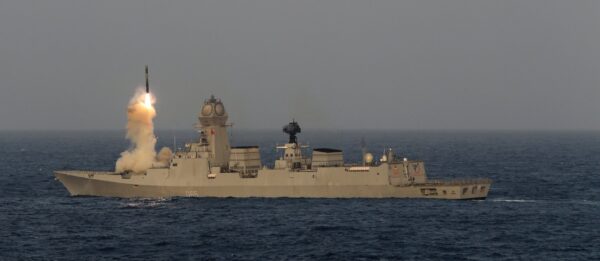
In May 2025, the confrontation between India and Pakistan was limited to the land and air domains. In the naval domain the two sides took to signaling and positioning but did not engage in active combat. At the start of the conflict, India deployed its naval aircraft carrier INS Vikrant for four days in the Arabian Sea but later moved it back to its base in Karnataka. The Pakistan Navy undertook counter-deployments with an operational offensive-defensive posture. It dispersed its surface combatants, intensified maritime ISR, and moved its coastal missile units into a state of heightened readiness. However, there was no confrontation between the two navies during the crisis. However, a few weeks after the announcement of the ceasefire between India and Pakistan, Indian Defense Minister Rajnath Singh visited INS Vikrant and issued a stern warning for Pakistan. He said, “If Pakistan tries anything nefarious again, the opening move might come from our Navy.” Since the May 2025 clashes, both states have actively invested in further strengthening the capabilities of their naval forces. Recently, the Indian Navy announced its plan to equip more frontline warships with BrahMos supersonic cruise missiles. The plan is to work toward a fleet-wide integration of the BrahMos weapon system by 2030. This development may also increase pressure on Pakistan to take both defensive and offensive measures to maintain naval parity in the region. Currently, the Indian Navy operates a diverse range of missiles for anti-ship and land-attack roles. This includes the BrahMos missile deployed across 20 major frontline combatant platforms, the Klub series deployed on Talwar-class frigates, Kh-35E Uran deployed on older systems, and French-made Exocet missiles and American Harpoon missiles on its diesel-electric submarines. However, the BrahMos system has proven its operational relevance for the Indian military after its combat use during the May 2025 crisis. Further integration of the BrahMos would provide India with an indigenous option that can help reduce its reliance on a diverse array of imported missile systems. In 2024, the Indian Cabinet Committee on Security approved the purchase of 220 Extended Range (ER) BrahMos missiles for naval ships. The ER-BrahMos has a range of 800 kilometers that can increase the operational space for Indian naval platforms against the Pakistan Navy and also engage coastal targets without getting very close to Pakistan. Moreover, the BrahMos is a supersonic missile with a speed of around Mach 3, reducing the time available for an adversary to detect, identify, and respond to the incoming missile. Also, the precision-strike capability of BrahMos provides a major advantage while targeting moving naval platforms. Because of its indigenous production, range, precision, and speed, the BrahMos has emerged as a major weapon for India and an ideal candidate for deployment across all its naval platforms. To achieve its target, the Indian Navy is equipping its older and smaller naval vessels with BrahMos launchers, as evidenced by its replacement of the P-15 Termit with four twin-tube BrahMos launchers on Veer-class corvettes, starting with INS Vidyut. The latest Indian warships including the Nigri-class stealth frigates – INS Udaygiri, INS Himgiri, and INS Mahendragiri –are equipped with eight vertically launched BrahMos missiles. All four Visakhapatnam-class destroyers carry 16 BrahMos missile each. The Indian Navy is also planning to retrofit its older warships with BrahMos systems to achieve system-wide integration. India has also successfully tested the BrahMos missile from an underwater platform, paving way for its integration with diesel-electric submarines. Further, India is developing six highly agile compact missile vessels that can carry eight BrahMos missiles each. These are called next-generation missile vessels. These developments have significant implications for Pakistan’s naval strategy and also regional strategic stability. Pakistan is undertaking its own efforts to further strengthen its sea-denial strategy. Pakistan has developed an indigenous anti-ship ballistic missile – P282 SMASH – and integrated them with surface combatants like Zulfiqar-class frigates and Babur-class corvettes. The missile has a range of 350 km. Moreover, it has developed the Harbah subsonic cruise missile and acquired Chinese-imported YJ-83 anti-ship cruise missiles. Pakistan Navy has also tested anti-ship air-launched cruise missiles (ALCM) Taimoor to strengthen its maritime capabilities. Pakistan is working on its defense systems by deploying CAMM-ER missiles on Babur-class corvettes and LY-80 missiles on Tughril-class frigates. Both offensive and defensive capabilities developed by Pakistan are designed to maintain operational parity with the Indian Navy. However, there would be certain challenges for Pakistan if India successfully integrates all its naval warships with BrahMos missile systems. This would increase pressure on Pakistan to strengthen its maritime surveillance as India would have a quantitative edge in its missile carrying naval platforms. As the naval domain is a possible battlefield for a future crisis between India and Pakistan, these developments can have serious repercussions for regional stability. Any attacks on naval systems and coastal areas carry serious escalation risks in a nuclearized environment. India’s accidental launch of a BrahMos missile in May 2022 showcased a serious problem with command and control of this platform in an environment in which two nuclear weapon states operate. Another major problem with the deployment with BrahMos is that the missile is dual-capable in nature and can carry nuclear weapons. This conventional-nuclear entanglement further increases the risks of miscalculation and inadvertent escalation. In conclusion, the Indian deployment of the BrahMos missile on all of its naval warships has negative implications for deterrence stability, crisis stability, and arms race stability between India and Pakistan. Increasing the number of mobile platforms capable of conducting long-range precision strikes could create greater pressure for Pakistan to adopt countermeasures, while simultaneously increasing the incentives for pre-emption during a crisis. The combination of BrahMos’s long range, high speed, and dual-capable nature further complicates escalation management between two nuclear-armed states, particularly when the origin and intent of a naval strike may be difficult to determine in real time. The developments risks transforming the Arabian Sea from a domain of signaling and maneuver into a potential trigger for rapid escalation, with consequences extending beyond South Asia to the wider Indian Ocean Region.
India’s BrahMos at Sea: Implications for South Asian Stability
Full Article
Original Source
Read the full article at Thediplomat →KhanList aggregates and links to publicly available news content. We do not host full articles from third-party sources. Always verify important information with original sources.