
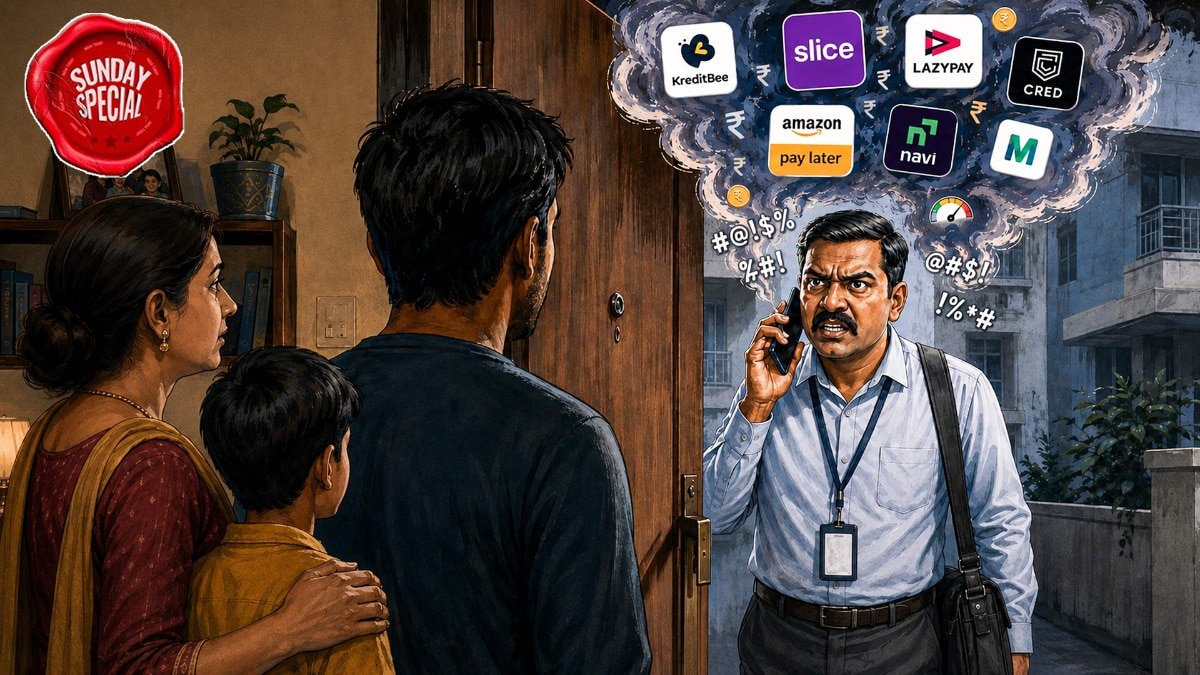
Lucknow-based engineer Rishabh Shukla did not realise he was entering a debt trap when he took his first loan through a lending app. He was in the final year of engineering and needed some financial support. It was all about downloading an instant loan app, following some simple steps, and receiving the amount in the bank account.The loan was small, the approval was quick and repayment appeared manageable. Whenever he needed money after that, Shukla returned to the same app. Gradually, the loans grew. Some were for emergencies, others for everyday expenses. On one occasion, he even borrowed to buy protein supplements."The loans were small and getting approved was so easy that it never felt like a serious financial decision," Shukla told India Today Digital.The turning point came when he missed a repayment. Instead of using his savings to clear the outstanding amount, Shukla borrowed from another lending app and used the new loan to repay the old one. One loan had become two.Soon, borrowing was about keeping up with earlier borrowings. The immediate cash crunch had eased, but the debt remained for years. His CIBIL score eventually took a hit, and access to formal credit had become more difficult. The problem is often not the first loan, but the borrowing that follows it.Credit has become easier to access than ever. A few taps on a smartphone, a quick KYC verification, and money can reach a bank account within minutes. Smaller loans and monthly EMIs can make borrowing appear affordable, particularly when the repayment is spread over several months."Credit is increasingly filling the gap left by stagnant real incomes and inadequate social protection," Manoranjan Sharma, Chief Economist at Infomerics Ratings, told India Today Digital. "The danger arises when debt grows faster than repayment capacity. Households become trapped in a cycle of refinancing, borrowing simply to service existing obligations," he explained.The growth in instant lending apps and easy loans have fuelled a financial epidemic of repeated borrowing and financing.Data from a recent survey by debt-resolution platform Expert Panel shows how widespread this cycle can become. Nearly six in 10 distressed borrowers who approached the platform were either making only the minimum payment on their loans or had stopped repayments altogether by the time they sought help. One in five had already received legal notices from lenders.Around 60% of respondents said their monthly EMI obligations either matched or exceeded their family's total monthly income. For such households, servicing debt leaves little room for basic expenses such as groceries, school fees and rent.Another 40% said they were taking fresh loans or relying on credit cards to repay existing debt.The new borrowing increases the repayment burden, leaving even less disposable income the following month.In this story, we look at how irresponsible borrowing from easy loan apps creates a debt trap, fuelled by easy loans from instant lending apps. We also delve into the lives of some distressed borrowers, for whom recovery pressure has reached a point where they say they have been pushed to the brink.A LOAN RECOVERY AGENT TELLS DEBT TRAP IS DUE TO SALARY-LIFESTYLE GAPSuresh Gowda, a Mumbai-based loan recovery agent who works on contract for several banks and lending apps, has seen a pattern among the borrowers he deals with. In the last five years, he has come across young people taking on debt before their incomes have had time to catch up with the cost of living.Gowda said many of the borrowers he encounters are students or early-career professionals earning around Rs 25,000-30,000 a month. A loan between Rs 7,000 and Rs 15,000, he said, is often easy to obtain through lending apps with basic KYC. But once the EMI is deducted, a sizeable part of a young worker's salary is already committed before the month begins."It doesn't look like much, but a part of their income is already gone. I know of people whose Rs 15,000 loan has gone on for two to three years because they just did not have any means to pay back even a small amount," Gowda told India Today Digital.For young professionals in a city like Mumbai, he said, the pressure is not always about survival. It is also about keeping up with the lifestyle around them, like eating out in nice places to post on Instagram, travelling to Insta-worthy locations, going to clubs in South Bombay, or simply doing things they see their peers doing on social media."Social media is a big reason why people take loans mindlessly," Gowda said.The salaries, however, do not rise at the same pace. "A worker earning Rs 30,000 might get an increment of around 10% after a year, taking the salary up by only Rs 3,000," he said.Gowda's own role in this ecosystem is complicated. He is a recovery agent, but also lends money privately.The economic squeeze is important here. India's consumer prices, according to the Ministry of Statistics and Programme Implementation, have risen by roughly 40-45% between 2016 and 2025. In simple terms, Rs 1.5 lakh today has purchasing power comparable to roughly Rs 1 lakh a decade ago.So, when young workers enter their careers on Rs 25,000-Rs 30,000 a month, their salaries might look higher in nominal terms, but the cost of the lifestyle they aspire to has risen too."People want to live like they earn Rs 1-1.5 lakh with a salary of Rs 50,000-70,000," Gowda told India Today Digital.LOANS APPS PREYING ON INDIA'S WORKING CLASSDigital lenders are now the source of four out of five personal loans in India, Andy Mukherjee, a Bloomberg Opinion columnist, wrote on August 7."Faced with low wages and a rising cost of living, many are being tempted by lending apps to take on exorbitantly-priced new loans to meet interest payments on existing obligations," wrote Mukherjee.The value of the digital lending market in India grew from $270 billion in 2022 to $350 billion in 2023, according to a report in the Asian Banking and Finance from earlier this year.Lending apps themselves are a $23-billion annual market, the size of which has grown 2.5 times in the last three years.Mukherjee, in his Bloomberg Opinion, wrote that the instant loan apps "prey on India's working class" with "targeted ads and push notifications".That India is the world's biggest user of smartphone apps helps these predatory digital lenders. The Asian Banking and Finance report said India accounted for 82% of all Android-based mobile lending applications globally.As Indians take loans to fund their lifestyle amid a stagnation in real wages and to repay old loans, these digital lenders are trapping them in an endless borrowing chakravyuh, handing out small amounts."Last fiscal year [2025-26] alone, fintech platforms sanctioned over 130 million such loans, averaging 16,000 rupees ($170)," wrote Mukherjee, adding, "A majority of this credit is pushed to borrowers classified as medium- to high-risk."THEN COMES THE RECOVERY OF THE MONEY"I'm getting over 300 calls daily. Recovery agents are calling my office, my boss, even my relatives. They are threatening to spoil my image and reputation. Some have even come to my house and office. This pressure of loan repayment is affecting my mental health too much," a distressed borrower said during a debt-counselling session with Expert Panel.Another borrower said recovery agents came to his home, shouted in front of neighbours and demanded repayment. Others described repeated calls to spouses, parents and employers, saying that their unpaid loans had spilt into their personal lives.According to the Expert Panel survey, recovery calls and abusive language were the most commonly reported forms of harassment. Borrowers also reported repeated calls from multiple lenders, visits to homes and workplaces, threats of legal action and calls to family members.The counselling sessions also recorded more severe accounts. One borrower said, "Sometimes I thought to commit suicide but when I heard about your company, I had some hope." Another said, "If everyone troubles me like this for some more time, I will commit suicide."One borrower alleged that recovery personnel even suggested suicide so that insurance proceeds could be used to settle the outstanding loan.A borrower who misses an EMI is not necessarily someone who has chosen not to repay. In many cases, the missed payment is the result of a financial shock, followed by more borrowing and eventually an inability to keep pace with multiple repayments.Anurag Mehra, Director of Expert Panel, said the findings point to a problem that goes beyond unpaid loans."The numbers tell us that India's debt problem is no longer just about missed EMIs, it is about people losing their dignity, peace of mind, and in some cases, even the will to live. Most borrowers we counsel are not habitual defaulters; they are ordinary individuals pushed into financial hardship by medical emergencies, job losses, or unexpected life events.""Recovery must happen within the framework of empathy, law, and human dignity. Financial institutions, regulators, and policymakers need to work together to ensure that borrowers receive structured resolution mechanisms instead of intimidation and psychological harassment," Mehra added.The Reserve Bank of India has also tightened its focus on recovery practices and issued guidelines aimed at curbing harassment by recovery agents.But for borrowers already caught in the cycle, regulation of recovery practices addresses only one part of the problem.The larger question is what happens before a loan turns into two, and two turn into several.BORROWING TO BUILD A LIFE, OR JUST TO GET THROUGH THE MONTH?There is a common perception that people fall into debt because they spend recklessly or live beyond their means. But the survey tells a different story.Medical emergencies were the biggest reason people borrowed money, accounting for 26% of respondents. Another 22% said they had taken loans to meet family and personal expenses such as education and weddings. Job losses and business-related challenges accounted for 18%, while 15% borrowed simply to manage everyday household needs."With out-of-pocket healthcare spending accounting for nearly 39% of total health expenditure and inadequate insurance penetration, a single medical emergency can severely weaken a middle-class family's finances," Sharma told India Today Digital.Borrowing for homes, cars or other asset purchases formed the smallest share. The findings suggest that for many households, borrowing is no longer primarily about creating wealth or buying assets. It is becoming a coping mechanism for financial shocks.A sudden illness. A delayed salary. A child's college fees. An unexpected household expense. Each, by itself, might appear manageable. But together, they push families into borrowing.The Expert Panel survey found that job losses or salary reductions were the biggest reason borrowers struggled to repay their loans, followed closely by high EMI burdens relative to income and multiple outstanding loans.So, if so many people are borrowing not to upgrade their lifestyle but simply to maintain it, what does that say about the financial resilience of Indian households?"India's household debt problem is becoming more serious, though it has not yet become systemic," Sharma told India Today Digital."Over 40% of GDP household debt is moderate by emerging-market standards, but its composition has changed markedly. Over 50% of retail borrowing now comprises unsecured personal and consumption loans. The real concern is not the overall level of debt but its fragility. When EMIs consume most of a household's income, even a temporary shock such as job loss, illness or higher interest rates can trigger defaults," the economist also said.WHEN BORROWING STOPS BUILDING WEALTHDebt, by itself, is not the villain. For decades, loans have helped families buy homes, send children to college, expand businesses and create wealth. Economists often call this "productive debt" because it finances an asset or an opportunity that can improve a family’s financial future.A recent paper by Sharma makes a similar distinction. It argues that while borrowing to create productive assets has long supported economic growth, rising household indebtedness increasingly requires policymakers to distinguish between credit-led expansion and debt-led vulnerability. In other words, borrowing becomes a concern when it is no longer creating assets or future income, but merely helping households finance current consumption and absorb repeated financial shocks.Warning signs, Sharma says, include EMIs exceeding 50–70% of income, borrowing to repay older loans, relying on credit for everyday expenses, paying only minimum credit-card dues, and rising outstanding balances despite regular repayments.In this economic mix, throw in the lending apps that provide easy loans and you have a perfect financial storm. The business model of these instant loan apps depends on borrowers borrowing more to pay off the original loan. They are the digital versions of the loan sharks that operate in India."The business model [of the digital lenders] relies on serial refinancing — knowing an over-leveraged borrower will take out a second loan from a rival app to service the first. An ever-growing loop of fintech platforms trades cash flows amongst themselves while stacking 15 or 30 active loans onto a single balance sheet," wrote Andy Mukherjee.WHAT WILL HELP BORROWERS AT LARGE?The challenges, Sharma argues, are therefore not merely a credit issue but also an income and structural policy problem."Strengthening healthcare, unemployment and education safety nets, improving wage growth, tightening fintech and NBFC underwriting standards and expanding debt-resolution mechanisms are essential. Banks should adopt stricter affordability norms, stronger early-warning systems and better loan design, while households need greater financial discipline through emergency savings, adequate insurance and limiting EMIs to around 30-40% of income," Sharma said.The bigger question, then, is not simply how much Indians are borrowing, but where they are borrowing from, and whether enough is being done to ensure that a temporary setback does not become a long-term financial trap.- EndsPublished By: Anand SinghPublished On: Aug 9, 2026 07:00 IST
Indians trapped in repayment chakravyuh as loan apps fuel endless borrowing cycle
Full Article
Original Source
Read the full article at Indiatoday →KhanList aggregates and links to publicly available news content. We do not host full articles from third-party sources. Always verify important information with original sources.