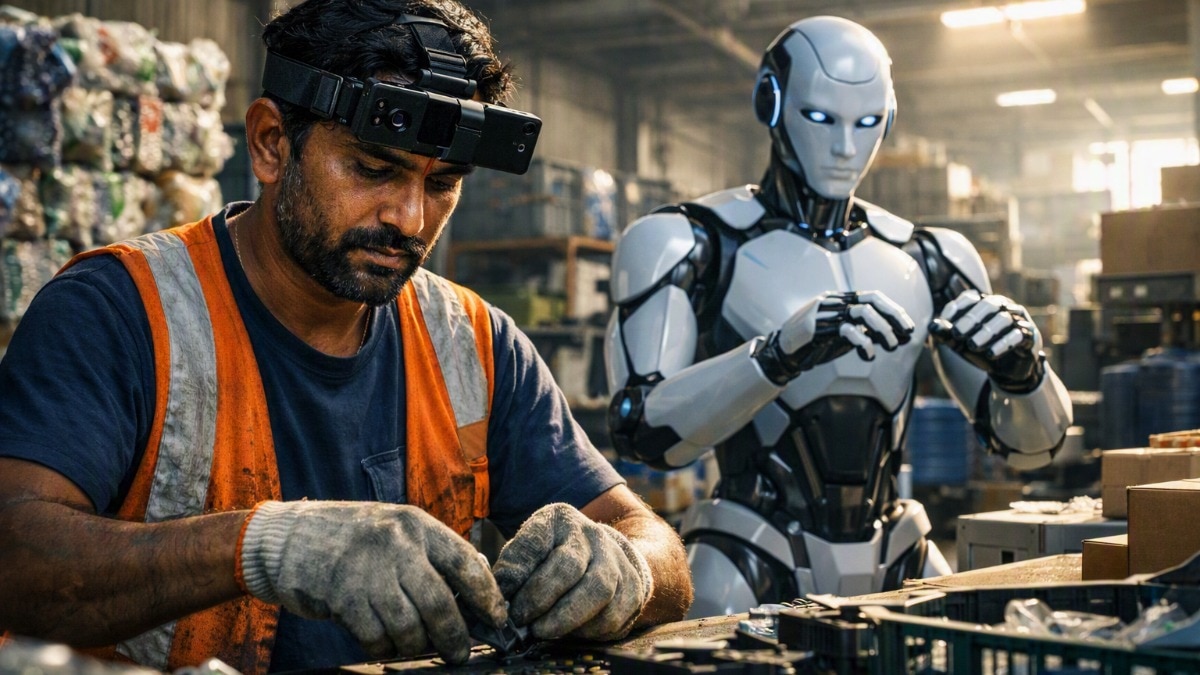
Indian workers are being paid extra to record their everyday tasks, unknowingly helping companies train the robots that could one day do those jobs. From recycling colonies to factories and warehouses, India is emerging as a major source of real-world data for the global robotics race.Indian workers are recording their everyday tasks to help train the humanoid robots that could one day replace them. (Image created using AI for representational purposes)For 43-year-old Sunita Rathore, a few extra hours of work now come with an unusual piece of equipment, an iPhone strapped to her head. Rathore sorts plastic waste at a recycling colony on the outskirts of New Delhi, earning around Rs 20,000 a month. Now, as she removes labels from plastic bags, sorts waste and stacks sacks, a head-mounted phone records every movement of her hands, Bloomberg reports. For doing this, she earns an additional Rs 150 an hour.She does not know exactly where the footage goes. She only knows that the extra money is helping her save for the education of her four children. Rathore is part of a growing workforce across India that is recording everyday physical tasks to help train the next generation of robots. Workers in factories, warehouses, farms and even homes are being asked to wear cameras and motion-tracking devices while they work.The recordings capture something AI companies desperately need, data showing how humans actually move and use their hands in the real world.India becomes giant training ground for robots, human jobs at riskHumanoid robots can already perform impressive demonstrations, but getting them to reliably handle ordinary jobs remains a major challenge. Teaching a robot to fold, pack, weld, lace a shoe or pick something up requires enormous amounts of real-world training data. India offers an unusual advantage. Millions of workers still perform manual tasks that have already been automated in richer countries, giving robotics companies access to a huge variety of human movements. Startups are now sending camera rigs into shoe factories, warehouses, textile units and farms. Bloomberg also reported that some workers use phones attached to caps or helmets, while others wear specialised cameras and motion-tracking gloves. The footage is then cleaned, labelled and sold to robotics companies and AI labs. Raw first-person video can fetch more than $7 an hour, while highly annotated footage can command $15 to $30 an hour or more.For workers, the money can be meaningful. At a footwear factory near Delhi, one worker receives an additional Rs 300 a day for recording his work. Elsewhere, warehouse workers film themselves packing and scanning products. But behind the extra income lies a bigger question that what happens when the machines they are helping train become capable of doing the same jobs? The irony is not lost on the industry. Workers are effectively creating detailed instructions for machines that could eventually replace some human labour.The money is coming with a privacy problemThe rush for data has also raised concerns about consent. Many workers have little idea how their recordings will be used or who will ultimately buy them. Cameras can also unintentionally capture faces, homes, personal belongings and other details beyond the worker's hands.India's Digital Personal Data Protection Act is expected to bring stricter obligations, but key provisions are not due to take effect until 2027. At the moment, the demand for human movement data is growing rapidly as companies race to build useful robots. In Bangalore, warehouse worker Yeshwanth N has already thought about what he might do if robots eventually take over his job. He says he would return to farming on his family's land. "No robot can do that."- EndsPublished By: Ankita GargPublished On: Aug 13, 2026 12:52 IST
Indian workers unknowingly teaching robots their work to earn Rs 150 per hour
Full Article
Original Source
Read the full article at Indiatoday →KhanList aggregates and links to publicly available news content. We do not host full articles from third-party sources. Always verify important information with original sources.