
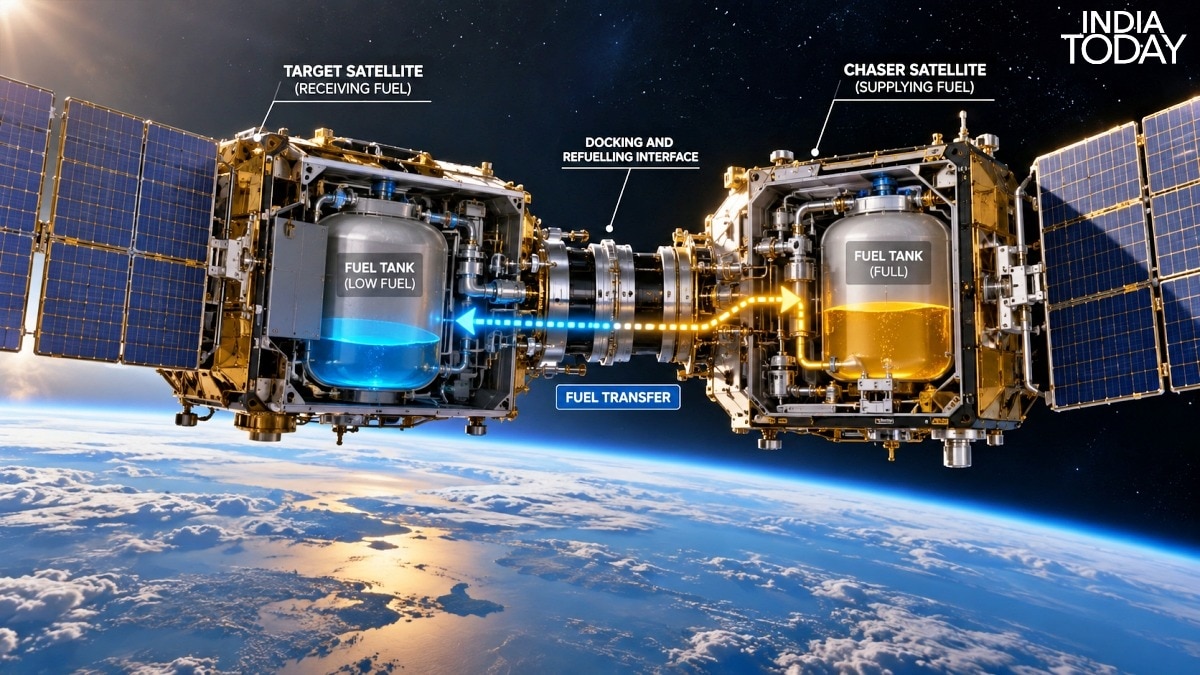
An Indian space startup is preparing to demonstrate a technology that could one day allow satellites to refuel in orbit, potentially extending their operational lives and reducing the need to replace expensive spacecraft when they run out of fuel.OrbitAID Aerospace, founded by Sakthikumar R, is gearing up to launch a satellite weighing around 30 kg aboard the Small Satellite Launch Vehicle (SSLV) in November 2026.The satellite, dubbed AayulSAT-1A, will demonstrate docking, internal refuelling and inspection capabilities, laying the groundwork for commercial in-space servicing.“The satellite is ready. We are planning to complete the final tests next week, following which it will be shipped to Sriharikota for launch preparations,” Sakthikumar, founder and CEO of OrbitAID Aerospace, told IndiaToday.in in an exclusive conversation. The launch date has not yet been confirmed, with the company indicating a tentative window around mid-November. The mission will carry two satellite buses, two tanks and the interface. (Photo: OrbitAID) The mission will carry two satellite buses, two tanks and the interfaces and mechanisms required for the experiments. OrbitAID aims to validate its docking and refuelling mechanisms through the demonstration. While the mission builds on capabilities the company had planned to demonstrate earlier, Sakthikumar said it would not be merely a replacement for the mission affected by the PSLV failure in January this year. The company has incorporated additional payloads and capabilities into its plans.Some onboard innovations will remain undisclosed until after the launch, he said.BUILDING A PETROL PUMP IN SPACEThe idea behind orbital refuelling is straightforward: instead of abandoning a satellite when its fuel runs low, a servicing spacecraft could rendezvous with it, dock and replenish its propellant supply.Such capabilities could help extend satellite lifetimes, reduce replacement costs and support a future in which spacecraft are serviced rather than routinely discarded. However, these benefits depend on the technology being demonstrated and scaled up for operational use. The mission will launch aboard India's SSLV. (Photo: Isro) OrbitAID's November mission is an early step towards that goal. The company plans to use the results to develop commercially available in-space servicing technologies for future satellite customers."AayulSAT-1A is our next step towards building a fuel station in space. Our earlier mission could not reach the demonstration stage because of a launch anomaly, but our commitment remains strong. We aim to validate internal docking, refuelling, and power and data transfer within the satellite, while also demonstrating in-orbit inspection capabilities," Sakthikumar said.BIGGER MISSION PLANNED FOR 2027OrbitAID is also planning a more advanced mission for the first quarter of 2027. It will involve two satellites, a chaser and a target, to demonstrate rendezvous and proximity operations, docking, refuelling and other servicing capabilities.The company also plans a “jet-pack” demonstration involving satellite propulsion technology. The objective is to validate manoeuvring capabilities using its own spacecraft before progressing towards applications involving other operational satellites."We intend to validate the technology before progressing towards applications involving other operational satellites. The idea is to develop a propulsion capability that could help a satellite manoeuvre or provide assistance to another spacecraft," the founder added.Manufacturing for the 2027 mission is underway, with integration expected to begin around December, after the upcoming missions.Together, the two missions are intended to help OrbitAID move towards commercial in-space servicing, an emerging field that could become increasingly important as satellite constellations expand and demand for longer-lasting spacecraft grows.- Ends
Indian startup builds petrol pump for space to test refuelling outside Earth
Full Article
Original Source
Read the full article at Indiatoday →KhanList aggregates and links to publicly available news content. We do not host full articles from third-party sources. Always verify important information with original sources.