
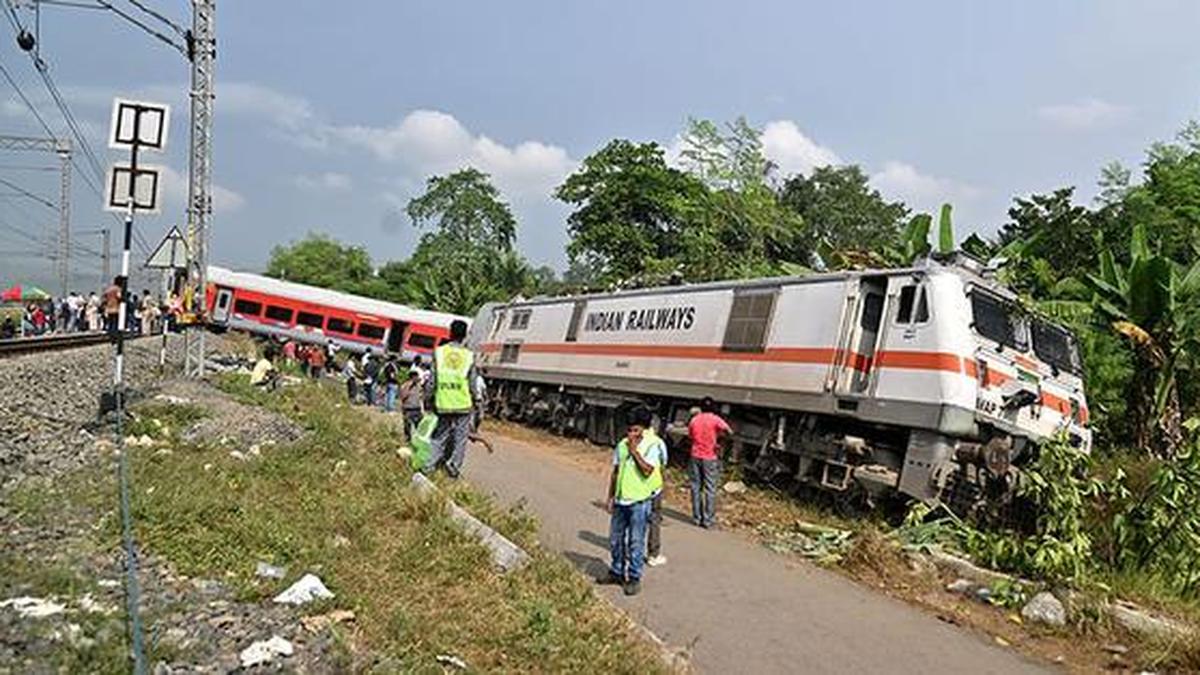
Railway workers during rescue work at the site of a derailed train near Digaru railway station, on the outskirts of Guwahati, on November 11. | Photo Credit: Ritu Raj Konwar The Indian Railways has asked Loco Pilots to check the effectiveness of brakes before speeding up trains from originating stations.The instructions follow at least two incidents of trains running with brake failures, in which one express train derailed on a Northeast Frontier Railway line, while another was operated in an unsafe manner on the South Eastern Railway, in the last one month.According to railway sources, Loco Pilots taking charge of a train were told to conduct a ‘Brake Feel Test’ after departing and attaining a speed of 15 kmph. They should feel the application of brake till the speed drops to 10 kmph and then proceed as per the prescribed speed limits.They were also directed to conduct a ‘Brake Power Test’ after the train gained a speed of 60 to 70 kmph (passenger trains) and 40 to 50 kmph (freight trains).The Loco Pilot would observe the application of the brake and brake power of the train till the speeds dropped to 30 to 35 kmph for passenger trains and 20 to 25 kmph for freight trains.The Assistant Loco Pilots were instructed to keep a watch and ensure that the tests were conducted by the Loco Pilots without fail. They were told to equally participate in the process by assessing the effectiveness of the braking system in the train.Derailment due to brake failureThe advisory to conduct speed tests came after two incidents of brake failure were reported, flagging safety concerns in the operation of trains. Train 13125 Kolkata to Sairang Express derailed at Digaru railway station on the Northeast Frontier Railway on November 11, 2026.According to the Loco Pilot, the train –which was diverted to the Loop Line in the station – could not be controlled even after he applied regular brakes and emergency brakes. It hit the dead end, resulting in the derailment of five coaches.Another incident of serious safety lapse was reported on October 24, 2026, on the South Eastern Railway. An empty rake of the Vande Bharat Express was allowed to run 463 km with poor braking power.Railway sources said the incident occurred when the train was operating between Hatia and Jhansi railway stations. Soon after the train departed Hatia, the Loco Pilot realised that brake power was “very poor and ineffective”.Train ran without effective brakesUpon reaching Ranchi station, he gave a written complaint to the Section Controller and informed the Train Loco Controller about the poor braking system in the train. However, both the officials allowed the train to run without attending to the safety issue at Ranchi, the sources said.The train was permitted to proceed in the same condition despite the reported poor power brake. After the train was handed over to the next crew, the Loco Pilot who took over from Muri (railway station) also informed the Section Controller and Train Loco Controller about the poor brake performance.Despite these reports, the train was allowed to continue in the same condition, a preliminary inquiry report sent by the South Eastern Railway headquarters to the Divisional Railway Manager, Ranchi, said.‘Serious safety concern'The preliminary inquiry revealed failures on the part of various staff, resulting in the train being operated without effective brakes. It was operated while depending solely on locomotive brakes and regenerative braking and travelled approximately 463 km without application of the train brakes.“Running a train without adequate brake power is a serious safety concern that may lead to a major accident, endangering the lives of staff and passengers and affecting the safety of railway operations,” the report said. Published - November 24, 2026 06:59 pm IST
Indian Railways asks Loco Pilots to check brakes before speeding up
Full Article
Original Source
Read the full article at Thehindu →KhanList aggregates and links to publicly available news content. We do not host full articles from third-party sources. Always verify important information with original sources.