
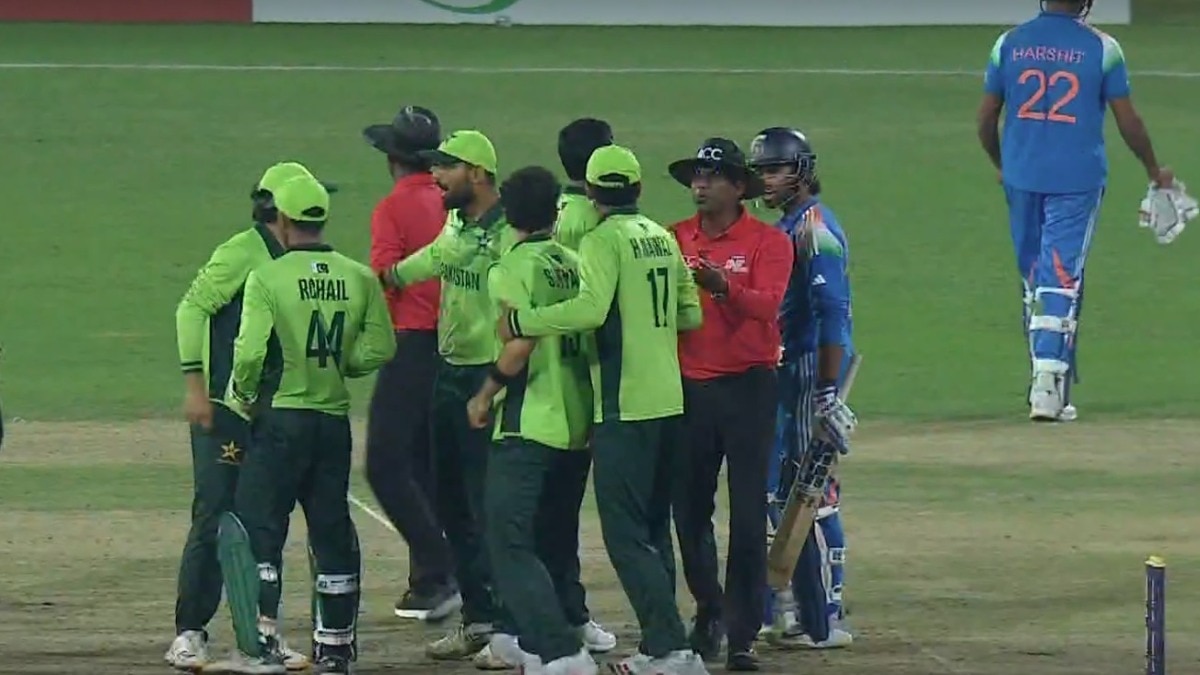
India lost to Pakistan by 48 runs in Doha on Sunday. Well, no, Virat Kohli and Rohit Sharma weren't there. No, it wasn't the U19 men's Asia Cup either. And no, Smriti Mandhana and Harmanpreet Kaur weren't involved. This was a group-stage match in the Men's Rising Stars Asia Cup, featuring India A and Pakistan Shaheens.Tilak Varma was leading India A. Abhishek Sharma and Vaibhav Sooryavanshi were in the XI. Harshit Rana, meanwhile, seemed more interested in getting involved in verbal exchanges with Pakistan's batters than concentrating on his bowling. He had his moments, including a couple of animated send-offs, but India eventually came up short.The one-day match began at 3.30 pm IST on Sunday. It ended at 12.20 am on Monday. Nearly nine hours for a 100-over contest. There were repeated interruptions, heated exchanges and plenty of time spent waiting for the game to resume. Umpires Chamara De Zoysa and Morshed Ali Khan had their hands full, with no DRS available to assist them.And this was not even the only cricket demanding attention that day. India's first Test against New Zealand in Wellington was also under way, with play beginning at 3.30 am IST. 21 hours of cricket on a Sunday. Even the most ardent cricket fan could be forgiven for switching off. Please, let's not call this Super Sunday. It is overkill.The Doha contest was the second India-Pakistan meeting in eight days. On November 14, India's U19 team, featuring Aaryavir Sehwag and Anvay Dravid, had beaten Pakistan in a last-ball thriller in the U19 Asia Cup final. That match, too, was a long, exhausting affair, with India chasing down 338 to win by one wicket. Another India-Pakistan contest. Another dramatic finish. Another occasion for broadcasters and social media to package the rivalry as the mother of all battles.Nobody is complaining, right? India and Pakistan almost every other Sunday. A thriller every week. What's not to like?Well, here's the catch. India and Pakistan are playing more cricket against each other now than they did when bilateral cricket was still a reality.RIVALRY ON REPEATSince the senior men's Asia Cup in September 2025, the two countries have featured in 14 fixtures across senior, A-team and age-group competitions. Fourteen. That is quite a number for two cricket boards that insist bilateral cricket is off the table.Now, consider this comparison. In 2007, the last year in which India and Pakistan played a bilateral Test series, the two countries played 10 international matches against each other: five ODIs and three Tests and two in the inaugural edition of the men's T20 World Cup.Today, without bilateral cricket, they have already met 14 times across different levels of the game.So, what exactly are we pretending? India and Pakistan have played 14 matches against each other since September 2025 The broadcasters, the Asian Cricket Council and the two cricket boards owe the audience some clarity. This is hardly a coincidence. India and Pakistan are repeatedly placed in the same groups in multi-team tournaments, giving them a guaranteed meeting in the group stage and, depending on the format, the possibility of another encounter in the knockouts.The build-up is familiar. The mother of all battles. The biggest rivalry in world cricket. The numbers game. The television promos. The social media campaigns.If the two teams are going to be brought together so frequently, why maintain the charade that bilateral cricket is entirely unacceptable? Is the audience being taken for a ride? Is the objection to bilateral cricket about the principle of playing Pakistan, or does that principle suddenly become negotiable when a tournament provides the perfect commercial setting?There is no pretending otherwise. India-Pakistan cricket is a cash cow. The broadcasters know it. The ACC knows it. Both boards know it. The streaming numbers from Sunday's Rising Stars encounter will probably reinforce that belief.There is nothing inherently wrong with commercialising a sporting contest. Cricket is a business, and India-Pakistan games attract audiences that few other fixtures can match. But commercial interests cannot be allowed to dictate the entire calendar while administrators continue to take refuge in political circumstances.There is another argument in favour of these tournaments. A-team and age-group competitions are important. They give young cricketers exposure, help them understand pressure and offer them opportunities to test themselves against players from different cricketing systems. Nobody is suggesting that these competitions should disappear.THE RERUN BUSINESSBut what exactly is the need for so many overlapping competitions? A senior men's Asia Cup, a U19 Asia Cup and a Rising Stars Asia Cup, all within a relatively short period. What next? A Medium Stars Asia Cup?More importantly, what are these tournaments becoming? Platforms for developing young cricketers or convenient vehicles for manufacturing another India-Pakistan spectacle?HOSTILITY FOR SALE A Pakistan fast bowler giving Harshit Rana a send-off in Doha (Screengrab from SonyLIV) And then there is the ugliness.The U19 Asia Cup final was supposed to be remembered for India's remarkable last-wicket victory. Instead, videos of the celebrations attracted widespread criticism, with footage appearing to show some Indian players making obscene gestures and directing abusive language towards their Pakistan counterparts. The celebrations became another talking point, overshadowing much of what should have been a memorable achievement for a young team.Even as videos of Indian players making gestures at their Pakistan counterparts drew criticism, BCCI secretary Devajit Saikia brushed aside the concerns, saying the youngsters deserved to celebrate. Apparently, sportsmanship can wait when the celebrations are this good. Ugly scenes in U19 Asia Cup final in Oman (Screengrab from SonyLIV) Sunday's Rising Stars encounter offered another uncomfortable reminder. Harshit Rana was involved in heated exchanges with Pakistan batters, with his animated send-offs adding to the hostility. The Pakistan players responded in kind as the contest became increasingly fractious.This is not an isolated incident any more.It began with the handshake controversy during the 2025 men's Asia Cup. India's decision to avoid the customary handshakes with Pakistan became a recurring feature of encounters between the two teams. But Pakistan's players were hardly above provocation either. Sahibzada Farhan's gun-firing celebration and Haris Rauf's '6-0' and crashing-plane gestures added fuel to an already combustible situation. India responded with gestures of its own, and soon the cricket was being overshadowed by a contest of taunts, snubs and symbolic retaliation.But let's stop dismissing everything as heat of the moment. When the same hostility keeps resurfacing across senior teams, women's cricket and age-group competitions, it deserves greater scrutiny. Players are entitled to their emotions and competitive intensity. They are not entitled to turn every encounter into an opportunity for public humiliation.The danger is that this behaviour is being normalised. Social media is already overflowing with abuse and nationalistic chest-thumping whenever these teams meet. The conduct on the field increasingly provides fresh material for those looking to fuel that hostility.Sport is supposed to offer a common ground, even between rivals. It does not have to erase political differences, but it should not become another vehicle for amplifying them.And if administrators are happy to keep arranging these fixtures because of their commercial value, they must also take responsibility for the environment in which they are being played.TROPHIES STILL MISSINGThen comes the farce surrounding the trophies.Two Indian teams have won the men's and women's Asia Cups. Neither has received its trophy. Mohsin Naqvi, the ACC president and PCB chairman, presided over both controversies. BCCI secretary Devajit Saikia promised that the trophies would eventually reach Mumbai. So, where are they? What has the BCCI done to get them back? And why has the ACC been allowed to turn the presentation of a trophy into a political standoff?A continental championship should not end with the winners chasing their silverware. What exactly is the ACC's purpose if it cannot ensure that the champions receive what they have earned? And how long will the BCCI settle for statements and assurances instead of demanding accountability?And yet, the next India-Pakistan fixture will arrive, the promotions will begin, the television studios will fill up and millions will tune in. The same boards will talk about the significance of the rivalry and the same broadcasters will sell it as an unmissable event.There is money to be made, after all.But at some point, somebody needs to ask what exactly Indian and Pakistani cricket are trying to achieve here. If bilateral cricket is unacceptable, why are the two teams repeatedly brought together through tournaments?If the ACC cannot ensure basic sporting conventions, why should it be trusted to administer these competitions? And if administrators are unable to keep politics and personal animosity from infecting the game, what example are they setting for the next generation?Fourteen matches without bilateral ties. Two trophies still awaiting their champions. A handshake that has become a controversy in itself. And now, even age-group cricket is beginning to resemble a battleground.This is not the rivalry cricket should be selling. And it certainly isn't the future the game should be encouraging.- Ends
India vs Pakistan rivalry now a circus: No bilaterals, but 14 games in 14 months
Full Article
Original Source
Read the full article at Indiatoday →KhanList aggregates and links to publicly available news content. We do not host full articles from third-party sources. Always verify important information with original sources.