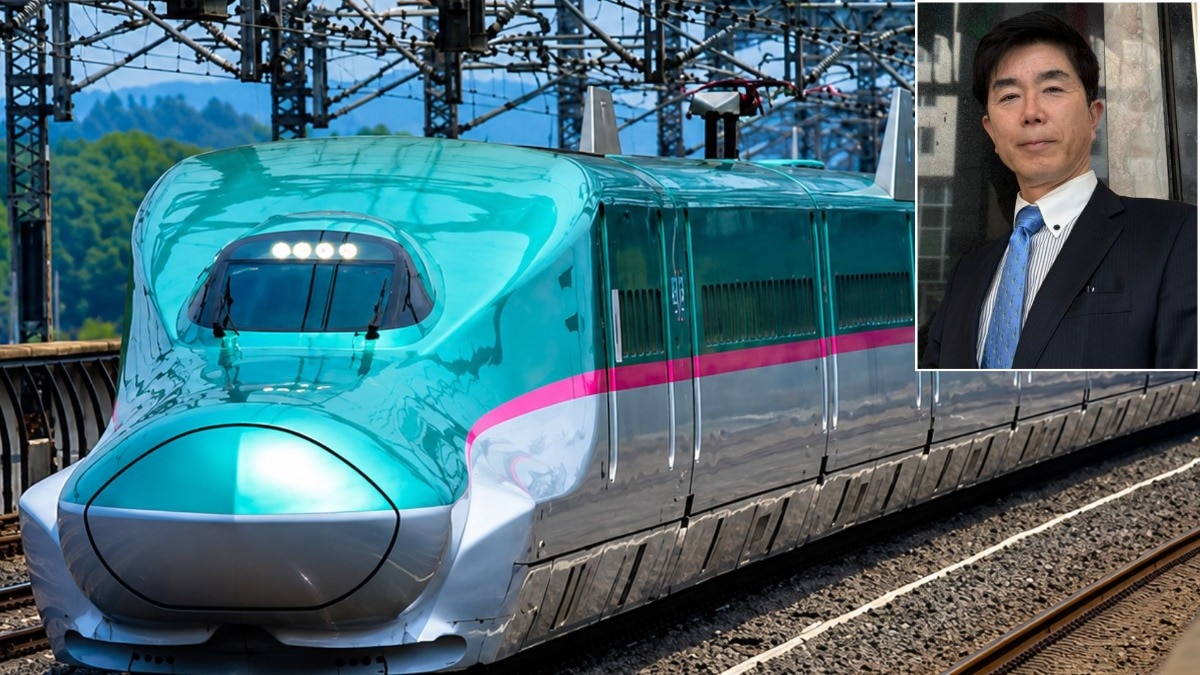
Former Japanese minister Hideki Makihara accused Indian authorities over the alleged delay in the Mumbai-Ahmedabad Bullet Train project. The minister in-charge of the negotiations was especially awful, alleged Makihara. Indian officials have junked the allegations.Former Japanese Minister of Justice Hideki Makihara (inset) accused India of delaying its Bullet Train Project that is using Japanese Shinkansen technology. (Images: PTI and @hmakihara/X)A former Japanese minister has blamed an Indian minister and officials over an alleged "delay" in the ambitious Mumbai-Ahmedabad Bullet Train project. Former Japanese Justice Minister Hideki Makihara, on July 15, accused them of "sheer recklessness", alleging that officials repeatedly failed to honour commitments and pursued "self-interest" during negotiations on the Shinkansen project. Makihara's claims came after an opinion piece in a Japanese news outlet said that the project had diverged from the original Shinkansen model.Makihara claimed in a post on X that the lack of progress in India's flagship high-speed rail corridor was "entirely on the Indian side".The first section of India's inaugural high-speed rail corridor, the Mumbai–Ahmedabad High-Speed Rail (MAHSR), is expected to begin phased passenger operations on August 15, 2027.The Mumbai-Ahmedabad corridor uses Japanese Shinkansen technology and is partially funded by the Japanese government's Japan International Cooperation Agency (JICA). Makihara on X posted his comments in response to an opinion piece on a Tokyo-based business news portal by Isao Tsujimura, a senior Japanese railway engineer and Delhi-based metro vehicle consultant, on July 15, who argued that India's first bullet train project has significantly diverged from the original Japanese Shinkansen model.Tsujimura alleged that Indian officials privately knew that the target of starting operations in 2023 was unrealistic. Amid Makihara's allegations, news agency ANI, citing Indian government sources, reported that the discussions between India and Japan on the Mumbai-Ahmedabad high-speed train were progressing well.In fact, India's Bullet Train project has recently crossed several construction milestones.The post by Makihara on X is in Japanese, and we have reported on the basis of its English translation.Congress MP Pawan Khera criticised the PM Modi-led government over Makihara's allegations. "A former Japanese minister who was personally involved in the India–Japan Shinkansen project has claimed that, despite Prime Minister Takaichi's visit, the project failed and that Japan was excluded from the signalling system – a component crucial to railway safety," Khera on Friday posted on X.INDIAN OFFICIALS DON'T KEEP PROMISE, SAYS EX-JAPANESE MINISTERReacting to Tsujimura's article on Tokyo-based business publication Toyo Keizai Online, Makihara, who briefly served as Japan's Justice Minister in 2024, wrote on X that his own experience with the project matched Tsujimura's assessment."The Shinkansen project in India is something I was involved with myself, but what stood out in international meetings and negotiations was the sheer recklessness of the Indian side, repeated over and over," Makihara said.He alleged that Indian officials routinely failed to honour commitments. "They just don't keep promises, no matter what. Even if they make a promise, they flip it right away," the former Japanese minister added.Makihara further accused Indian authorities of negotiating solely in their own interest."They keep pushing their own self-interest right up to the very end. The minister in charge was especially awful. If the top guy's like that, there's no way to have any decent dealings," he said."For the honour of all the Japanese folks who poured their hearts into this, I have to say it: I feel 100% that the reason this hasn't moved forward is entirely on the Indian side."Makihara also referred to Tsujimura's opinion piece and remarked that even Japanese Prime Minister Sanae Takaichi's July 2026 visit to New Delhi had failed to produce meaningful progress on the issue.However, India Today Digital tried to check the details of Mahikara's involvement in the project in India, and found no concrete evidence.WHY IS JAPAN TALKING ABOUT THE INDIAN SHINKANSEN PROJECT NOW?Former Japanese Minister Makihara's comments were triggered by an opinion piece authored by Tsujimura on July 15, who currently lives in Delhi and works as a metro vehicle consultant.Although the Japanese engineer clarified that he has no professional role in the Mumbai-Ahmedabad project, Tsujimura said he has closely monitored its development.Writing after Japanese Prime Minister Takaichi's July 1-3 visit to India, Tsujimura said discussions with her Indian counterpart, Prime Minister Narendra Modi, covered several strategic issues, including the Mumbai-Ahmedabad High-Speed Rail corridor.The engineer, in his opinion piece, argued that the project has drifted away from the original Shinkansen vision (an iconic Japanese railway network) that Japan had intended to export to India.According to Tsujimura, the project initially generated tremendous enthusiasm following its groundbreaking ceremony in Ahmedabad in September 2017. He recalled attending the event as an observer."Ahmedabad was filled with excitement, with Japanese and Indian flags flying everywhere," Tsujimura wrote.According to the engineer, officials privately knew that the original target of commencing operations in 2023 was unrealistic in India. He further added that both countries initially appeared committed to implementing the project according to Japanese high-speed rail standards.ANI reported on Friday, quoting Indian government sources, that the India-Japan discussions on the Mumbai-Ahmedabad high-speed train are progressing well.The report further added that Japan would provide the E10 series train in the early 2030s. The train is still under development.Both the Indian and Japanese authorities have agreed to start operations with the Indian high-speed train. The project execution is in line with the common goal of starting the high-speed train project at the earliest.INDIA'S MOST ANTICIPATED BULLET TRAIN PROJECTThe Mumbai-Ahmedabad High-Speed Rail corridor is India's first Bullet Train project and represents the centrepiece of India-Japan strategic infrastructure cooperation.The 508-kilometre corridor will connect Mumbai's Bandra Kurla Complex with Ahmedabad through 12 stations across Maharashtra, Gujarat and Dadra and Nagar Haveli. The project is designed for an operational speed of 320 kmph. The line is expected to reduce travel time between the two cities from around eight hours to about two hours.The Bullet Train project is based almost entirely on Japanese Shinkansen technology. It incorporates Japanese ballastless track systems, signalling standards, operational safety protocols and train technology. The corridor is being built with substantial financial assistance from JICA through long-term concessional loans.INDIA'S BULLET TRAIN PROJECT HAS ACTUALLY GAINED PACEDespite the criticism from the Japanese side, the project has recently crossed several construction milestones. Indian authorities have announced that the first operational section, likely between Gujarat's Surat and Bilimora, is expected to open for phased passenger services from August 15, 2027, with the remaining sections to become operational in stages thereafter.Construction has accelerated across viaducts (high bridge which carries a railway across a valley), tunnels, and stations after years of delays caused primarily by land acquisition and political changes.India is also preparing for domestic manufacturing of future trainsets through Indian Railways' Integral Coach Factory and BEML Limited while simultaneously receiving technological support from Japan for the initial fleet.The latest progress has also strengthened India's plans to develop a wider high-speed rail network connecting cities such as Delhi, Varanasi, Bengaluru, Chennai and Hyderabad.However, the remarks by Japan's former minister might hint at some underlying tensions over how the flagship India-Japan infrastructure partnership has evolved over the past nine years. This even as the construction on the corridor is now progressing at its fastest pace since its launch, and Indian officials reject any issue with Tokyo.- EndsPublished By: Avinash KateelPublished On: Jul 17, 2026 16:09 IST
India to blame for Bullet Train project delay, says former Japanese minister
Full Article
Original Source
Read the full article at Indiatoday →KhanList aggregates and links to publicly available news content. We do not host full articles from third-party sources. Always verify important information with original sources.