
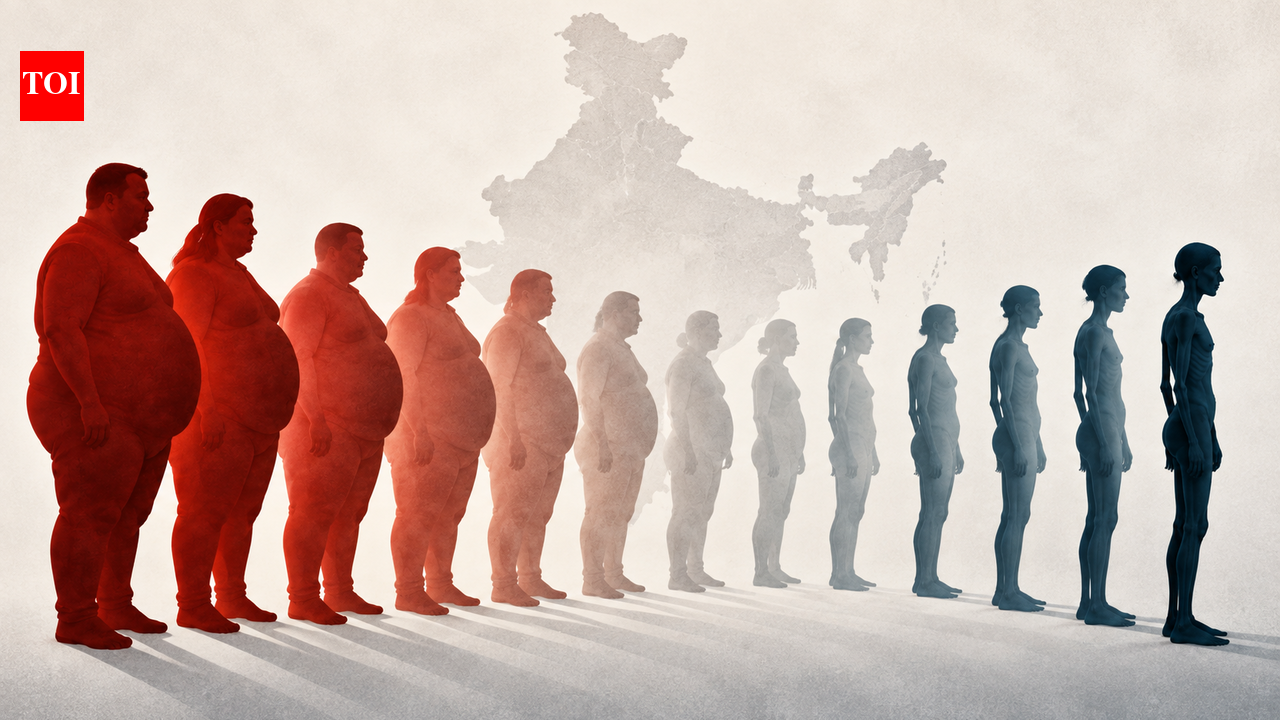
AI generated image for representational purposeSedentary lifestyles are often blamed for rising obesity. It is perhaps the most obvious explanation, repeated ad nauseam in this digital age, where often the entire world stays within our six-inch screen. But data from the government's latest pan-India health survey (NFHS-6) suggest something quieter, and potentially more complicated for policymakers. Below-normal BMI has stopped retreating in India even as overweight and obesity rise.The National Family Health Survey (NFHS) is the government's main source of data on health and nutrition, run by the International Institute for Population Sciences for the Union health ministry. Its sixth round, NFHS-6, covered about 6.79 lakh households across 715 districts, with fieldwork running from May 2023 to December 2024. It reports 101 indicators for India and every state and union territory except Manipur.Among women aged 15-49, the share with below-normal BMI rose marginally from 18.7% in NFHS-5 to 19.7% in NFHS-6, while the share classified as overweight or obese rose steeply from 24% to 30.7%. Hence the calculated share of women in the normal-BMI range fell from 57.3% to 49.6%, a decline of 7.7 percentage points.Men aged 15-49 are moving in the same direction. Below-normal BMI rose from 16.2% to 19.7%, while overweight or obesity increased from 22.9% to 27.3%. Hence the share of men in the normal-BMI range shrank from 60.9% to 53%, a decline of 7.9 percentage points.The dual problemBMI is weight in kilograms divided by height in metres squared. For these indicators, NFHS classifies BMI below 18.5 as below normal and BMI of 25 or above as overweight or obese. It does not publish the normal range in between; TOI calculated that middle by subtracting the two published shares from 100.The NFHS-6 fact sheets are provisional, and without unit-level data it has not been tested whether the changes are statistically significant.Trend reversal in low BMIComparable figures for both sexes begin with NFHS-3, and below-normal BMI fell in each round until now. Among women it went from 35.6% in NFHS-3 (2005-06) to 22.9% in NFHS-4 (2015-16) and 18.7% in NFHS-5; among men, from 34.2% to 20.2% and then 16.2%.Trend reversalNFHS-6 is the first of these rounds in which the below-normal share rises for both sexes, and men's share, lower than women's in each earlier round, now matches it at 19.7%. Overweight has risen in every round, from 12.6% to 30.7% among women since NFHS-3 and from 9.3% to 27.3% among men.How states faredBelow-normal BMI increased from NFHS-5 in 20 of the 35 state/UT comparisons among women and 27 of 35 among men. Overweight or obesity rose even more widely, in 33 of 35 among women and 28 of 35 among men. Both rose together in 19 of the comparisons for women and 20 for men.State-wise comparison for menAmong women, just seven of the 35 states and Union territories in the NFHS-6 release had a calculated normal-BMI share below 50% in NFHS-5; in NFHS-6, that number has risen to 16. So in 16 states, more than half of women in the 15-49 age group are either overweight or underweight. Among men, only one of the 35 — Puducherry — was below 50% in NFHS-5. In NFHS-6, 11 are below 50%.Rajasthan recorded the sharpest increase in below-normal BMI for both sexes: from 19.6% to 27.3% among women, a rise of 7.7 percentage points, and from 14% to 24.7% among men, up 10.7 points. Other large increases in low BMI among women were in Jammu & Kashmir, Madhya Pradesh, Uttar Pradesh and Jharkhand; among men, the sharpest increases were in Chhattisgarh, Jharkhand, Madhya Pradesh, Tripura and Delhi.At the other end, Lakshadweep saw the largest increase in overweight or obesity among women, from 33.5% to 50.1%, followed by Sikkim, West Bengal, Andhra Pradesh and Karnataka. Among men, the biggest increase was in Chandigarh, from 34.4% to 48.5%, followed by Goa, Andhra Pradesh, Gujarat and West Bengal.State-wise comparison for womenThe state numbers show this is not confined to a few pockets.Urban-rural divideAmong urban women, 13.2% have below-normal BMI and 42.8% are overweight or obese. Among rural women, below-normal BMI is much higher at 22.5%, while overweight or obesity stands at 25.5%. Against NFHS-5, below-normal BMI among rural women has risen from 21.2%, while the urban estimate is unchanged at 13.2%. Overweight or obesity rose in both, from 33.2% to 42.8% in urban areas and from 19.7% to 25.5% in rural areas.Men show a similar urban-rural divide. Among urban men, 14.9% have below-normal BMI and 36.3% are overweight or obese. Among rural men, 21.9% have below-normal BMI and 23% are overweight or obese. Compared with NFHS-5, low BMI among urban men rose from 13% to 14.9%, while among rural men it rose more sharply, from 17.8% to 21.9%. Overweight or obesity increased from 29.8% to 36.3% in urban areas and from 19.3% to 23% in rural areas. Among men, the rise in low BMI was larger in rural India, while the increase in excess weight was sharper in urban India.Contrasting trend in urban and rural areasDr Sadajit Banerjee, a Kolkata-based internal medicine and geriatrics specialist, says that as an urban doctor he has been seeing mostly a shift towards overweight. Patients increasingly arrive asking about semaglutide and tirzepatide, having read about them; those whose BMI is still within acceptable limits are advised on lifestyle change instead.Most urban Indians, he says, do not seem motivated enough to exercise or change how they live, while others are frightened of the side effects of those drugs. The patients who take up either route readily are usually the ones who already have diabetes or another metabolic disorder. At population level, the coexistence of low BMI and overweight or obesity is consistent with what the World Health Organization calls the double burden of malnutrition. Low BMI is one marker of undernutrition rather than a complete measure of it.India not following global pattern?Most of the world has been moving in one direction. A 2024 Lancet analysis by the NCD Risk Factor Collaboration, covering 200 countries and territories, found obesity rising almost everywhere between 1990 and 2022 and more than a billion people living with obesity, while adult underweight fell in most countries.That is what makes the NFHS-6 reading unusual: India's overweight share is rising in line with the global pattern, but its below-normal share is not falling. A Global Burden of Disease study put India second only to China, at 180 million adults aged 25 and older with overweight or obesity in 2021. That is a modelled estimate on a different age base.The district-level analysisThe fact sheets report these BMI measures only for women, so the district picture is a picture of women. The female BMI indicators exclude women who were pregnant or had given birth in the preceding two months.Of the 713 district records in the release, 680 can be compared with NFHS-5, where both BMI figures are available for both rounds. In 372 of those 680, or 54.7%, both ends grew at once: more women with below-normal BMI, and more women overweight or obese. All districts in Punjab, Kerala, Andhra Pradesh, Delhi and Goa fall below 50% on the calculated female normal-BMI measure. So do the overwhelming majority in Tamil Nadu, Gujarat, Haryana and Karnataka.A normal BMI can hide muscle loss and excess fatBMI can also conceal what it is measuring. With the elderly population growing, Banerjee says he is seeing patients whose BMI is skewed by sarcopenia — too little protein and too little exercise producing muscle loss on one side and fat gain on the other. The number on the chart often stays in the normal range. Such patients may have low muscle mass and excess body fat despite an apparently normal BMI, risks that BMI alone can miss.Blood sugar also climbedNFHS-6 also tested blood sugar, on a different age base of 15 and above, against 15-49 for BMI. The share of women with high or very high blood sugar, above 140 mg/dl, or taking medication for diabetes rose from 13.5% to 17.8%; among men, from 15.6% to 20.9%. Urban prevalence is higher on both counts, at 21.9% among women and 23.9% among men, against 16.2% and 19.7% in rural areas. The fact sheets do not establish cause and effect.Overweight and obesity are rising fast, and low BMI has stopped retreating. Across much of the country both are now visible at the same time, which leaves public-health programmes carrying two problems rather than watching one give way to the other. For Banerjee, they are not two problems at all. "Overnourished or undernourished, both fall in the malnourished category," he says. Much of the chatter is about improving urban lifestyles. How rural India gets proper nutrition is the question policymakers will have to answer.
India sees rise in both overweight and underweight
Full Article
Original Source
Read the full article at Timesofindia →KhanList aggregates and links to publicly available news content. We do not host full articles from third-party sources. Always verify important information with original sources.