
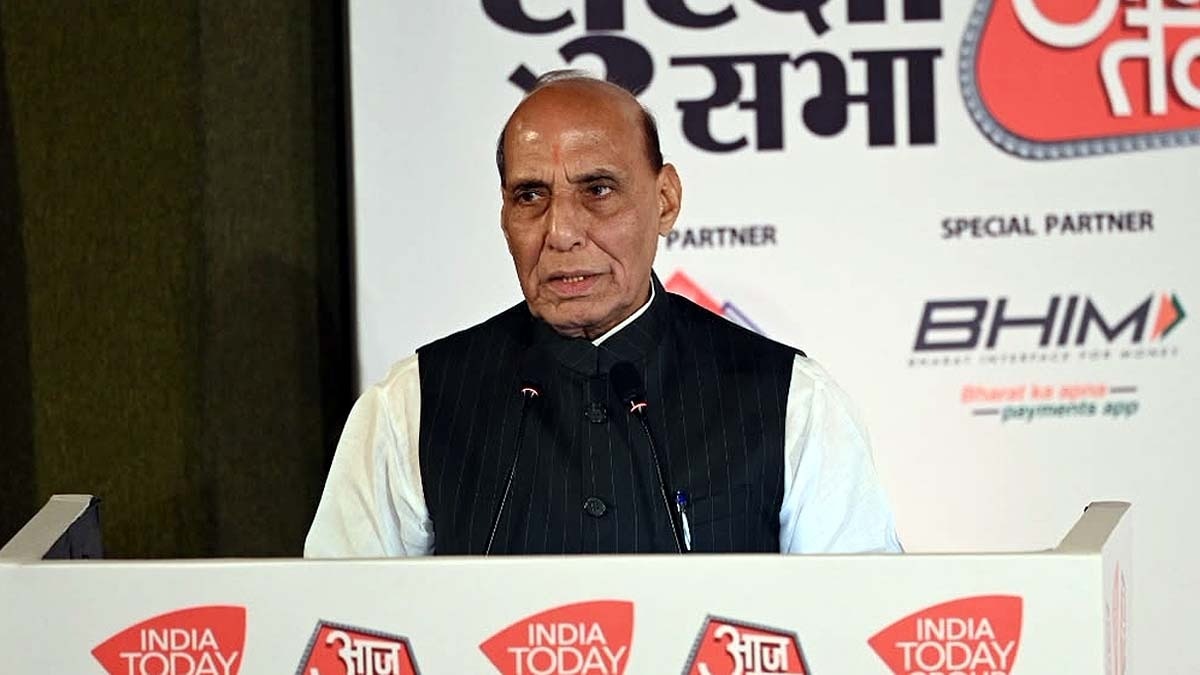
Defence Minister Rajnath Singh said India was no longer waiting for threats to materialise before responding, arguing that the country had adopted a more forward-looking approach to national security under Prime Minister Narendra Modi-led government.Defence Minister Rajnath Singh addresses ‘Suraksha Sabha’ in New Delhi on Monday. (Photo: ITG)Defence Minister Rajnath Singh on Monday said India’s defence policy has shifted from being “reactive” to “pro-active” under Prime Minister Narendra Modi, citing stronger military capabilities, rising indigenous production and greater diplomatic leverage as evidence of the transformation.Addressing the ‘Suraksha Sabha’ event organised by Aaj Tak in New Delhi, Singh said India was no longer waiting for threats to materialise before responding, arguing that the country had adopted a more forward-looking approach to national security under the Modi government.He cited India’s entry into the Missile Technology Control Regime (MTCR) in 2016 as an example of how the government’s diplomacy had helped expand the country’s defence capabilities. According to Singh, MTCR membership enabled India to work on increasing the range of the BrahMos missile.SINGH HIGHLIGHTS BRAHMOS ROLE IN OPERATION SINDOORReferring to Operation Sindoor, Singh said the BrahMos missile had played an important role during last year's military operation against Pakistan. He also referred to a recent video in which, he said, Pakistan's Prime Minister had acknowledged the impact of BrahMos strikes on targets in Pakistan.Singh said the government had worked across multiple fronts, including strengthening border security, modernising the armed forces, increasing indigenous defence production and transforming the country's ordnance factories. "Today, India is not only self-reliant but also confident in the defence sector," Singh said.INDIGENOUS DEFENCE PRODUCTION RISES TO RS 1.8 LAKH CRORE Singh contrasted India's current defence production with the levels recorded during the UPA era, saying indigenous defence production had risen from around Rs 40,000 crore to approximately Rs 1.8 lakh crore.He said India's defence exports had also grown significantly, with the country now exporting defence equipment worth around Rs 38,500 crore to more than 100 countries."Before 2014, the country's defence production was around this level. Today, we are exporting almost this much," Singh said, referring to the current export figure.He said the government had simplified licencing rules for defence manufacturing and used the Defence Acquisition Procedure (DAP) to prioritise indigenous systems.AKASHTEER, AKASH, PINAKA, TEJAS AMONG INDIGENOUS SYSTEMSSingh listed a range of weapons and platforms as evidence of India's growing indigenous defence capabilities.These include the Akashteer air defence control system, Akash air defence missile, Pinaka rocket launcher, Astra air-to-air missile, Prachand and Dhruv helicopters, Tejas fighter aircraft, Arjun tank, drones and counter-drone systems.He also highlighted INS Vikrant, India's first indigenously designed and built aircraft carrier, which has been inducted into the Indian Navy.SINGH ATTACKS UPA OVER DEFENCE SCAMSSingh also criticised the Congress-led governments before 2014, alleging that defence procurement had been marred by corruption.He cited the Bofors scandal, the HDW submarine case, the Tatra truck case and the AgustaWestland helicopter deal while making his argument for greater transparency in defence procurement.Singh said India's defence budget had increased from around Rs 2.5 lakh crore to nearly Rs 8 lakh crore over the past 12 years.He asserted that the increased allocation had been used transparently and that not "a single penny" had been diverted, saying every rupee was being used to strengthen India's security.BORDER INFRASTRUCTURE INVESTMENT UP 400%: RAJNATHSingh also highlighted the government's investment in border infrastructure, claiming that spending in the sector had increased by as much as 400 per cent. He cited the abrogation of Article 370 as another measure that, according to him, had strengthened India's "integrity and sovereignty".Turning to India's cultural influence, Singh said the government had not only protected the country's cultural identity but had also turned it into an element of India's global influence. He pointed to the worldwide observance of International Yoga Day and efforts to develop Nalanda University as a global centre of knowledge.'INDIA HAS DIPLOMATIC ACCESS AND LEVERAGE'Singh also positioned India's growing diplomatic influence as an important component of national security. He cited India's leadership of initiatives such as the International Solar Alliance and Global Biofuels Alliance, as well as its presidency of the G20 in 2023.Singh said India had been invited to G7 meetings continuously since 2019 and highlighted the adoption of the New Delhi Leaders' Declaration during India's G20 presidency despite significant differences among participating countries.He also cited the Voice of Global South Summit and the MAHA-SAGAR initiative as examples of India's efforts to strengthen the voice of developing nations. "When our neighbouring countries face a crisis, India reaches there first as a first responder," Singh said.He added that India now had both "diplomatic access" and "diplomatic leverage".ECONOMIC SECURITY IS NATIONAL SECURITY, SAYS SINGHSingh stressed that economic security was an important component of national security, arguing that only a strong economy could support investment in advanced military capabilities and allow a country to maintain strategic autonomy during crises.He said India was continuing to grow at 7.8 per cent despite economic uncertainty around the world.The government, he said, had strengthened supply chains, increased self-reliance in critical sectors and promoted domestic manufacturing.Singh cited the development of India's semiconductor ecosystem and the Production Linked Incentive (PLI) scheme as examples of efforts to strengthen manufacturing and reduce external dependence.'WHEN INDIA SPEAKS, THE WORLD LISTENS'Singh said India was moving forward with greater strategic autonomy and the ability to determine its own priorities.He praised the Indian armed forces and soldiers for their courage and combat capabilities, but argued that before 2014, the country lacked political leadership that was willing to give the military a "free hand" and ensure adequate resources.Singh also accused the previous Congress government of constraining the armed forces in the fight against terrorism."The courage and war-fighting skills of our soldiers are unparalleled," he said, adding that the armed forces had always been ready to make the ultimate sacrifice for the country.- EndsPublished By: Sonali VermaPublished On: Sep 7, 2026 19:42 IST
India now strikes before...: Rajnath Singh credits Modi govt for defence transformation
Full Article
Original Source
Read the full article at Indiatoday →KhanList aggregates and links to publicly available news content. We do not host full articles from third-party sources. Always verify important information with original sources.