
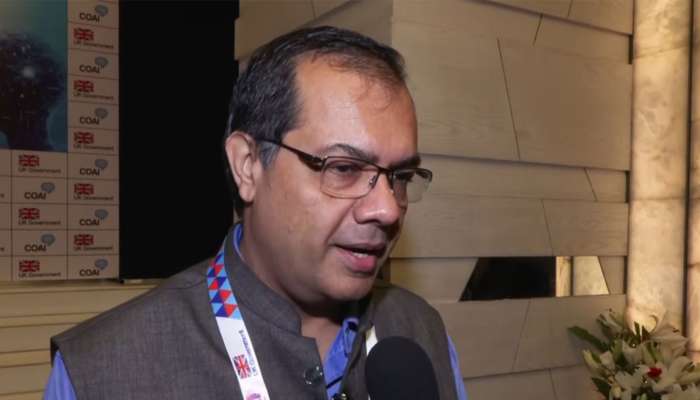
New Delhi: India needs to collaborate with other governments to share information about cyber threats, with the British government stepping forward to have such collaboration, Jaijit Bhattacharya, President, Centre for Digital Economy Policy Research, said on Monday.“There was a requirement to join hands with everybody, not just the British… If the British come to know that there is a threat, they need to let us know and everybody else know that there is a threat and that’s really why we need to collaborate with other governments and the British government has stepped forward to have that collaboration,” Bhattacharya told ANI. Speaking on the sidelines of the CO.AI 2026 event organised by the Cellular Operators Association of India (COAI) in association with the British High Commission, Bhattacharya said the increasing use of Artificial Intelligence (AI) was creating both opportunities and threats for telecom networks.He said AI could help protect telecom networks from spam and make the “healing” of networks more efficient, but the same technology was also being used to identify deficiencies in networks and attack them at an extremely large scale.“We have seen that happening during Operation Sindoor and therefore how do we prevent AI-based attacks? What are the steps to be taken from a regulatory and technological perspective, from a standards perspective and from the perspective of collaboration between industry, academia and the governments,” he said.Bhattacharya said the growing complexity of cyber threats meant that cybersecurity could not be addressed through a single policy, particularly with AI becoming an increasingly important factor.On the government’s approach to cybersecurity regulation, he said it was important to maintain a balance between protecting systems, critical infrastructure and people and ensuring that regulation did not become a barrier for industry.He said excessive government intervention could become a “deadening hand” on industry and also risk stifling innovation, which the government did not want.“The government is carefully thinking on what is the right level of regulation which protects our systems, our critical infrastructure, our people while not stifling innovation and industry,” Bhattacharya told ANI.He said India was providing leadership in the Global South by bringing countries together to discuss critical issues, including AI, rather than claiming that it was ahead of every other country in technology.Bhattacharya said AI was being discussed repeatedly because the technology had become “very, very critical” and was moving extremely fast. He noted that even those who were leaders in AI were calling for a slower pace of development.On measures required to strengthen India’s AI capabilities, he said regulation itself was not the tool for becoming a leader in technology. Instead, the focus should be on creating the conditions needed for the development and adoption of AI.“What we need to do, and the government is doing is actually pushing for more data to be available to train models, to promote those who are capable of coming out with world-class models and to provide a market for those who are able to provide the solutions,” he said.Bhattacharya said these steps were aimed at strengthening the ecosystem for AI models and solutions while ensuring that the technology was used for the right purposes and did not harm people or critical systems.
India needs to collaborate with other governments on cyber threats: C-DEP President
Full Article
Original Source
Read the full article at Timesofoman →KhanList aggregates and links to publicly available news content. We do not host full articles from third-party sources. Always verify important information with original sources.