
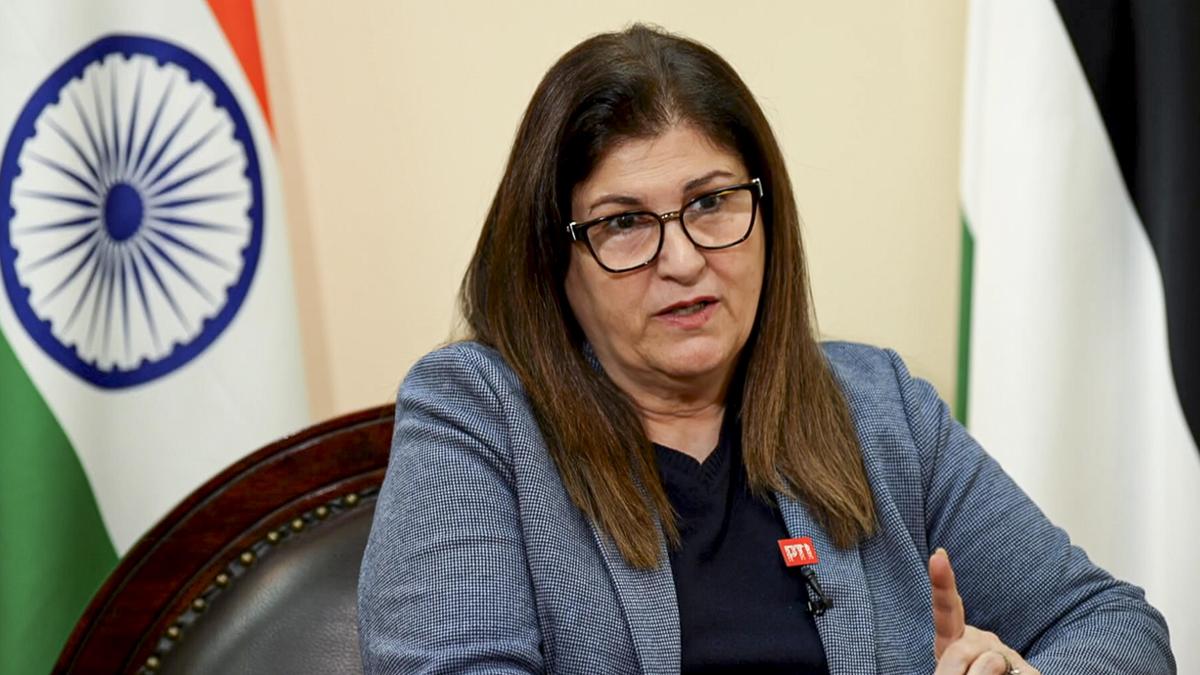
India needs to be more vocal about violations of international law and use its global weight to push for peace between Israel and the Palestinians, Palestinian Foreign Minister Varsen Aghabekian Shahin has said, while urging New Delhi to examine arms transfers to Israel seriously.In an interview with The Hindu, Ms. Shahin said Palestine had a “very long-standing relationship” with India and had no issue with New Delhi maintaining friendly ties with Israel. She also said the situation in the West Bank, where settler violence is spreading, is “very bad”. On the two-state solution, the Minister said there was “no other solution” and urged the international community to uphold their support for international law everywhere. She added that she believes U.S. President Donald Trump is serious about his Gaza peace plan. Let’s start with the West Bank. Reports of settler violence are emerging almost every day. How serious has the situation become in the West Bank? Well, the situation is really bad and it’s getting worse because settler terrorism is part and parcel of an Israeli policy aimed at erasing the Palestinian presence in the occupied Palestinian territory. It has been ongoing since day one of the occupation, but today, we see that settler terrorism is spiking. And it is spiking because settler terrorists are emboldened by ministers in the Israeli government who are themselves settlers. They arm the settlers, and provide them with money. They themselves are ministers in the morning and part of the settler group in the evening. So the aim is very well-known to the Palestinians and the world today. It is about erasing the Palestinian presence and it is done in a systematic way. It’s not carried out by settlers here and there. It is part of a broader policy of occupation. Is the Israeli government planning to annex the West Bank? The Israeli plan has been there since day one of the occupation. The intention is known. Kick the Palestinians out, displace them, grab their land, and call it your own. And they don’t shy away from telling the world that this is what they will be doing. And today they call it Judea and Samaria. They don’t even use the term West Bank or occupied Palestinian territory. So, the intention is very well known. They are systematically working on it. And we will continue our struggle because the occupied territory is occupied. This is what international law says. This is what the International Court of Justice confirmed and as such, our focus and compass are international law. Whatever Israel, through its arms, settlements and settlers, is doing in the occupied territory does not change the fact that this is occupied territory. Let’s look at [U.S. President Donald] Trump’s 15-point peace plan for Gaza. He says Hamas would be demilitarised and Israeli troops would withdraw from Gaza, and the territory would be placed under a technocratic administration. What is the Palestinian Authority’s view of the plan? Our utmost priority was and still is stopping the bleeding in Gaza. I mean, Gaza has been genocided for almost three years now. And the priority is to bring some peace and security to the devastated people in Gaza. Everything in Gaza today has been destroyed. And people require immediate assistance. In that sense, we have welcomed the peace plan. Today, we would like to see that the terms of the peace plan are respected. That plan has specific points going through various phases. We’re stuck in phase one. We need to embark on phase two, and President Trump has said how we need to move on to phase two, and they need to hold all sides accountable. Hamas said it is ready to give up the arms; no matter how you look at it, there is some responsiveness in that regard. Now, the ball is in the Israeli court. They need to come forward because they have obligations. And the first and foremost obligation is for Israel to withdraw from the Gaza Strip. What we hear from Israel is contrary to that. Israel is telling the world that it will stay in Gaza. It is already occupying 60% of Gaza. It wants to entrench its occupation. Do you think President Trump is serious about the Israeli pull-back from Gaza? If he put that in his plan and that plan is his legacy, then I would assume that he is serious about it. And if somebody can do it today, it would be President Trump. There are ideological and institutional divisions between Hamas [which runs parts of Gaza] and the Palestinian Authority [which is based in Ramallah in the West Bank]. Do you see a possibility of Palestinian national unity emerging? Unity is a must because if you want to embrace the world and embrace the realisation of the state of Palestine, we need to show a united front. We can differ on many things, but our national project remains the same. Our target is ending the occupation. We have different views on how to end that occupation. But unity is possible and we have embraced dialogue on unity in the past years, and in that sense we appreciate all the mediators, whether it was Qatar, Saudi Arabia, Turkey or Algeria. So, we are ready to move forward with unity, but that unity needs to rest on principles. One of the basic principles is to agree on the mandate of the PLO [Palestine Liberation Organisation] because we all fall under the PLO. All political factions in Palestine must fall under the PLO, under the vision of one government, one law, one administration, and one weapon. So, it is open and if we come to terms on that, then I think we can move with the unity issue. If Hamas agrees to disarm and accept the PLO’s worldview, would it be allowed to join the PLO? Participation in the PLO is open, but you need to embrace what the PLO mandate stands for and what kind of Palestine we’re looking forward to and how to achieve the strategy towards materialising the state of Palestine. If that is the case, the PLO is open to any Palestinian individual or faction. Is the two-state solution still alive? Do you still see a practical way forward? There is no other solution. The other solution is a one-state solution, if Israel is adamant on not having two states, which gives Israel 78% of historic Palestine. No one can imagine that Israel will accept one state for all its citizens in which Palestinians today are more numerous than the Israeli Jewish population. So you can imagine what will happen in 10-20 years from now. Israel does not want to give any of the occupied land, but if it wants to live in peace and security, it needs to become a normal state. Today it is not a normal state. Today, it voices its expansionist, colonialist ideology and infringes on the rights of neighbouring countries. This is an expansionist state that does not comply with international law. It has shown the world that it is capable of committing genocide and continues to violate the rights of Palestinians. It needs to be stopped in accordance with international law. Israeli officials would say their hard military response is necessitated by Palestinian or Hamas terrorism. They also point to the October 7, 2023 attack, when Hamas killed roughly 1,200 people in Israel. What is your response to this? I think this is a very faulty response. We’ve been living under state-sponsored terrorism from day one of the occupation. Israel has obligations towards the occupied people and throughout the years of occupation, our right to self-determination, our basic rights as human beings have been violated. In education, in mobility, in health, in social services, anything you can think of has been violated. So people under such violations for decades would want to get rid of that occupation. That is not called terrorism. That is called a struggle against an illegal occupier. Today, what Israel is using is state-sponsored terrorism through its various arms. What Israel has done in Gaza is terrorism. Yes, October 7th was violent, but it has to be seen in a context of years and decades of violence. It was violent, but the Israeli response was way disproportionate to the violence that was exercised on October 7. October 7 does not give Israel the right to kill 75,000 people, injure another 175,000 and destroy 80% of Gaza. This is not acceptable. Do you think Palestinians are worse off today than they were before October 7? Today, the situation is very hard. Of course, we have 2 million people in Gaza living under immense devastation. They don’t even have their basic needs met. In the West Bank, the entrenchment of occupation is much stronger and the situation on the ground is much worse. What happened to the international support that the Palestinians once enjoyed? Do you still receive meaningful support from the world’s major powers, or do you feel that the Palestinian issue is being pushed to the margins of global politics? I think this fluctuates, but in general, yes, we still enjoy a lot of support, and that support needs to be nurtured. But we also understand that today the world is based on interests, and countries have various interests, rightly so. But for all countries that say they support international law and compliance with international law, there should be no double standards in its application. They need to come forward. This is what is expected of countries that respect international law. Otherwise, if there is no respect for international law and there is no response to Israel’s violations, then talking about international law and your responsibilities towards it and towards the Palestinian people becomes irrelevant. Let’s look at India’s position as well. India has historically supported the Palestinian cause, and its position today is that it backs a two-state solution. But India’s position has also evolved over the years and it has built strong bilateral ties with Israel. How do you assess India’s position today? Look, we have a very long-standing relationship with India. India was among the first countries that recognised [Palestine]. It is a friend of Israel as well, and we have no issue with that. They need to be vocal about what is right and what is wrong, and they need to be vocal about violations of international law. This is what is expected of India. India continues its development and humanitarian assistance with the Palestinians. It continues to voice its compliance with the idea of the two-state solution. And we expect India, being a friend of both [Israel and Palestine] and a country with significant global weight, to push more towards respecting a world order based on international law and [ensuring there are] no violations of that law. So, there was a recent Amnesty International report claiming that more than 2,500 shipments of arms and ammunition were sent from India to Israel after October 7. What is your response to this report? Any report that comes out from [Amnesty] or any other international organisation needs to be looked at very seriously. Because such reports have a lot of credibility. And today, arms sales, arms dealings with the State of Israel need to be questioned because we have obligations. All states have obligations based on international law and our position and the world’s position must be guided by international law and continuing transfer of arms to the state of Israel might violate international law. The ICJ said very clearly that there is plausible genocide in Gaza and any arms transferred to Israel might be contributing to the terror on the Gaza front or on the West Bank. And as such you know we need to be very careful when we deal with arms with the state of Israel and this is what is expected from India as well. Would you expect India to play any substantial role as a peacemaker between the Israelis and the Palestinians? Yes, we expect any country with such weight and stature worldwide to exercise whatever it can on forging peace in the region because that peace and that intervention will not only benefit Israel, Palestine and the region. It will benefit the world at large because the conflict is a global issue. It’s not just a West Asian issue.
India needs to be more vocal on international law violations: Palestine’s Foreign Minister
Full Article
Original Source
Read the full article at Thehindu →KhanList aggregates and links to publicly available news content. We do not host full articles from third-party sources. Always verify important information with original sources.