
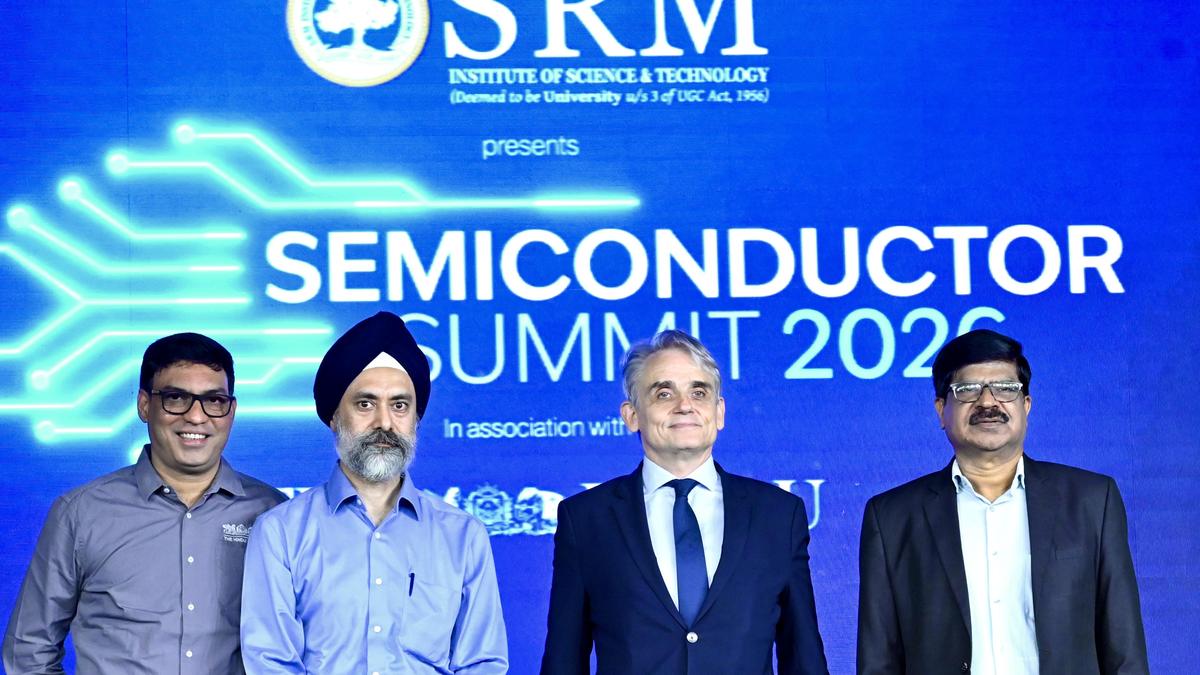
India must build domestic capabilities across the semiconductor value chain, from manufacturing and materials to research and specialised skills, to reduce dependence on foreign technologies and strengthen supply-chain resilience, Dr. Kamaljeet Singh, Director-General of the Semiconductor Laboratory (SCL), Mohali, said on Tuesday.Speaking at the inaugural session of the Semiconductor Summit 2026, organised by SRM Institute of Science and Technology in association with The Hindu, he said India had a strong foundation in chip design but remained dependent on foreign suppliers for critical inputs, including electronic design automation (EDA) tools.“But the EDA tools which we are using also come from the U.S. So that is why all dependencies are foreign,” he said.India must overcome challenges relating to technology, talent, resources, time, market acceptance and capital to emerge as a technological power, he said. This would require greater investment in research and development (R&D), manufacturing infrastructure and skills, supported by closer collaboration among industry, academia and startups.Under the India Semiconductor Mission 1.0, ₹76,000 crore had been committed, with 12 projects approved and five operational, Mr. Singh said. The second phase had expanded the mission’s focus to include R&D and skill development alongside chip design, manufacturing, materials and machinery.He stressed the need to bridge the gap between research and commercial production through pilot lines, manufacturing facilities and greater industry participation.SCL had integrated its process design kit with open-source tools to help students learn chip design without having to pay for commercial EDA software. The initiative would widen access to semiconductor education, particularly for students in tier-two and tier-three cities, he said.As conventional transistor scaling becomes increasingly difficult, advanced packaging and the integration of different types of chips will play a bigger role in improving computing performance, he added.India-Germany cooperationMichael Hasper, Consul-General of Germany, said semiconductors had become central to economic competitiveness, technological sovereignty and national security. No country controlled the entire semiconductor value chain, making international cooperation essential even as nations sought to reduce strategic dependencies.“The global semiconductor industry is no longer simply another high-tech industry. It has become a central element of economic competitiveness, technological sovereignty, and national security,” he said.India and Germany had established a framework for closer cooperation through a joint declaration of intent signed during German Chancellor Friedrich Merz’s visit to India in January 2026. The initiative aims to encourage investment and strengthen links among companies, research institutions and government agencies.Mr. Hasper identified four priority areas: chip design and research; power semiconductors; manufacturing technologies and supply chains; and skills development.Tamil Nadu offered significant opportunities given its automotive, engineering and electronics industries. German expertise in power semiconductors, sensors, precision engineering and manufacturing equipment could complement India’s engineering talent and expanding electronics market, he said.Power semiconductors are particularly important for electric vehicles, charging infrastructure, renewable energy and modern electricity grids.Citing cooperation involving Infineon, India’s National Institute of Electronics and Information Technology, research institutions and IIT Madras, he highlighted opportunities to deepen research and chip-design collaboration.“After all, technological sovereignty does not mean technological isolation,” he said, advocating cooperation based on mutual benefit, reciprocity and trust, while protecting intellectual property and sensitive technologies.Bridging the talent gapC. Muthamizhchelvan, Vice-Chancellor of SRM Institute of Science and Technology, said India needed to address the gap between its large semiconductor market and dependence on imported chips.“Factories alone will not close that gap. We need ideas, we need designs, and we need people,” he said.India would need about three lakh semiconductor professionals by 2030, he said, underscoring the need to develop skills across fabrication, packaging, testing and equipment, beyond chip design.Universities should assess research not only through academic publications but also through patents, prototypes and commercial products, he said. SRM was aligning research with national missions and encouraging students to work on industry-defined problems.He invited companies to collaborate through joint laboratories, research projects, patent development and product commercialisation.Navaneeth LV, CEO of The Hindu Group, said India’s semiconductor ambitions extended beyond manufacturing to research, design, innovation, resilient supply chains and skilled talent. He highlighted the role of universities in preparing engineers and researchers and the need to bring industry, academia and policymakers together to address the sector’s challenges.
India must cut foreign dependence across semiconductor value chain; needs to build capabilities beyond chip design, says Semiconductor Lab chief
Full Article
Original Source
Read the full article at Thehindu →KhanList aggregates and links to publicly available news content. We do not host full articles from third-party sources. Always verify important information with original sources.