
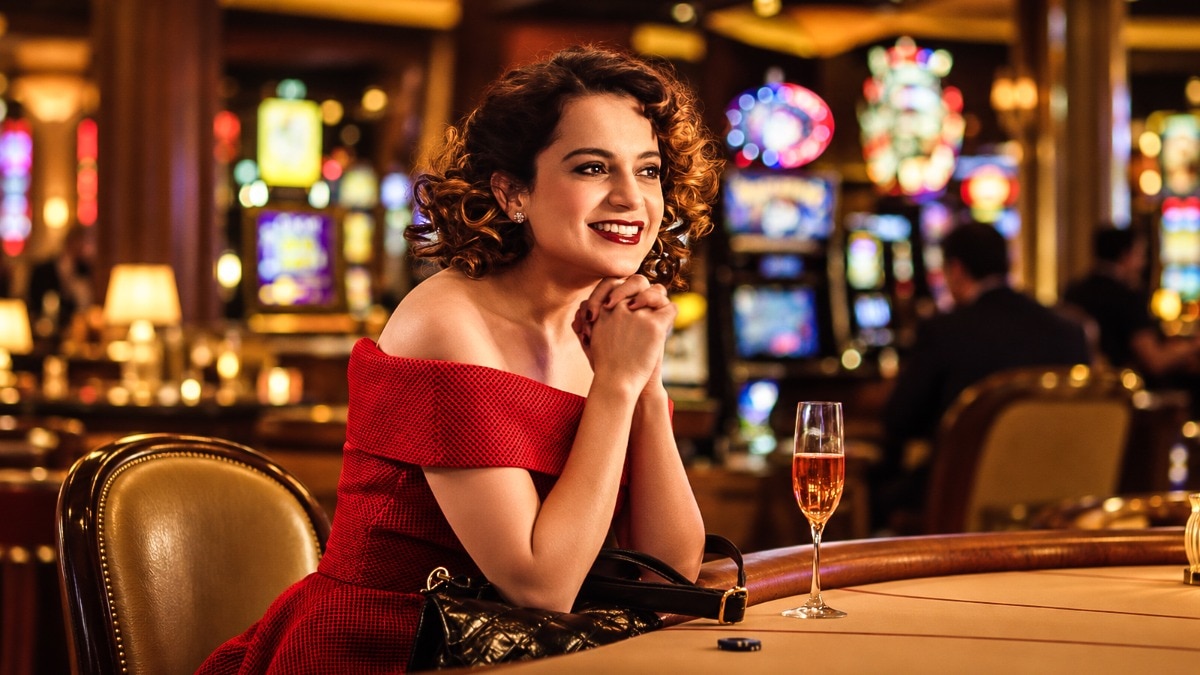
Indian restaurants are reworking tables, menus and service as more people dine alone. But is that enough for the diners?Kangana Ranaut in a still from the film Simran.There was a time when walking into a restaurant alone in India could feel like making a small social announcement: Yes, I am here by myself. No, I am not waiting for anyone. Yes, I really do intend to eat this meal alone.That awkwardness is slowly disappearing.Across restaurants, chefs and founders say solo diners are no longer an occasional oddity, a business traveller in town for the night or someone who has been stood up. They are young professionals, women, tourists, regulars from the neighbourhood and, sometimes, simply people who wanted to eat at a particular restaurant and couldn't be bothered to wait for company.The more interesting question, then, isn't whether Indians are dining alone more often. They are. The question is whether restaurants are keeping up. Some have changed their menus, portions, tables and even staff training to make a table for one feel as considered as a table for four. Others have taken a more understated approach: don't create a separate category for solo diners at all. Make the restaurant comfortable enough and the food flexible enough, and let people come alone without making a song and dance about it.At Burma Burma, solo diners now account for around 5–6% of covers, according to co-founder Ankit Gupta. At Delhi’s Top Banana, founding executive chef and brand lead Tarannum Sehgal estimates the number at around 10–15%, particularly at the bar. At Bengaluru’s NAVU co-founders Kanishka Sharma and Pallavi Menon say they have also seen a clear increase over the past couple of years, although they don't put a percentage to it. And that difference itself is telling. Solo dining isn't yet being measured uniformly across the industry, but Indian restaurants are indeed noticing a shift in behaviour.Table-for-one is not a consolation prizeThe pandemic may have nudged people towards eating alone, but the habit appears to have outlived the circumstances that created it. “Post-2021, we saw a clear uptick in solo dining at Burma Burma restaurants as larger groups stayed away from restaurants,” says Gupta. What began as a pandemic-era behaviour, he adds, has proved resilient.At Foo, which serves pan-Asian cuisine styled as tapas and small plates and is operational in five Indian cities, founder and managing director of Pebble Street Hospitality (owns Foo) Keenan Tham has noticed a similar change, particularly during weekday lunches, early dinners and among work travellers. More importantly, he says people are increasingly dining alone by choice rather than by necessity.Solo dining is no longer necessarily a person hurriedly eating lunch between meetings or sneak peek into their ‘sad lives’. At Top Banana in Delhi's GK2, Sehgal sees a mix of young professionals, neighbourhood regulars and women dining independently. At Burma Burma, the profile changes by location: Bengaluru and Hyderabad see more young professionals, while the Saket and Kala Ghoda outlets see more tourists dining alone.OMO culinary director Chef Chetna Chopra says solo diners, particularly women, have been part of the restaurant's audience almost since it opened. In other words, there isn't really a “solo diner type”. There is just a person who happens to be eating alone.Which raises an obvious question: why should the restaurant treat them differently?Some restaurants are changing the roomThe most visible problem with solo dining is not always the food. Sometimes, it is the chair (no, not joking).Put one person at a four-seater and the table can suddenly feel like an accusation. Are you sure you're supposed to be here? There is also the nagging sense, familiar to anyone who has occupied an unnecessarily large table, that three invisible people might arrive at any moment and demand their seats back.Burma Burma has responded quite literally by changing its table mix. Gupta says the chain increased the number of two-seater tables from 2021 onwards. The idea is not merely to squeeze more people into a restaurant, but to make a solo diner feel that the space they occupy was meant for them.At Top Banana, flexibility was built into the seating itself. Its Allermuir Mozaik seating allows the restaurant to configure the space differently depending on how it is being used.NAVU takes an even more laissez-faire approach. A solo diner might get a seat at the bar, a table for two by the window or even a larger table if it happens to be free.The common thread is simple: don't make the customer feel as though they have wandered into the wrong part of the restaurant.Then, there is the portion sizeThe traditional restaurant menu wasn't exactly written with one hungry person in mind.Sharing plates make sense when there are four people around a table. Less so when there is one person staring at a menu and calculating whether ordering three dishes means dinner, lunch tomorrow and a regrettable amount of food waste.This is where formats such as tapas and small plates have an advantage.For instance, there are restaurants that have small plates and tapas style menu making it easier for patrons to enjoy smaller portions and at the same time try out more things on the menu. Or let’s say they do have combos which allow a person to get a main as well as a rice or noodles to go with it.Burma Burma introduced a dedicated Single Diner menu, with portions designed so one person can have a starter, main and dessert without over-ordering or paying for food they cannot finish. Its five-course Flavours of Burma set lunch also gives solo diners a way to sample multiple dishes.And this is perhaps where the difference between accommodating solo diners and actually designing for them becomes clear.You can tell a solo diner, “Of course you can eat here.” Or you can quietly make sure the menu, portions and table don't punish them for coming alone.But the economics are still sitting at the tableHere is the part restaurants understandably don't romanticise. A table for one usually produces less money than a table for two. There is no amount of solo-dining empowerment that can change basic arithmetic.NAVU is candid about it. Smaller portions mean a solo diner may spend less, and Sharma and Menon acknowledge that a table for one generates less income. But they don't see that as a reason to discourage the customer.Burma Burma has taken a different approach. Gupta says its solo diner menu is priced below the equivalent a la carte cost, making the economics fairer for the customer. He also points out that solo diners can turn tables faster, which can help offset the lower bill per table.Sehgal looks at it over a longer period. A solo guest may spend less on one visit, but if the restaurant becomes somewhere they feel comfortable returning to alone, that relationship has value beyond a single bill.For restaurants, then, the question isn't necessarily whether a table for one is worth as much as a table for two. It is whether treating solo diners as second-class customers is worth losing them altogether.The real problem might be the serviceAnd this is where solo diners themselves have something to say.Because there is a strange paradox to eating alone: you don't want to be ignored, but you also don't want to be watched. Solo diners have spoken of servers staring at them, checking in too frequently or hovering around in a way that makes them suddenly hyper-aware of the fact that they are alone.Good hospitality, it turns out, may involve doing slightly less.Perhaps this is the one accommodation that costs restaurants nothing. Don't hover.Alone doesn't have to mean lonelyThere is another choice restaurants are making: whether to make solo dining social. The answer from most chefs is, essentially, only if the diner wants it.At Burma Burma's Bengaluru and Hyderabad outlets, community dining tables allow people who enjoy meeting others to do so. At Top Banana, the bar naturally creates opportunities for conversation with bartenders or fellow diners.But nobody should be forced into a social experiment simply because they arrived without a companion.NAVU's Sharma and Menon put it neatly: if someone wants to talk, the team is there; if they want to sit quietly and eat, that's fine too.That may be the biggest shift of all. Restaurants are slowly moving away from the assumption that a person sitting alone needs to be rescued from their solitude. Because sometimes solitude is precisely what they ordered.So, are restaurants doing enough?These are some of the restaurants that have indeed taken the first step. But these restaurants do not necessarily show the actual picture of what lies beyond them. They could just be a mere 5 per cent.While some are changing their table configurations, some are offering smaller portions. One has a dedicated single-diner menu. Others haven't changed anything because, in their view, their existing food and spaces already work for one.However, some restaurants need to catch up with this fact that a table for one isn't an incomplete table. It is a complete customer, making a complete decision to eat there.- EndsPublished By: Tiasa Bhowal Published On: Sep 13, 2026 16:21 IST
India is dining solo. Are restaurants ready for it?
Full Article
Original Source
Read the full article at Indiatoday →KhanList aggregates and links to publicly available news content. We do not host full articles from third-party sources. Always verify important information with original sources.