
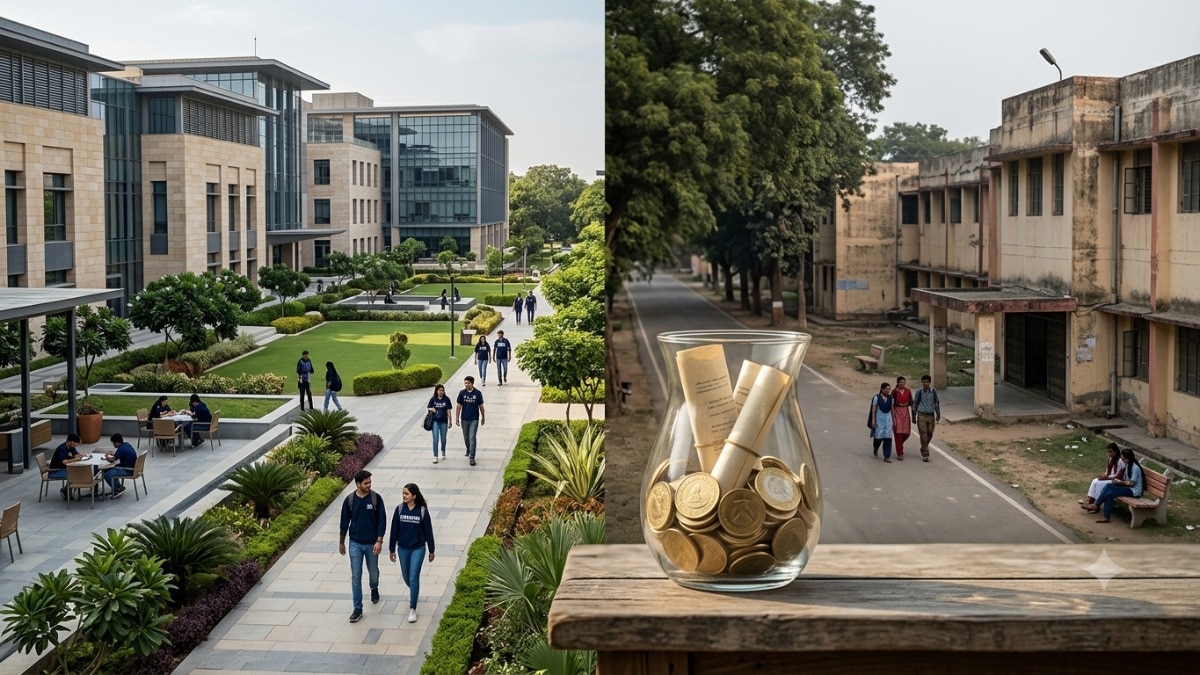
A USD 20 million gift to a US university. A USD 1 million endowment for scholarships at BITS Pilani. And hundreds of crores donated or pledged to India's top institutes in recent years.India is clearly seeing bigger education donations. But a more revealing question is this: Why are permanent university endowments still not a common part of the country's higher education system?The country has the world's largest population, a growing pool of wealthy professionals and entrepreneurs, and millions of alumni spread across the globe. Yet large, long-term endowments remain concentrated among a relatively small group of IITs, IIMs and elite private institutions.The issue may not be a lack of money or even a lack of willingness to give. It may be whether Indian institutions have built the systems, relationships and confidence needed to receive and manage that money for decades. BIG GIFTS, BUT A NARROW CIRCLEThe latest donations bring the contrast into focus.BITS Pilani recently received a USD 1 million endowment from alumna Revathi Advaithi and her husband Jeevan Mulgund to support scholarships for deserving women students from economically disadvantaged backgrounds. Meanwhile, Indian-origin philanthropists Anuradha and Vikas Sinha committed $20 million to the University of North Texas. The gift is set to create six permanent endowments covering scholarships, academic leadership, professorships, entrepreneurship and research.India has also seen major contributions to institutions such as IIT Delhi, IIT Bombay, IIT Madras, IIT Kanpur, IIM Ahmedabad and BITS Pilani. As reported in India Today's March 2026 feature, the size and frequency of large alumni donations have been increasing.But the pattern remains uneven. The question is not whether India has big donors. It is why the endowment model has not spread more widely across central universities, state universities, government colleges and smaller institutions.A GRANT ENDS. AN ENDOWMENT IS MEANT TO LASTA grant and an endowment are not interchangeable.A grant usually supports a defined project, activity or period. It may fund research, infrastructure, a programme or a scholarship initiative. Once the project or grant period ends, the funding may also end.An endowment is designed for the long term. Its principal is generally invested, while the income generated from it is used for the purpose specified by the donor.As Abhishek Vaidya, Chief Financial Officer, Woxsen University, explains, "A permanent endowment is fundamentally different: the donor is effectively entrusting capital to an institution across generations of leadership."That means the university is not merely receiving money for immediate use. It is taking on an obligation to preserve the corpus, manage it responsibly and honour the donor's intent over time."For a 20-year or permanent endowment, assurance should come from institutional mechanisms rather than personal commitments from the incumbent leadership," Vaidya says.He points to clearly documented objectives, restrictions on using the corpus, an approved investment policy, defined decision-making authority, accounting systems and periodic donor reporting."The corpus should be separately identifiable and its utilisation traceable through the institution's financial records and audit processes," he adds.This is what makes an endowment different from a one-time donation. It is supposed to create a financial asset that can support students, faculty or research long after the original gift has been made.THE TRUST QUESTIONWhat makes a donor comfortable giving a large sum that may be managed long after the donor and the university's current leadership are gone?Vaidya believes the biggest friction is not necessarily the willingness to donate. "It is creating confidence that an institution can honour the donor's intent not merely today but 10, 20 or 30 years later," he says.That requires more than a fundraising office. It requires governance, professional fund management, institutional continuity and transparent reporting. Institutions without these systems may struggle to attract large gifts, even when alumni are willing to contribute.India does not have one comprehensive law governing university endowments. The framework involves multiple laws and institutional regulations, while foreign contributions may also bring FCRA compliance into the picture.A NITI Aayog report on internationalisation of higher education identified several challenges, including the lack of clear guidelines on the deployment of endowment funds and utilisation of endowment income. It also pointed to weak fundraising capacity, limited professional fund management and the absence of reinvestment strategies.But Vaidya does not see regulation as the only explanation."Regulation and taxation can add complexity but I would not consider them the only constraint," he says.The bigger question is whether a university can show a donor exactly how the money will be protected, invested, spent and reported.WHY PUBLIC UNIVERSITIES OFTEN MISS OUTAbha Dev Habib, Associate Professor at Miranda House and Secretary of the Democratic Teachers' Front, offers a different perspective.She says the process of donating is not necessarily difficult. "You just have to do a cheque to a letter, the money is given," she says, referring to contributions and scholarships.The bigger issue, she argues, is that donations are not a continuous or equal source of income for institutions. "This is not a continuous source of income, and it is not equal for all units," Habib says.She also questions the assumption that public institutions can simply be asked to raise their own funds through alumni donations. "The government, which is aspiring that they will not fund institutions and ask institutions to its own funds and as if the alumna wants to give money, that is a wrong assumption," she says. (Photo: India Today) Expecting alumni donations to fill gaps in public funding is risky. Philanthropy is uneven by nature: institutions with wealthier alumni and stronger networks are better placed to attract it, while colleges serving students with fewer financial advantages may find it harder to raise comparable sums.For Habib, the history of public-funded education matters. Central and state institutions have educated large numbers of first-generation learners and students from less privileged backgrounds. But their alumni may not always have the same financial capacity as graduates of elite professional institutes."Only a particular percentage will reach a particular stature, a very small percentage," she says, explaining why alumni giving cannot be assumed to work uniformly across institutions.ALUMNI NETWORKS MATTER, BUT SO DOES GRATITUDELeading global universities have spent decades building alumni engagement, fundraising and endowment management systems. In India, alumni giving has often been linked to specific buildings, scholarships, laboratories or immediate institutional needs.Vaidya says many Indian institutions are still developing the capabilities required for long-duration giving."Many leading global universities have spent decades building an institutional culture around alumni engagement, fundraising and professional endowment management," he says.Thus, endowment-building also depends on whether universities have established systems to engage alumni, manage donated capital professionally and sustain donor relationships across generations. A large one-time contribution can help, but it does not by itself create that culture.Habib, however, stresses that giving is not always about professional networks or financial success. At Miranda House, she says, contributions have often come from college teachers and retired teachers who understand the institution's role in their lives."It is about gratitude," she says. "They understand what this institution did to them." (AI-generated image) She gives examples of teachers contributing towards facilities such as a paper recycling plant, a seminar room and other institutional needs.For her, this is a reminder that alumni giving cannot be reduced to a simple formula of wealth plus a prestigious degree."By working well for 35 years educating students, I've done enough for the institute," she says, describing how contribution to society can also be understood as a form of giving back.WHAT HAPPENS IF THE MONEY IS NOT USED AS PROMISED?A donor may give money for scholarships, research or a laboratory with a specific expectation. But what happens if the money is not used as intended?Habib says donor instructions may be included in letters or agreements, specifying that money should support a particular scholarship, classroom or facility. Institutions may then report how the funds were used.But she also points to the limits of donations as a source of recurring income.If a donor sees that a promised scholarship is not being provided or a project has not been completed, she says, the relationship can suffer."The same person who has the potential to invest again ... you will not give money for another scholarship. You will invest somewhere else then," she says.That makes transparency more than a compliance issue. It can determine whether a donor relationship survives.Vaidya similarly argues that assurances should be built into the institution rather than depend on individual administrators."The strongest assurance a university can provide is a system that remains credible even when the individuals who originally created the endowment are no longer involved," he says.WHO GETS ACCESS TO LONG-TERM PRIVATE CAPITAL?India's endowment question is therefore not simply about the size of cheques. It is about whether institutions can turn one-time generosity into long-term academic support.A grant can fund a project. An endowment can support generations of students, faculty and researchers. But that requires the corpus to be protected, the income to be used as promised, and the system to remain credible after leadership changes.The real test is whether India’s growing philanthropic wealth can support more than a small circle of prestigious institutions. Endowments could help universities fund scholarships, research and academic positions over decades, but that promise depends on transparent management and sustained donor engagement.Public universities, meanwhile, cannot be expected to treat alumni donations as a substitute for stable public funding.India's recent USD 1 million and USD 20 million gifts show what is possible. The bigger question is whether the country can build an endowment culture in which such contributions become less exceptional, more transparent and accessible to a much wider range of universities.The future of educational philanthropy in India may depend not just on how much donors give, but on how confidently institutions can show what that money will do, and who will benefit from it.- Ends
India has wealthy alumni. So why are big college donations still so rare?
Full Article
Original Source
Read the full article at Indiatoday →KhanList aggregates and links to publicly available news content. We do not host full articles from third-party sources. Always verify important information with original sources.