
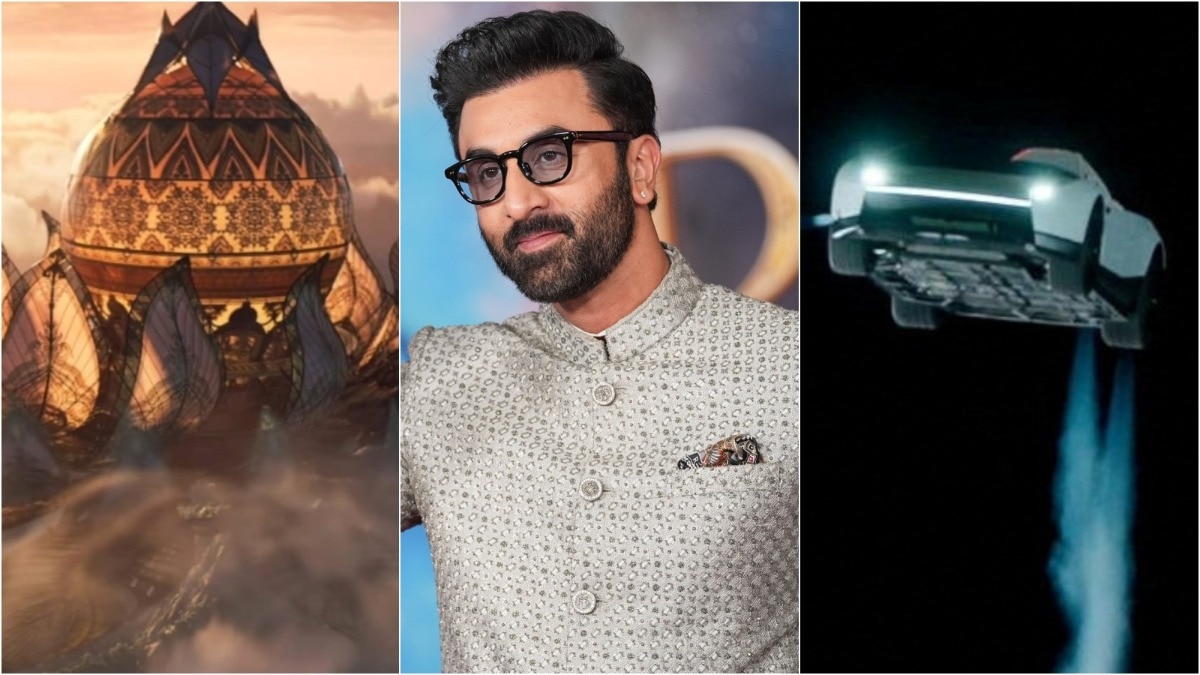
Elon Musk may be working on futuristic cars, but actor Ranbir Kapoor reckons India got there thousands of years ago. During a conversation about his upcoming film Ramayana, the actor compared the epic's mythical Pushpaka Vimana to Tesla's much-discussed Roadster, saying that the country had its own flying car 5,000 years ago.Ranbir made the remark during a special interview with TV presenter Suma on her show Chat Show, where he was joined by co-stars Ravi Dubey, Rakul Preet Singh and Yash, along with director Nitesh Tiwari. The conversation turned to the fantastical elements of the epic, including its weapons and flying chariot, and how the team had brought them to life for the big screen.The host pointed out that some of the weapons described in the Ramayana could rival modern inventions. She also praised the visual effects by Academy Award-winning studio DNEG, which is working on the film. Nitesh agreed that reimagining these elements for cinema was an exciting part of the process.Ranbir, who plays Lord Rama, then brought Elon Musk into the conversation with a cheeky observation. "Elon Musk recently invented a flying car. I think India did it 5,000 years ago!" he said, referring to the Pushpaka Vimana. Watch a clip from the interview here:Ranbir Kapoor On Elon Musk's Tesla Roadster I must also add that Elon Musk recently invented a flying car , i think India did it 5000 two days back , india did 5000 back #Ramayana https://t.co/s4kA8JwbNH— Filmy_Duniya (@ayaanpanda1) October 31, 2026During the same interview, director Nitesh Tiwari also revealed that it took around two years to build the Pushpak Vimana. He said, "It took us close to two years to arrive at the final design, and a lot changed along the way. That's why we took so much time to create the Ravana and Jatayu fight. When we were working on the earlier design of the Pushpaka Vimana, we'd imagined it would look a certain way, so the fight was choreographed accordingly. However, once we finalised a slightly different design for the Vimana, we had to go through several iterations to make it fit the existing choreography."The comparison comes as Tesla's next-generation Roadster has been back in the spotlight. Musk unveiled the long-delayed electric sports car at an event in Waco, Texas, on October 15, nearly a decade after first revealing the new version. During a demonstration at SpaceX's rocket development and testing facility, the car drove upside down along a large curved ramp, flipped in the air and landed safely. Musk's reaction after the demonstration was brief: "Well, it worked."However, anyone hoping to get behind the wheel will have to wait. Musk has said that the Roadster is expected to enter production in 2028. Tesla unveils its long-delayed Roadster nearly a decade after first revealing a next-generation version (Photo: Tesla/Handout via REUTERS) The Pushpak Vimana itself has quite a history in Hindu mythology. Described as a self-moving aerial chariot or flying palace, it was created by Vishwakarma, the celestial architect, for Lord Brahma. It was later given to Kubera, the god of wealth and Ravana's half-brother. Ravana eventually took possession of it after defeating Kubera.The Ramayana describes the vehicle as capable of travelling at the speed of thought and expanding to accommodate as many passengers as needed. The enormous flying structure also features in the film's trailer, offering a glimpse of the scale at which the makers are recreating the epic. A still of the Pushpak Vimana from Ramayana: Part 1 teaser Directed by Nitesh Tiwari, the two-part Ramayana stars Ranbir as Lord Rama, Sai Pallavi as Sita and Yash as Ravana. Sunny Deol plays Lord Hanuman, while Ravi Dubey takes on the role of Lakshman. The film is produced by Namit Malhotra and Yash, with AR Rahman and Hans Zimmer composing the music.The first instalment is scheduled to arrive in cinemas on November 5, 2026, during Diwali.- Ends
India had it 5000 years ago: Ranbir compares Pushpak Vimana to Tesla's new Roadster
Full Article
Original Source
Read the full article at Indiatoday →KhanList aggregates and links to publicly available news content. We do not host full articles from third-party sources. Always verify important information with original sources.