
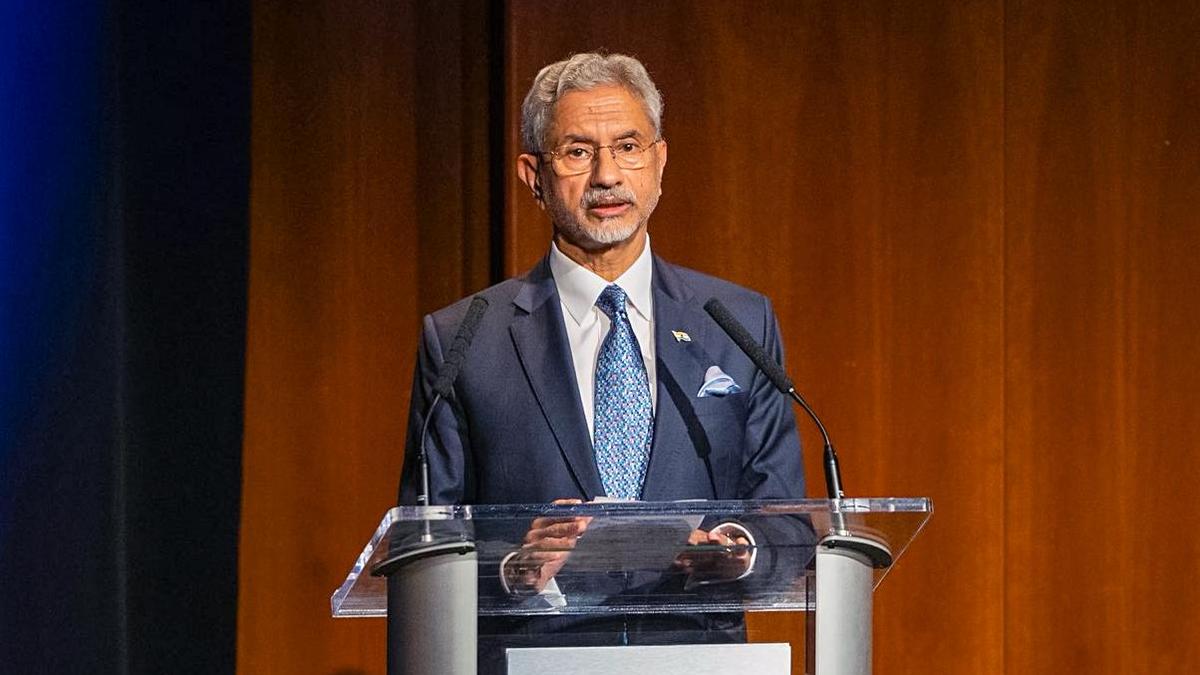
The ties between India and China are "better" today as compared to a couple of years ago, External Affairs Minister S. Jaishankar has said, underlining that as the border issues are resolved, the relationship returns to normalcy.Mr. Jaishankar was responding to a question on India-China relations, which have seen an upswing in recent times, including with President Xi Jinping's recent visit to India for the BRICS Leaders' Summit hosted by New Delhi."If you asked me, compared to where you were in 2025, is the relationship better today? I would say yes. Compared to 2024, even more so,” Mr. Jaishankar said during a conversation hosted at Asia Society on Monday (September 28, 2026).He said it’s not so much a “structural change”, but part of the reason why things have improved is “they had gone so much off-track that the moment you stabilised it, it was going to improve, because after what happened in 2020 and the long standoff that we had on the border, the relationship had really been impacted.”Following the 2020 border standoff between India and China, all “normal contacts" between the two nations had come to a halt, he said, adding that while “trade was continuing”, official exchanges, visa issuance, and flights had been impacted.“So once the border standoff was resolved, it was natural that this would start to improve,” he said.There was also this logic, which Delhi had long been conveying to Beijing, that a “standoff between us, a dip in our relationship, actually doesn't help either of us. In fact, it is third parties who will take advantage of that.“We also maintained consistently a very elementary principle of statecraft - don't get locked into a problem which benefits others,” Mr. Jaishankar said.“It took a little while for the Chinese side to agree with that, for whatever reason, but I don't think that long standoff served our interests. It certainly didn't serve theirs. And to the extent there is an improvement in our relations, I think it certainly helps our position, not only vis-à-vis China but vis-à-vis the rest of the world,” he said.“Because I don't want to get totally focused to my disadvantage on one particular relationship and issue. If I can find a solution which works for me, I would rather do that,” he said.“We came down to a very fundamental principle, which is that the state of the border determines the state of the relationship. You can't have tension on the border and say the relationship should be normal. So what we've had is, as the border comes back more towards normalcy, the relationship comes back more towards normalcy, and if the relationship comes back more towards normalcy, it helps both of us,” Mr. Jaishankar said.In his remarks to the audience, which comprised prominent members of the Indian-American community, Mr. Jaishankar said the world is moving “quite visibly” towards greater multipolarity.Listing his reasons for this argument, Mr. Jaishankar said that “in terms of the most powerful country in the world, which has been in many ways the ballast or really the shaper of the system as we know it currently, what we are seeing is really an erosion in alliances, a tendency to do it alone, and that has a huge impact on the thinking of the rest of the world.”Referring to the ‘G2’ summit meeting between U.S. President Donald Trump and Chinese President Xi Jinping last week in Washington, Jaishankar said that when the second most consequential or the weightiest economy joins the first, “while they may have their points of convergence, overall they are in a competitive mode.”“There are limits to what the two of them can agree upon vis-à-vis the rest of the world. And that then leaves the rest of us and the rest of us are coming to terms today with a very different America, with the fact that there is also today a certain conversation taking place between America and China,” he said adding that the rest of the world is busy making its arrangements.“Each one of us is looking for our optimal solutions. How do we de-risk? How do we diversify? Which are the new partners? Where do we get more value out of an existing partnership? We are really looking today at a difficult global situation. But as always, countries respond, they calculate, they adjust, they find new accommodations, they find new solutions, and that is how the international order develops, and it is that development today that I think the UN is a witness to,” he said.Mr. Jaishankar said that is, in many ways, reflected in the conversations and meetings that he, as well as other global leaders had during the just-concluded high-level UNGA week.
India-China ties ‘better’ than a couple of years ago: Jaishankar
Full Article
Original Source
Read the full article at Thehindu →KhanList aggregates and links to publicly available news content. We do not host full articles from third-party sources. Always verify important information with original sources.