
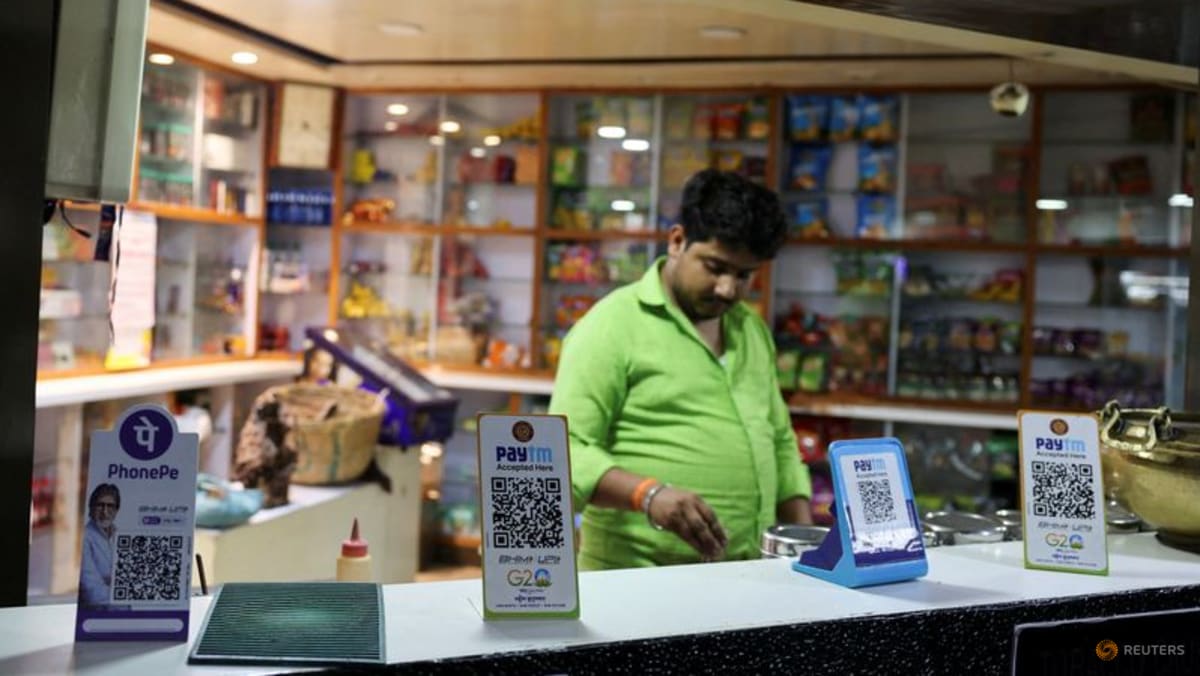
BENGALURU: A decade ago, most diners at Zachariah Jacob’s restaurants in Delhi settled their bills in cash. But today, reaching for a phone to scan a QR code and pay using the Unified Payments Interface (UPI) has become almost instinctive for his customers, he says.UPI is India’s real-time payment system that allows users to send and receive money instantly between bank accounts. Jacob estimates that about 60 per cent of payments across his three dine-in restaurants now come through UPI, with the rest split between credit or debit cards and cash.For Jacob, there is good reason to prefer it. When customers pay directly through UPI, the restaurant receives the full amount. A credit card payment, by comparison, can cost his business about 1.25 to 1.7 per cent in transaction fees, he tells CNA. Restaurateur Zachariah Jacob who operates the outlets under the Mahabelly brand. (Photo: Zachariah Jacob) But that advantage may no longer be guaranteed for every UPI payment.On Aug 10, the Indian parliament passed a bill paving the way for banks and payment companies to charge merchants a fee on UPI transactions above a yet-to-be-determined threshold, marking a shift from a zero-fee policy in place since 2020.The Ministry of Finance said the fee would be nominal and well below card fees. UPI has overtaken cash as the country’s preferred payment method, accounting for 57 per cent of user transactions, compared with 38 per cent for cash, according to a government study released in February.A 2025 International Monetary Fund report has called it the world’s largest real-time payment system by volume. The Indian government spent about 82.7 billion rupees (US$876 million) on UPI incentives over four financial years through March 2025 as it sought to encourage the adoption of digital payments. A man scans a QR code to pay after purchasing an electronic item at a wholesale market in New Delhi, India, Jan 31, 2025. (Photo: Reuters/Sahiba Chawdhary) But now, the prospect of fees has raised questions over who should bear the cost. Piyush Jhunjhunwala, founder and CEO of investment platform Stockify, said even a seemingly small charge can take a sizeable bite out of the earnings of businesses operating on thin margins.“If a merchant makes a 2 per cent margin and pays 0.5 per cent (as merchant charge), 25 per cent of his profit is gone,” he told CNA.THE IMPACT ON BUSINESSESAt Arif Hanfi's electronics stores in Maharashtra, customers buying expensive phones and other devices can pay by UPI, cards or bank transfers.With some transactions running into tens of thousands of rupees, UPI fees could add significant costs for businesses like his, said Hanfi. “The merchant will not pay from his pocket,” he added. Restaurant industry representatives said UPI charges could also squeeze restaurants, where transactions tend to be smaller but far more frequent. “UPI has become absolutely critical for the restaurant business,” said Zorawar Kalra, restaurateur and vice-president of the National Restaurant Association of India (NRAI).For restaurants, the absence of UPI transaction fees has been a “very meaningful cost advantage” over card payments, Kalra said. Zorawar Kalra, restaurateur and vice-president of the National Restaurant Association of India. (Photo: Zorawar Kalra) That advantage was deliberate.Launched in 2016 by the National Payments Corporation of India (NPCI), UPI carried merchant fees of up to 0.3 per cent per transaction until they were scrapped in January 2020 to promote digital payments, according to a report by India’s Ministry of Finance.The government also offered incentives to banks and payment companies for processing UPI merchant payments.Monthly transactions nearly quadrupled from 6.3 billion in July 2022 to 23.6 billion in July 2026, according to government data. A man uses his phone to scan a QR code of the digital payment app Paytm after purchasing a cold beverage at a shop in Kolkata, India on Jul 9, 2024. (Photo: Reuters/Sahiba Chawdhary) Ishan Sharma, head of growth at payments infrastructure provider Juspay, said: “I think the real growth of UPI was the enablement of the last mile - that was the real big win.” He said that banks, payment apps and other providers face growing costs to keep UPI reliable and combat fraud.“There is energy cost, server cost and a number of engineering talent required to build this stuff,” he said. That is increasingly the government's argument too. In August, the Ministry of Finance said UPI's rapid growth required continued upgrades in infrastructure, cybersecurity and fraud prevention, and that relying on subsidies alone was “not viable for the next wave of growth”.SMALL FEE, BIG DIFFERENCEFor restaurant owner Jacob, even a 0.5 per cent charge could make a huge difference to costs.Jacob estimated that UPI payments across his restaurants can reach 10 million rupees in some months. A 0.5 per cent merchant fee would cost the restaurant about 50,000 rupees a month. For a business that keeps only about 7 to 8 per cent of its revenue as profit, that cost becomes significant, he said. NRAI’s Kalra said a charge of around 0.1 to 0.2 per cent could potentially be absorbed by restaurants, particularly on larger value transactions.“But if the cost gets to 0.5 per cent or higher, I think many businesses would start questioning whether they can continue absorbing it,” he said.For businesses handling much larger payments, experts said the question is not just how much to charge, but whether UPI fees should be percentage-based at all. Harsh Bhudolia, co-founder of Takkada, a payments platform for distributors and wholesalers, said the technology costs for processing a 50,000-rupee UPI payment is broadly the same as a 500-rupee one, but a percentage-based fee would be 100 times higher. A QR code for Paytm is pictured at a groceries store in Mumbai on Nov 9, 2021. (Photo: AFP/Sujit Jaiswal) That is particularly relevant for distributors using Takkada, where individual payments can run into tens of thousands of rupees. For comparison, Bhudolia said distributors are already accustomed to paying a fixed fee of around 50 to 60 rupees for internet-banking transactions worth 20,000 to 50,000 rupees. Tanvi Kanchan, associate director at Indian financial services firm Anand Rathi Share and Stock Brokers, said the impact of UPI merchant charges would vary widely between businesses.A merchant selling expensive products could face a bigger fee on each payment, while for businesses handling large volumes, smaller charges can add up.But ultimately, she said, “margin determines whether a merchant can absorb the cost or has to pass it on”.That could leave businesses with high-value transactions but thin profit margins, such as fuel retailers, wholesalers and distributors, particularly exposed, she said. By contrast, she said businesses with greater pricing power or healthier profit margins may have more room to absorb a modest charge. For larger payments, however, the charge should be capped at a fixed amount, she said.Making a case for UPI charges, India’s Finance Minister Nirmala Sitharaman told parliament in August that other major fast-payment systems in Brazil, Indonesia, Singapore and Thailand also charge merchant fees. A woman pays using Pix, a free payment system, at a store in Rio de Janeiro, Thursday, April 16, 2026. (Photo: AP/Silvia Izquierdo) CONVENIENCE VS COST Jacob’s restaurant chain Mahabelly already absorbs the fees it pays when customers use credit cards, and he expects restaurants would initially have to treat a UPI charge much the same way. “The customer's expectation is that it is not their problem. It has to be absorbed by the business,” he said.“The only price that is actually in our control is our menu price,” Jacob said, adding that there is a limit to how much additional cost restaurants can recover.Store owner Hanfi sees more room to manoeuvre in his electronics business.If UPI charges apply only above a certain transaction threshold, that could also influence how transactions are structured, he said.“If merchants start charging customers for a large amount, customers can break up the amount across different payment modes,” Hanfi explained.Others could simply transfer the money directly to the retailer's bank account via internet banking, as some of his customers already do. Ishan Sharma, head of growth at payments infrastructure provider Juspay. (Photo: Ishan Sharma) Consumers prefer UPI for its convenience, said Sharma of Juspay.“What has made UPI the clear leader is the experience and the user adoption,” he said.In July, UPI accounted for 77.3 per cent of India's digital payments to merchants, up from 74.9 per cent a year earlier, according to a report by financial services firm Equirus Securities. Credit and debit card payments both lost market share over the same period. Once UPI transactions come with a significant fee, businesses will naturally start comparing the costs of different payment methods, experts said. “I wouldn’t want restaurants to be in a position where we have to tell a customer, ‘Please don’t pay by UPI’,” Kalra said. “That would be completely contrary to the incredible digital-payment ecosystem India has built.”“The objective should be to monetise the ecosystem intelligently without making the consumer or small business pay for its success,” Kalra said.
India built world’s largest real-time payment system. Now merchants fear being stuck with the bill
Full Article
Original Source
Read the full article at Channelnewsasia →KhanList aggregates and links to publicly available news content. We do not host full articles from third-party sources. Always verify important information with original sources.