
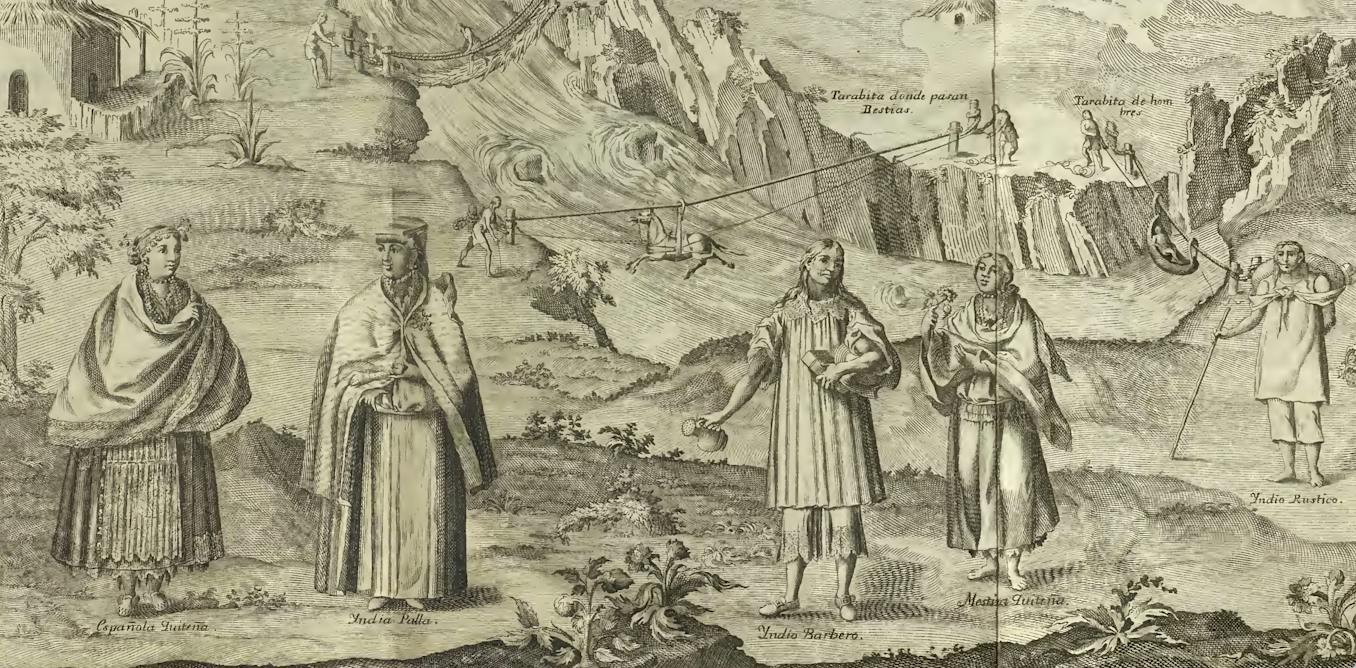
In May 2020, the murder of George Floyd by a police officer in Minneapolis set off a wave of massive protests that spread to Europe within weeks. Invited to comment on them, historian Michael Zeuske stated on German public radio that “Kant helped lay the foundations of European racism in his anthropological writings.” The remark sparked a debate in the German-language media. By the end of the year, the Berlin-Brandenburg Academy of Sciences and Humanities hosted a lecture series titled :“Kant, a Racist?” Immanuel Kant is one of the most widely taught thinkers in western moral philosophy, famous for the formulation of what he called the categorical imperative in 1785: “So act that you use humanity, whether in your own person or in the person of any other, always at the same time as an end, never merely as a means.” How could someone who set out such a demand have defended, at the very same time, a hierarchy among human races? The answer is less straightforward than it might appear. Behind the question “was Kant a racist?” lies another, more rarely asked: what principles guide our own reading of the racist prejudices of a classic author? The ‘Americans’ in Kant’s hierarchy In his texts, lectures and private notes, Kant affirmed the unity of the human species while distinguishing four “races,” identified by skin colour, to which he attributed unequal capacities. One feature sets his scheme apart: the Indigenous Peoples of the Americas, then called “Indians” or “Americans,” occupy the lowest rank, after the “Whites,” the “Hindus” and the “Blacks.” 1746 German map of the Americas by Homann Heirs. (Wikimedia Commons), CC BY-NC-ND In 1788, Kant explained this last rank through a hypothesis, with no empirical data and no claim to scientific status. As the ancestors of Indigenous Americans migrated from Africa through Asia to North and South America, passing through changing climates repeatedly interrupted and stalled the development of their natural dispositions. He concludes: “This race that is too weak for hard labour, too indifferent for industry and incapable of any culture — although there is enough of it as example and encouragement nearby — ranks still far below even the Negro, who stands on the lowest of all the other steps that we have named as differences of the races.” This hierarchy did not concern physical traits alone, but the complete development of the same initial dispositions. Kant saw human development as a gradual movement away from the natural condition, passing through four stages: discipline, culture, civilization and, finally, moralization. Every individual could, in principle, pass through all the stages, but environments had hereditary effects that stabilized different capacities among populations classified as races. The uneven development of these capacities across four stages could then be correlated with the differences among the four “races.” The Indigenous Peoples in the Americas would therefore have remained at the lowest level of development: able to discipline their natural instincts, but incapable of any culture — that first form of social life when talents, sciences, arts and moral discernment develop. How could Kant give the slightest credence to such a claim? To support it, he relied on Antonio de Ulloa, who had observed the inhabitants of the Americas. What Antonio de Ulloa really said Antonio de Ulloa (1716-1795) (Wikimedia Commons), CC BY-NC-ND De Ulloa travelled across South America for 11 years. On his return to Spain, he published a monumental account, the Relación histórica del viage a la América Meridional (1748). Translated into German in 1751 as A Voyage to South America, it became the primary source of information for all of Europe. The chapter on the “Indians” of the Quito region, descendants of the Incas, paints an unflattering portrait, quite close to what Kant would later say: lazy, slow, immoral, drunken, incapable of caring for their bodies and souls. But de Ulloa doesn’t present these as the fixed traits of a race. He describes them at that particular moment, and says he cannot understand their decline given the level of culture their ancestors achieved. What he describes is not an inherent incapacity for culture, but the historical destruction of a culture. The envoy of Spain did not speak publicly on the matter, but in a later 1826 analysis, de Ulloa openly blames colonialism for abuses against Indigenous Peoples, such as forced labour, land theft and oppression. He judges the opinion that Indians are lazy to be “entirely unfounded.” Kant could not have read this text — he died in 1804 — but the source he explicitly invokes already contains the elements of a counter-narrative: not a fixed racial incapacity, but a historical downgrading. I analyzed other discrepancies in a 2025 study (in French). Why does Kant say nothing of this? He may have read quickly or consciously set aside what contradicted his thesis. No single explanation is compelling; this is where the evidence ceases to permit a definitive answer, and forces us to question our own readings. How we read Kant matters Three readings dominate the discussion of the gap between Kant’s moral philosophy and his racism. The first, contextualist, sees in his racism the survival of attitudes common in Kant’s day, with no real connection to his philosophy. The second sees a head-on contradiction: Kant contradicts himself, but his moral philosophy remains intact. The third, internalist, argues that these prejudices are consistent with his entire system, and even that they reveal a dimension of it that had remained implicit. Each of these readings has its limits. The contextualist reading runs up against de Ulloa. The published texts Kant could have read already described a historical decline rather than an incapacity inscribed in “race.” The context was not unambiguous, and deciding what belongs to it is already a choice of reading. The contradiction reading identifies incompatibilities but does not try to explain them: it excludes them from what it takes to be Kant’s thought. The internalist reading links Kant’s inquiries into nature to the empirical conditions of morality. But to claim that the system “calls for” these prejudices, one has to fill in gaps in the text, sometimes against its letter, even though Kant himself calls his hypotheses a “fiction.” These readings diverge, but all assume a “proper” Kantian thought forming a coherent unity. This alone is an interpretive choice, rarely made explicit. Another approach is not to project a ready-made coherence onto a body of work. Statements written by the same author at roughly the same time do not necessarily belong to the same layer of thought. Following Fernand Braudel’s distinction between historical time scales, historians separate short-term events from the long-term structures and mindsets coexisting within the same period. Thought progresses and regresses Perhaps the same is true within a single period of an author’s thought. In Kant’s case, his critique of slavery and colonialism and his cosmopolitanism appear only in the 1790s, and yet his 1798 anthropology still maintains the link between physical constitution and moral character. An author’s thought can progress in one area and regress in another. None of this exonerates Kant: these statements are his own. But it prevents us from concluding in advance that they express the deep intention of his philosophy, or that they are merely a reflection of his time. The question therefore extends well beyond Kant. When we read statements from the past that we now judge untenable, both scientifically and morally, it’s not enough to document or condemn them. They force us to examine not just historical thinkers’ prejudices, but also the interpretive assumptions we use to frame their legacy.
‘Incapable of any culture’ — Kant’s racism and a forgotten source on Indigenous Peoples
Full Article
Original Source
Read the full article at Theconversation →KhanList aggregates and links to publicly available news content. We do not host full articles from third-party sources. Always verify important information with original sources.