
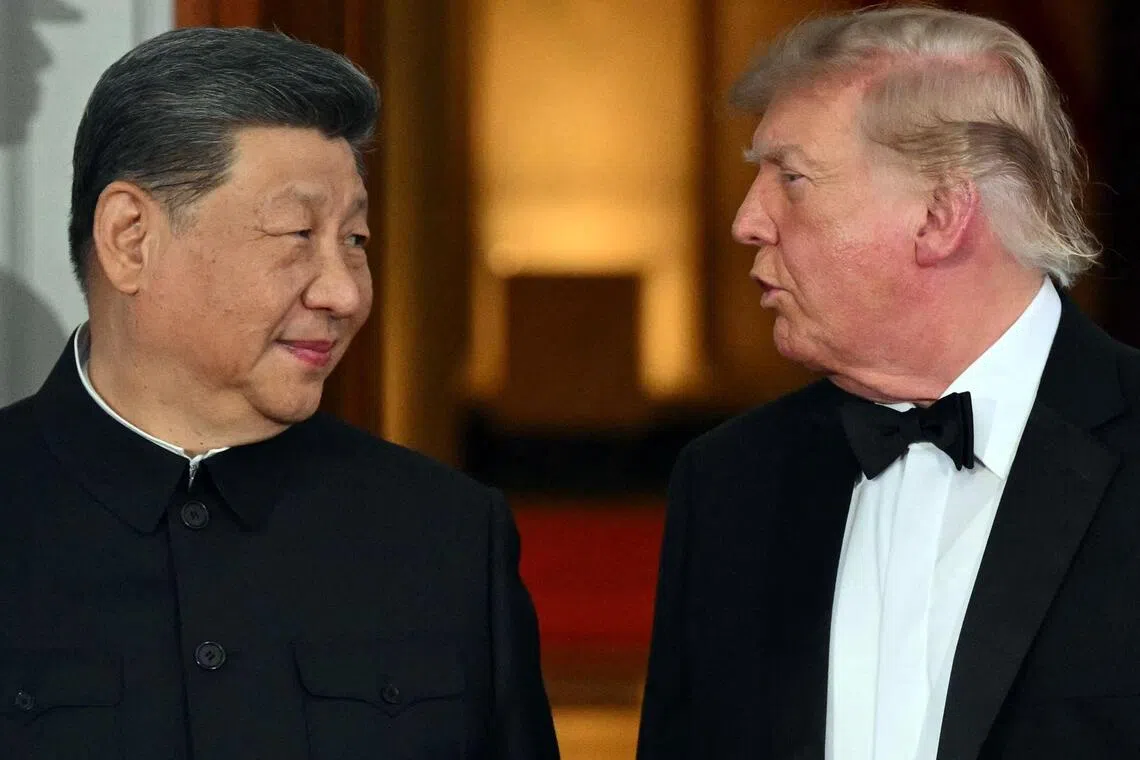
BEIJING – Consider the optics: The putative leader of the free world showing the foundational texts of American democracy to the world’s most powerful communist leader, beneath the marble dome of the National Archives in Washington.In an earlier era of US-China relations, such a setting might have invited the familiar ideological sparring: Washington invoking universal values and Beijing warning against interference in its internal affairs.But US President Donald Trump and Chinese President Xi Jinping would have none of that.On Sept 25, the last day of Xi’s state visit, Trump, at the National Archives, matter-of-factly contrasted America’s 250 years of independence with China’s 6,000 years of civilisation. Xi made a broader point: the two countries might have different histories, systems and development paths, but their peoples shared the same desire for a better life.Respecting those differences, Xi added, was the way to keep relations stable.That word – respect – was no throwaway.Just before visiting the National Archives, the two leaders had agreed to add it to their description of the bilateral relationship.US President Donald Trump and Chinese President Xi Jinping viewing the US Constitution during a tour of the National Archives alongside First Lady Melania and First Lady Peng Liyuan. PHOTO: AFPWhen Trump visited Beijing in May, the two leaders pledged to build a “constructive relationship of strategic stability” based on fairness and reciprocity. In Washington, they added “respect” to that foundation.That may sound like diplomatic wordsmithing. But for China, this was language that Xi had sought for more than a decade.In 2013, he proposed a “new model of major-country relations” with the US that called for non-confrontation, mutual respect and win-win cooperation.The Obama administration never fully embraced it, wary that “mutual respect” might oblige Washington to defer to Beijing on what China calls its “core interests”, including Taiwan. Trump has now agreed to put “respect” into the official formula for bilateral ties. That respect was visible from the moment Xi landed in the US.Before Xi emerged from his airplane at Joint Base Andrews on Sept 23, US service members got down on their hands and knees to smooth the red carpet.US military personnel got down on their knees to smooth the red carpet rolled out to welcome Chinese President Xi Jinping and his wife Peng Liyuan at Joint Base Andrews on Sept 23. PHOTO: AFPTrump and First Lady Melania then greeted Xi and his wife Peng Liyuan at the foot of the aircraft stairs – a rare tarmac welcome from a US President, who typically meets foreign leaders at the White House.The pageantry continued the next morning, with nearly 500 service members honouring Xi with drills and fanfare at the White House. Trump’s daughter, Ivanka, watched the welcome ceremony in a pale-blue dress with embroidery by Chinese designer Guo Pei.That night, the state dinner began with a toast featuring a California sparkling wine chosen to honour US President Richard Nixon’s 1972 “Toast to Peace” with Chinese Premier Zhou Enlai. Meanwhile, US tech titans including Tesla’s Elon Musk, Nvidia’s Jensen Huang and Apple’s Tim Cook joined Trump and Xi at the head table.US President Donald Trump’s daughter, Ivanka (2nd from left), was dressed in a pale-blue outfit by Chinese designer Guo Pei, during the welcome ceremony at the White House for Chinese President Xi Jinping. With her were (from left) US Secretary of State Marco Rubio, Second Lady Usha Vance and Vice-President JD Vance. PHOTO: AFPWhy did Trump lavish so much attention on Xi?Chinese analysts point to both the chemistry between the two men and a shift in the strategic arithmetic between their countries.Wu Xinbo, director of Fudan University’s Centre for American Studies, told The Straits Times that Trump is now dealing with a China that has proved much harder to squeeze than when he launched his trade war in 2018.“Trump has realised he needs to adjust the way he engages a China that is much more confident,” Wu said.Is the feeling mutual?Chinese President Xi Jinping during a state dinner in the East Room of the White House in Washington on Sept 24. PHOTO: BLOOMBERGAnd Xi returned Trump’s warmth. During a White House tour on Sept 24, he laughed heartily when Trump drew his attention to a framed image of an autopen, displayed in place of a portrait of his predecessor and political opponent, Joe Biden.Xi also dutifully followed Trump out of the building to admire the new granite helipad that the US President had rushed to finish before his visit.“Both leaders seem at ease and relaxed with each other. I think this shows there is some degree of trust between them,” said Da Wei, an international relations professor at Tsinghua University.With the November midterm elections approaching, Trump wanted to show voters that his handling of China could bring tangible economic benefits while avoiding tariff escalation that might aggravate cost-of-living pressures.US President Donald Trump and Chinese President Xi Jinping during a tour to see Marine One on the new helipad on the South Lawn of the White House on Sept 24. PHOTO: BLOOMBERGThe White House said the two sides agreed on recommendations for tariff relief covering US$30 billion (S$38 billion) of goods in each direction; China committed to buy at least 10 million tonnes of US coal annually in 2027 and 2028; and both sides opened channels for talks on investment and artificial-intelligence risks.Xi also brought softer offerings: an invitation for 100,000 young Americans to visit China over five years, and the imminent arrival of two giant pandas at Zoo Atlanta. None amounts to a strategic reset. But together, they reinforced Xi’s broader message: competition need not rule out peaceful coexistence.Some US analysts thought Trump should have pressed Xi harder to rein in Iran, ease pressure on US allies such as Japan and the Philippines, and loosen China’s rare-earth export controls. Chinese analysts, however, were broadly satisfied that Beijing got what it wanted.One was the chance to press Trump on Taiwan. Xi urged the US to “adhere to the correct position of opposing Taiwan independence” – possibly the first time he had publicly used that formulation, according to Eurasia Group’s Qiu Mingda.Washington says it “does not support” Taiwan independence and has not adopted Beijing’s stronger wording. But Xi had made his point: a Taiwan crisis could unravel the wider rapprochement.Another was that both leaders confirmed they would meet two more times before the year is out – at the APEC leaders’ meeting in Shenzhen in November and the G-20 summit in Miami in December.Throughout this trip, Xi received the show of respect that Beijing had long sought – in words and in spectacle.He was accorded two military flypasts: a pair of B-1B bombers over Joint Base Andrews on arrival, and then a B-2 stealth bomber flanked by four F-22 fighter jets over the White House the next morning.US President Donald Trump winced after a B-1 bomber flew past at Joint Base Andrews while Chinese President Xi Jinping watched impassively. PHOTO: AFPDuring the first flypast, the bombers’ sudden roar made Trump wince, while Xi watched them pass, impassively.A startle reflex proves nothing about national power. But the optics were hard to resist: With American might roaring overhead, Trump flinched; Xi unruffled – a fitting image of the confidence that the Chinese leader projected in Washington.
In Washington, Xi got the word he wanted
Full Article
Original Source
Read the full article at Straitstimes →KhanList aggregates and links to publicly available news content. We do not host full articles from third-party sources. Always verify important information with original sources.