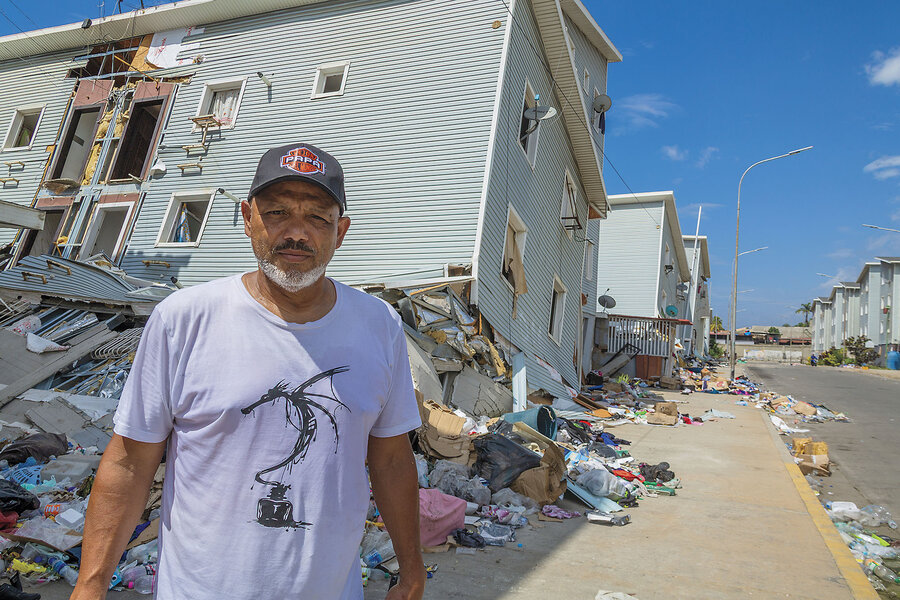
Urbanismo Hugo Chávez Frías was built as a promise.The public housing complex on Venezuela’s Caribbean coast carried the name of the late socialist president, who pledged to give poor and displaced families safe, dignified homes.For Luis Rodríguez, that promise became reality when he traded his modest, informally built house in the nearby city of Maiquetía for a new, state-built apartment near the water. Why We Wrote This The Misión Vivienda housing program pledged safe, dignified homes for the poor. Then they fell. “We were happy there,” he says. “It was a good area, calm. But then this happened.” On June 24, two powerful earthquakes struck Venezuela 39 seconds apart. The epicenter was over 100 miles away, but the worst damage was concentrated in La Guaira state, whereUrbanismo Hugo Chávez Frías sits along the coast. Inside Mr. Rodríguez’s apartment, the shaking felt endless. After nearly two terrifying minutes, the jerking stopped, but the first floor of his building had buckled. Mr. Rodríguez, his wife, and their children were trapped in a tangle of metal beneath the three floors above them. They escaped through a damaged corner of the building.“It was supposed to be earthquake-proof,” Mr. Rodríguez says. “But look at how earthquake-proof [these homes] are.”Across Urbanismo Hugo Chávez Frías, many homes failed in the same way. Four-story buildings appeared to have lost a floor: their upper levels still standing, but stacked on top of crushed ground-floor apartments.For three decades, the leaders of Venezuela have followed the political movement called chavismo, named, like the housing project, for former president Hugo Chávez. This philosophy aimed to create a new model of governance prioritizing the nation’s long-overlooked poor – and housing was a big part of that. Even after the 2013 death of the charismatic Mr. Chávez, and subsequent years of economic crisis and growing political repression, Venezuela’s public housing program remained a centerpiece of the movement. But after Venezuela’s 7.2 and 7.5 magnitude earthquakes, many residents say they can no longer trust the buildings, or the government that built them.“There’s a real sense of a broken pact,” says Alejandro Velasco, a historian at New York University who studies urban politics in Venezuela. “That if we support you, you support us. And here what we’re seeing is the rupture of that reciprocal promise.”“Constructed” riskExperts who are studying the damage say residents are right to demand answers. But they warn that the cause of each collapse can’t be determined from simply looking at the surface-level destruction. Rhonny Zamora/Special to The Christian Science Monitor At Urbanismo Hugo Chávez Frías, several four-story buildings were destroyed during the June 24, 2026, earthquakes in Venezuela. The complex was built as part of Misión Vivienda, one of the Chávez government’s flagship social programs. Venezuela’s northern coast lies in a seismic zone, where experts long warned a fatal earthquake was possible. Still, the June 24 quakes surprised many. Michael Schmitz, a renowned geologist and geophysicist who for decades worked at the state-run Funvisis, Venezuela’s seismological research foundation, says the vast devastation likely came from several factors including unusually strong shaking, local soil conditions, and building practices. The coast of La Guaira sits on deep layers of sediment. When seismic waves move from hard rock into those softer basins, Dr. Schmitz says, the shaking can grow stronger and shift in ways that are especially dangerous for mid-rise buildings.“Each building has its proper life,” he says. “We have to investigate the reason for each building that collapsed or that did not collapse.”But that kind of investigation is difficult to conduct in Venezuela, where basic information about structural integrity of government-built units has for decades been opaque. Years of economic crisis have weakened the institutions that would normally do that work. Dr. Schmitz, who was trained in Germany, says many technical staff left Venezuela or left Funvisis as the nation’s economic crisis worsened.“The salary didn’t even cover the bus tickets to go to work,” he says. About eight years ago he asked the government of then-President Nicolás Maduro for funding to carry out detailed seismic studies in La Guaira, Dr. Schmitz says. He never got it. If those studies had been carried out, they could potentially explain what happened on June 24 – and could guide any rebuilding, he says.Back at the destruction of Urbanismo Hugo Chávez Frías, there are twisted beams poking from what remains of Mr. Rodríguez’s home, which he describes as “sheet metal that just bent.” That same metal made escape harder, says Yoely Cabrera, another resident of the public housing complex. The walls were braced with diamond-shaped ties and crosses, leaving only small triangular openings. “After the first floor collapsed, residents had to squeeze through those gaps to get out,” she says. More than 3,000 families in the complex were affected by the quake, residents estimate, and most of the buildings were damaged, with some crushed, tilted, or sinking. “There was not really a consciousness that we need this really close supervision of governmental building programs,” Dr. Schmitz says.The complex used a lightweight construction system that, in theory, should have been suitable for a seismic area, says structural engineer Marianela Lafuente. But it performed badly: Many buildings failed at the first floor, a pattern engineers call a “soft-story” collapse.It is still too early to know whether the problem was the building system itself, poor adaptation to the site, construction errors, or a combination of factors, says Dr. Lafuente.But nature alone is not to blame for disasters of this scale. “Risk is constructed,” she says. “It is shaped by human decisions,” including where people build, how buildings are designed, whether rules are enforced, and whether institutions are strong enough to manage danger before it becomes a catastrophe.In Venezuela, she says, that’s part of the deeper problem. A lack of transparency “makes it very hard to investigate or hold the government accountable.”For many families in La Guaira, disaster has now come twice. In 1999, heavy rains triggered floods and landslides that destroyed thousands of homes. Some families who were relocated after that tragedy are now displaced again.The Venezuelan engineer who helped design the post-1999 reconstruction strategy, Carlos Genatios, says his team developed land-use plans for the state, identifying areas where homes should not be built. “No attention was paid to what we did,” Dr. Genatios says.At a recent press conference, acting President Delcy Rodríguez pushed back against criticism of government-built housing, saying most of the collapsed buildings were privately developed. But Dr. Genatios says safety standards should be enforced no matter who is doing the building.The disaster’s overall death toll has eclipsed 5,200 people and is expected to keep climbing.Losing lives – and trustUrbanismo Hugo Chávez Frías was part of Misión Vivienda, one of the most ambitious social programs of the Chávez era. Venezuela long struggled with housing shortages, but Misión Vivienda, which was created at a time of unprecedented oil wealth, promised to move poor Venezuelans into quality homes. The government says it’s delivered more than 5 million homes nationwide, though independent analysts question those figures.In 2011, officials announced it would build Urbanismo Hugo Chávez Frías in just 10 months. The following year, during a televised inspection, Mr. Chávez celebrated his administration’s speed.“Those who have eyes, let them see,” he said. “See how, in revolution, things change quickly.” Rhonny Zamora/Special to The Christian Science Monitor Ketty Ladera stands outside the tower built by Misión Vivienda, where several members of her family perished in Venezuela’s earthquakes. The project was meant to include more than 2,300 homes across 37 hectares, according to government figures at the time. It was built by Summa, a large Turkish construction company, using prefabricated homes made with light galvanized steel frames – a system the Housing Ministry described as technology that could modernize construction in Venezuela, and allow the complex to be finished rapidly. Summa did not respond to the Christian Science Monitor’s requests for comment. In Caraballeda, another Misión Vivienda development known as OPPPE experienced severe damage. Unlike the low-rise, prefabricated buildings at Urbanismo Hugo Chávez Frías, OPPPE was made up of massive concrete towers. Some 16 of those entirely collapsed in the quakes and another 27 towers need to be demolished. OPPPE resident Ketty Ladera says she believes the buildings were rushed to completion to fulfill political promises ahead of an important presidential election in 2012. There wasn’t enough attention to safety, she says. She lost her two daughters, two grandchildren, son-in-law, and the father of her youngest child when their tower fell in the quakes.Misión Vivienda was never only about housing, says Dr. Velasco, the historian. It was also about political legitimacy, allowing the government to claim it was solving a historic housing problem for poor Venezuelans, the party’s base.Under Nicolás Maduro, Mr. Chávez’s handpicked successor, the distribution of apartments became more explicitly political, Dr. Velasco says. Housing often went to loyalists, or to people the government hoped would become loyal.That is why the destruction at Urbanismo Hugo Chávez Frías carries such symbolic weight: For residents, it’s not just whether buildings can be rebuilt, it’s whether Venezuelans can ever again trust the very state that built them.In a video that went viral after the quakes, a resident named Damelis Díaz confronted Nicolás Maduro Guerra, the son of Nicolás Maduro, who was ousted by the United States government on Jan. 3. The younger Maduro was visiting the damaged housing complex when Ms. Díaz shouted that government officials should go to prison.“I didn’t lose a kitchen,” she yelled. “I lost my daughter.”
In Venezuela, trust crumbled with the buildings
Full Article
Original Source
Read the full article at Csmonitor →KhanList aggregates and links to publicly available news content. We do not host full articles from third-party sources. Always verify important information with original sources.