
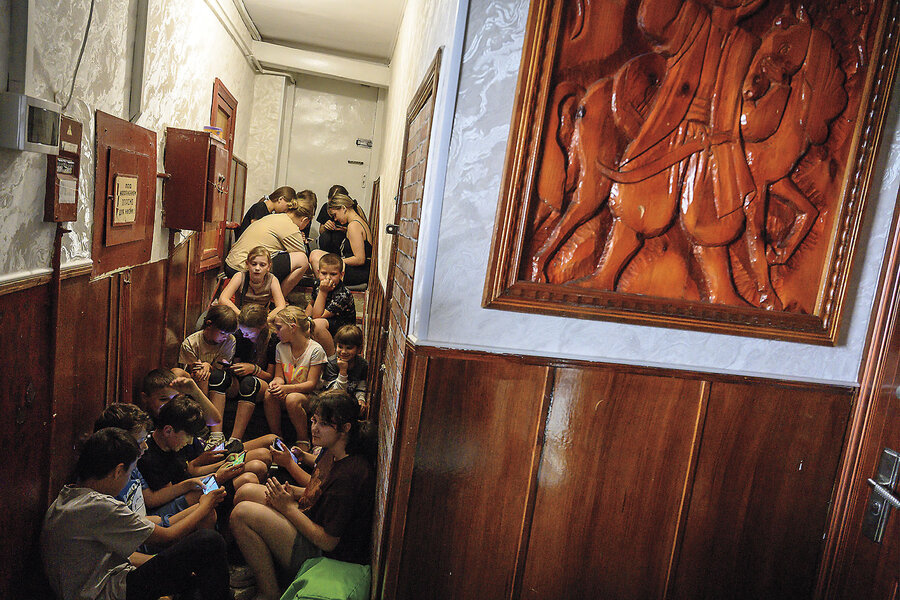
Izium, Vinnytsia, and Kamianske, Ukraine | Oct. 07, 2026, 4:35 p.m. ET | 8 min read As the air alarm sounds over Izium, the children drop their drawing pens, tubes of glue, and felt-cutting scissors in unison and make for the door.With familiar urgency, they race to a nearby stairwell in the Soviet-era community center. The day before, air alerts sent the group to this musty-smelling alcove four times in three hours. On this morning, seated hip to hip on the wooden steps, they loudly play games, talk, and joke together, as if still at their craft tables.As Russia’s all-out invasion of Ukraine intensifies in its fifth year, war is no longer a temporary emergency here. It is the stuff of an entire country’s everyday life. And for many children, that life is the only one they’ve ever known. Children here “know they must not stand in front of the windows, and they need to hide,” says Olesia Biliaha, the main instructor at the community center’s charity arts, dance, and computer program. Scott Peterson/Getty Images/The Christian Science MonitorUkrainian Emergency Service workers clear rubble from the Izium Comprehensive School No. 12 in Izium, Ukraine, Sept. 26, 2022. For this generation, the toll of this war can be tallied in empty playgrounds, lost school years, and loved ones they will never see again. It is 2.6 million displaced children and 1 million textbooks destroyed by Russian bombs.Barely 20 miles from the front line in eastern Ukraine, Izium is a parable of what the war has taken. School is entirely online. Anti-drone netting is draped over streets where children once roamed freely.Yet even here, in the heart of Europe’s deadliest conflict since World War II, kids express particular resilience. As sirens wail, on the steps inside, Anzhela wraps her arms supportively around the shoulders of her 7-year-old friend, Mira. “Children cope,” says Ms. Biliaha. “They adapt.”To explore how Ukraine’s children are adapting, the Monitor revisited three locations where families are living with the reality that Russia’s war against Ukraine is unlikely to end anytime soon. Scott Peterson/Getty Images/The Christian Science MonitorUkrainian choreographer and instructor Olesia Biliaha encourages children taking part in a race with blocks onstage, during an arts, dance, and computer learning program supporting children in front-line communities. Education under fireMany of the children in the stairwell were only toddlers when Russian troops occupied Izium for six months beginning in April 2022. The Russians turned schools into fighting positions and surgical stations, and carted in boxes of Russian toys and notebooks as part of a plan to replace the Ukrainian school curriculum with a pro-Russia one.Instead, a Ukrainian counteroffensive drove the occupiers out. But the city – and its people – were battered. When the program for kids at the community center began, the building’s broken windows were still boarded up, and flashlights were used to light the rooms.The children had “no socializing experience, no kindergarten,” remembers Inna Honcharova, the program director. During the occupation, families in Izium frequently lived without electricity, gas, heat, and water, and most kept their kids off the street, fearful of the Russian military presence.Their experience is not exceptional. According to UNICEF, some 40% of children ages 3 to 6 in Ukraine do not attend preschool, up from 15% before the war, cutting them off from their peers at a moment when play is essential for social and emotional growth. Social and academic losses also upend the lives of older children. Air raids force Ukrainian children to miss an average of 20% of their classes. To sidestep the problem, 1 in 3 kids now go to school completely or partially online, and some front-line cities have resorted to building schools in underground bunkers. But it is not enough. As of 2025, Ukraine’s children were an average of two years behind in reading and one year behind in math. Scott Peterson/Getty Images/The Christian Science MonitorUkrainian children take part in a charity arts, dance, and computer program under the guidance of instructor Olesia Biliaha in Izium, 20 miles from Ukraine’s eastern front line. In Izium, in-person school is out of the question: The threat of Russian attacks is so ever-present that the local school system is now constructing its first totally underground school.In this context, the community center provides an oasis. In this program, which is primarily sponsored by the Howard G. Buffett Foundation, children bead and sculpt with Plasticine. There are dance classes, and time set aside simply for mental relaxation, where children sit on mats provided by a group of Ukrainians living in Los Angeles, and do nothing at all.The kids “have the ability here to talk to each other, to be with each other, and it’s very important to them,” says Ms. Biliaha, the choreographer and teacher. About 55 of these charity arts programs exist across Ukraine to support communities near front lines, says Ms. Honcharova.“Now you see how drastic the change is,” she says, of the children’s social progress. “The change is great.”Yet just a day after the Monitor visited in late July, two Russian aerial bombs that landed on a kindergarten in a nearby district prompted the center to close its doors for two weeks, according to Ms. Biliaha. Then a bomb struck 500 yards from the building, and then another just 200 yards away. Now the closure, like Russia’s war against Ukraine itself, has become indefinite. Scott Peterson/Getty Images/The Christian Science MonitorYulianna Palahniuk was only 6 years old when she lost her father, 1st Lt. Oleksandr Palahniuk, in the early days of Russia’s invasion of Ukraine. The weight of memoryUkraine’s children have not only lost years of their education to Russian bombs. One in 5 children in the country – more than a million total – have lost a relative or friend, according to UNICEF.On Yulianna Palahniuk’s sixth birthday, in May 2022, she waited eagerly for a call from her dad, Oleksandr. He had recently deployed as an airborne assault soldier on the front line in the country’s northeast, but the two spoke regularly by phone. When the call didn’t come, Yulianna asked her mother, Zhanna, why.“[Your] father is already an angel,” Zhanna explained.In an instant, what was left of Yulianna’s peacetime childhood evaporated. As Russian bombs continued to fall, her feelings became explosive, too. “She had problems in school, a very hot temper, and when she came home, she was already charged with that energy,” says Mrs. Palahniuk.She was not alone in bearing such feelings. The mental health of Ukraine’s children has been severely shaken by the war. One study found that 32% of teenagers show signs of moderate or severe depression, while an estimate from the Ukrainian mental health nonprofit Voices for Children says that 1 in 2 children in the country have symptoms of anxiety. Scott Peterson/Getty Images/The Christian Science MonitorFour years later, Yulianna Palahniuk and her mother, Zhanna, are still making sense of their lives without 1st Lt. Oleksandr Palahniuk. For years after her father’s death, Yulianna continued to dream of him coming home, “and she was devastated by that,” Zhanna recalls. The girl’s nails were ragged from biting, and Zhanna struggled to balance her daughter’s grief alongside her own. She had a recurring fear that they would be separated during a Russian strike, and “I will not be on time to find her.”As the death toll from the war grows, programs for Ukrainians traumatized by war and grieving loved ones are becoming increasingly common. Last spring, Yulianna and Zhanna participated in a two-week rehabilitation session with 20 other families in Lithuania called “Children of Heroes”. There, mother and daughter wept and composed letters to each other. “I hope that you will become normal,” Yulianna wrote in hers.“We both learned there are ways to talk to each other,” says Mrs. Palahniuk. Within months, she also began dating a devoted Christian named Zhenya. Tentatively, Yulianna began to make space for a new father figure in her heart, too, adding Zhenya to her bedtime prayers. With him around, “the negative energy in our home disappeared,” Mrs. Palahniuk says. Scott Peterson/Getty Images/The Christian Science MonitorZhanna Palahniuk, widow of 1st Lt. Oleksandr Palahniuk, and Mykhailo Palahniuk, father of the airborne officer, visit the veteran soldier's grave in his home village of Pokutyne, south of Vinnytsia, in July 2026. Scott Peterson/Getty Images/The Christian Science Monitor Family photos sit alongside medals and military certificates in Lieutenant Palahniuk’s former bedroom. But her papa, Sasha, as Oleksandr was known, remains present in Yulianna and her mother’s life. In his home village, two hours’ drive south of Vinnytsia, the family has turned his former room into a shrine, with pictures, certificates, and medals. Sometimes Yulianna and her mother lay flowers on her father’s grave up the road from the house, a granite memorial etched with images of him.At age 10, Yulianna is round-faced and a head taller than most of her peers. But sometimes, in her mind, she is still the little girl her father once pulled out of kindergarten for a secret visit to his military base. His fellow soldiers fawned over the freckled 5-year-old. That was half her life ago, but the emotional charge of that day has never dulled.“I felt like a queen!” she says.A home that no longer existsSerhii Yeroshenko will never have any memories of the place he comes from. He was just 2 ½ years old in 2024 when his family fled their spacious apartment in the southeastern coal-mining town of Myrnohrad, as a Russian ground advance crept within three miles of their home.At the time, his mother, Irina Yeroshenko, was a coordinator for volunteer evacuation and rescue teams for Caritas and Search Donbas, helping many children and their families escape from the advancing front. The work helped relieve her own depression at the situation and gave her insight into the risks of staying in place for too long as danger closed in. Scott Peterson/Getty Images/The Christian Science MonitorSerhii and his mother, Irina Yeroshenko, play on the grounds of a church in Kamianske, during a program run by the charity Caritas-Spes for children displaced from Ukraine’s eastern front line, July 21, 2026. With the Russians taking village after village close to Myrnohrad, Serhii’s older sister, Kamila Voytenko, then age 17, watched her friends and classmates flee, one by one. Meanwhile, Russian bombardments increased by the day – along with the family’s stress levels. “You ... realize you enter this beautiful period of teenage life, and you have no idea if you will see [friends] again,” Ms. Voytenko says.Today, more than a third of Ukrainian children – about 2.6 million – live in exile. Some 800,000, like Serhii, are displaced within the country. The rest are refugees, mostly in nearby countries in Europe. As Russian troops closed in, Irina, Serhii, and Kamila finally left Myrnohrad, settling 150 miles west in the city of Kamianske.Although Serhii understood little of what was happening, he was visibly unmoored. Irina says he “started to panic and to cry a lot” each time she tried to carry him inside their tiny new one-bedroom apartment. That first day, they bought candies and sat on a bench outside, trying to talk to Serhii, who refused their efforts to soothe. They had to stay on the street until 11 p.m., when he finally fell asleep and could be carried inside. Scott Peterson/Getty Images/The Christian Science MonitorSerhii Yeroshenko (from left), along with his mother, Irina Yeroshenko, and older sister, Kamila Voytenko, fled Myrnohrad in mid-2024 as Russian troops advanced. At nursery school, meanwhile, he barely spoke or interacted with the other children. Mrs. Yeroshenko says she began to see that even though Serhii was very young, “all of those explosions, all of those things we went through together that I thought did not influence him” in Myrnohrad were having a profound effect.Then, tentatively, Serhii began molding himself into his new life. Now age 4, he goes to kindergarten and to the children’s program run by the Catholic charity Caritas-Spes. In these moments, as he plays hide-and-seek with friends in a church courtyard and bobs for plastic fish in a bucket with a toy rod, his life looks like it might have before the war. Deepen your worldviewwith Monitor Highlights.Politics with respectGet political stories with respectful analysis.There‘s a world of new ideas in everyBooks newsletter.There‘s more to life, enrich yours withCulture & Learning weekly.Follow humanity‘s discoveries withScience & Nature stories in your inbox.Gain a spiritual perspectivefrom the stories in your inbox.Want to understand the deeper impact of critical events? Learn the Monitor‘s insight.Already a subscriber? Log in to hide ads. But watching him, Irina mourns the home Serhii will never see. “What hurts now is we are left without our city,” she says. “I won’t be able to take Serhii to some street and say, ‘This is the place where I met your father.’ ... It just doesn’t exist anymore.”Oleksandr Naselenko supported reporting for this story. ALREADY A SUBSCRIBER? LoginReal news can be honest, hopeful, credible, constructive.The Christian Science Monitor was founded in 1908 to lift the standard of journalism and uplift humanity. We aim to “speak the truth in love.” Our goal is not to tell you what to think, but to give you the essential knowledge and understanding to come to your own intelligent conclusions. Join us in this mission by subscribing.
In Ukraine, holding on to childhood in a time of war
Full Article
Original Source
Read the full article at Csmonitor →KhanList aggregates and links to publicly available news content. We do not host full articles from third-party sources. Always verify important information with original sources.