
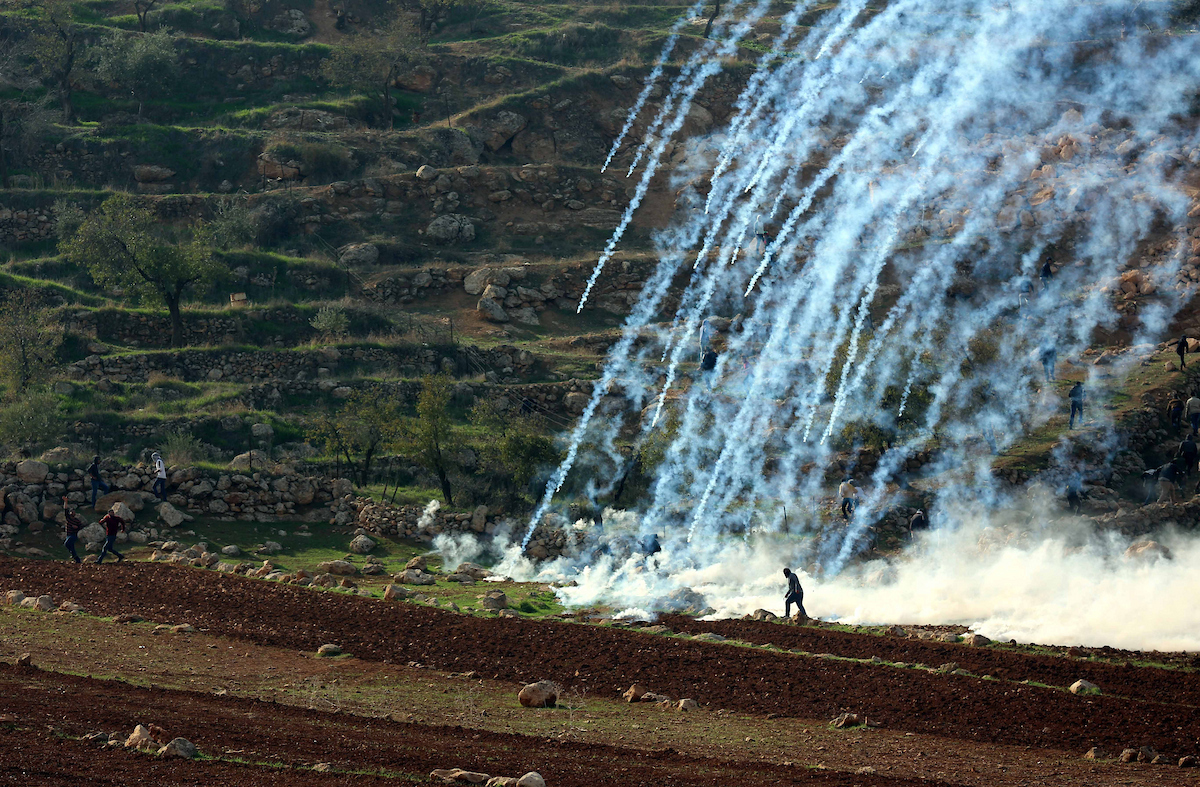
“Almost every day.” That’s how often Youssef Ziad Abu Alia, an 11th-grade student at al-Mughayyir Boys’ School, northeast of Ramallah, said Israeli forces have fired tear gas on his way to school since September. One morning, the intensity of the gas forced him to turn back halfway. The problems start long before reaching the classroom: on the road, at checkpoints, and around the school, where Israeli raids, tear gas, and settler attacks have hindered students and teachers from attending school in the village of al-Mughayyir. Between January and early September 2026, the UN Office for the Coordination of Humanitarian Affairs (OCHA) documented more than 56 settler attacks in al-Mughayyir that caused Palestinian casualties or property damage, averaging around seven attacks per month, more than double the monthly average of the previous three years. The attacks can be deadly. Five students from al-Mughayyir Boys’ School have been killed in 2026: Hamdan Mousa Abu Alia, Mohammed Saad al-Na’san, Aws Hamdi al-Na’san, Omar Mohammed al-Na’san, and Khalil Rasem Abu Alia. Two of these children were killed by Israeli forces on 2 September, as reported by OCHA. A sixth student, Fadi Hamdallah al-Na’san, died on July 18 from wounds he sustained from Israeli fire during a settler attack. On November 15, soldiers fired tear gas into the schoolyard while students and teachers were inside, headmaster Bassam Abu Assaf told Mondoweiss. The headmaster has also been targeted by the occupation in the past. Israeli forces detained Abu Assaf and abused him at a checkpoint near the village’s western entrance on September 30, 2025, according to WAFA. The disruption affects teachers as well as students. Restrictions on movement keep teachers who live outside the village from reaching the school. Some are turned back, especially at the checkpoint at the entrance to Turmus Ayya, where teachers coming from the northern region of the West Bank are routinely stopped. “The morning shift teachers, instead of coming early to the school and trying to help us keep order and stand at the morning assembly and so on, sometimes arrive late, and other times they are completely prevented from entering the school,” Abu Assaf said. On one day, seven of the school’s roughly 30 teachers could not get to work on time, which resulted in canceled classes and a disruption to the entire school’s timetable. The school has since struggled to recruit teachers from outside the village, and some staff members have requested workplace transfers due to the dangerous conditions. Since September 6, the school has run an emergency timetable of five classes per day, so that teachers from outside al-Mughayyir can leave before the roads close. At least four times this year, the school was forced to close and request that students stay home due to Israeli army raids. Earlier this month, on November 4, several students suffered tear gas suffocation when Israeli forces fired canisters toward a school in al-Mughayyir and detained a teacher, the Palestinian news agency WAFA reported. “For the students’ safety, we have had to stop them from going to school and close the school,” Abu Assaf said. “We don’t let them go to school, for fear that, God forbid, we lose some students or they get hurt or injured, especially from the gas.” Abu Assaf estimates that around half of the total lessons have been canceled, leaving parts of the curriculum untaught. A wider pattern On September 2, Israeli forces killed two children in al-Mughayyir, according to OCHA, amid a surge in settler attacks on the village. The attacks have injured residents, damaged property, and blocked movement through the village’s only open entrance. The pressure reaches schools across the West Bank. The Education Cluster, a humanitarian coordination group co-led by UNICEF and Save the Children, documented 174 education-related incidents affecting 140 schools and about 24,500 students between September 1 and October 20, 2026. Students lost more than 875 school hours, compared with about 174 in the same period of 2025. Israeli checkpoints stop or delay teachers most mornings, so the first class of the day is often lost, said Sadiq al-Khudour, spokesperson for the Palestinian Ministry of Education. “This can be measured quantitatively. But there are aspects that, unfortunately, cannot be measured, if we talk about students’ distraction, their ability to concentrate, the psychological side,” he said. Al-Mughayyir Boys’ School has joined the ministry’s support teaching program, al-Khudour said, which hires teachers from inside the village or nearby so that classes do not depend on teachers crossing checkpoints. Grades one to four now run five days a week, and the school plans to extend the arrangement to grades five to nine. The program started in early October, and the ministry is still evaluating its efficacy. The ministry follows the school daily, al-Khudour said, and has raised this case to the Palestinian Foreign Ministry, diplomats, and human rights bodies, in addition to inviting international partners, such as UNICEF, to visit. Despite the school’s best efforts to continue educating the students of al-Mughayyir, interim support teachers cannot get the original teachers through the checkpoint, and a shorter timetable cannot make up for the lost lessons. One eye on the window Sabreen Abu Na’im, whose younger son, Muataz, is in his final year at the school, was told by the teachers that students often stop following the lesson and look out of the windows instead, watching for Israeli soldiers, military jeeps, and settlers. For mothers in al-Mughayyir, every school day begins with an eye on the roads and a scroll through WhatsApp groups to work out whether it is safe to send their children to school. The boys’ school has about 500 students, from first grade to the final year of secondary school, so every raid or closure affects hundreds of families. The fear continues after the school day ends. Night raids leave children afraid that soldiers will storm their homes, Abu Na’im said, which affects their sleep, their concentration, and their grades. Some children act out clashes in their games, throwing stones at each other. Families try to make up for lost classes with private tutors from outside the village, but the same checkpoints and settlers keep them out. “For the final secondary exams, Tawjihi, teachers come from outside the village to teach mathematics and English language classes. But most days the teachers can’t enter due to checkpoints or the presence of settlers in Marj Sia,” Abu Na’im said. During a raid last year, soldiers stopped and photographed 13 students at the school entrance, she said, her son Muataz was one of them. Eleven were arrested, including him, and he spent six months in prison. He returned to school after being released, despite being ill. Her older son, Saif, was arrested while in 11th grade and spent about two years in administrative detention, Israel’s system of holding people without charge or trial. He was released in May 2026, after registration for the final exams had closed, and is now preparing to sit for the exams as a private candidate. Fadi al-Na’san, who was killed in July of this year, was Muataz’s friend and classmate. He would have sat the final exams alongside his classmates this year. Instead, they adorn his desk with photos, flags, and flowers. Throughout the arrests, injuries, and losses, families in al-Mughayyir continue sending their children to school. “You know, we love life, if we can find a way to it,” Abu Na’im said, echoing a line by the Palestinian poet Mahmoud Darwish. This story was produced in collaboration with Egab.
In this West Bank village, the road to school runs through Israeli tear gas
Full Article
Original Source
Read the full article at Mondoweiss →KhanList aggregates and links to publicly available news content. We do not host full articles from third-party sources. Always verify important information with original sources.