
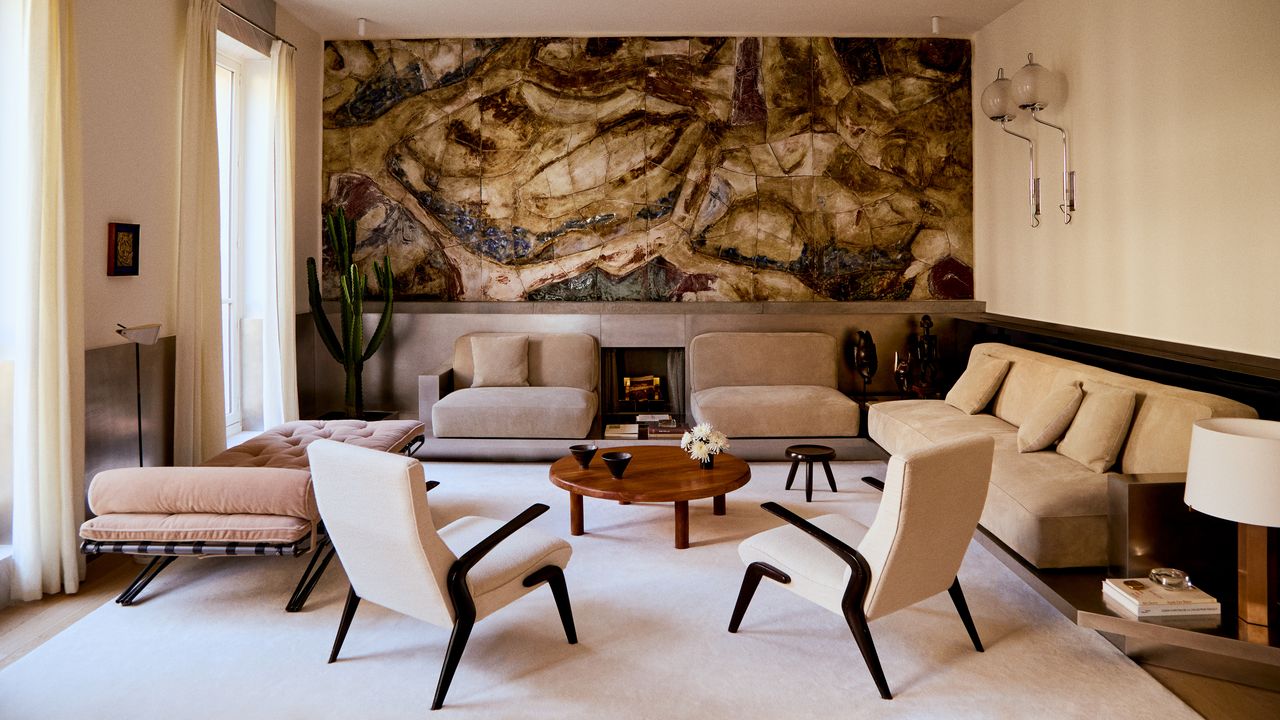
Giampiero Tagliaferri was at home in Los Angeles reading Françoise Sagan’s 1965 novel La Chamade (published in English with the title That Mad Ache) when the topic of his American client’s new Paris pied-à-terre first came up. Since the book takes place largely in Paris, he couldn’t shake the idea of using the novel’s world as inspiration for the new interior design project. “The book describes nights in Paris and the decadence of moving from one apartment to the next,” explains Tagliaferri. “There’s a passage where the protagonist says how much she loves the silence, the warmth, and the freedom of the night. That initial thought was the catalyst for all the other ideas about what this apartment should look like.”Tagliaferri first discovered Angelo Mangiarotti’s space-age Chicago chairs at a retrospective of the designer’s work at the Triennale di Milano. The dining table by Carlo Scarpa is also vintage. The art is ST, série Oblicollor (1984) by Jean Degottex, from Mennour gallery. Billal TarightBohemian life meets 1970s styleWhen Tagliaferri and his young client first stepped into the apartment—located in the Triangle d’Or among the grand boulevards of the 8th arrondissement—it was move-in ready. What it lacked, however, was character. “Unfortunately, many of the original historic elements had been removed over the years. There were no Haussmann-style details like decorative moldings or arches,” recalls the designer. “For us, it was out of the question to artificially recreate these elements. Instead, we took advantage of the stripped-down shell and treated it like a blank canvas, infusing it with characteristics from various eras.” Tagliaferri turned to the 1970s to give the Paris pied-à-terre character without creating a time capsule. Despite numerous references to bygone eras, the interior succeeds in being very much contemporary while also very Parisian.The young client comes from a hospitality dynasty, and the pied-à-terre in Paris was designed to be a place for entertaining. “Perhaps even the final stop of a long night,” Tagliaferri muses. “A place where everyone returns to and stays up until the next morning.” He was also drawn to the idea of a French salon, an homage to Paris’s bohemian culture.A salon for night owlsTo evoke this feeling, Giampiero Tagliaferri immersed himself once again in the world of Lucile, the protagonist of La Chamade, imagining Yves Saint Laurent and his muse and model Betty Catroux in the 1960s returning home after a long night out. “I used materials that date back to that era,” he says, noting that the sofas are upholstered in light suede, while lacquer surfaces and the stainless-steel paneling that wraps around the entire living room create tension and contrast. A more traditional element is the light-colored natural stone typical of Paris, which Tagliaferri used for the floors.The sculpture Angel (2026), by Vanessa Beecroft, keeps an eye on the bathroom. Tagliaferri had the marble vanity custom-made. Billal TarightIn the bathroom, he added accents of Cipollino marble. “An elegant apartment doesn’t have to be austere or formal,” he insists. Relaxed moments are a central aspect of Tagliaferri’s design aesthetic, which is shaped by a California mindset.Tagliaferri transformed the bedroom into a sensual cocoon. The wall sconce was designed by Gabriella Crespi. Art advisor Truls Blaasmo found the torso at Galerie Chenel in Paris. Billal TarightThe bedroom is the aesthetic highlight of the apartment. The room’s rounded corners envelop guests like a cocoon. The upper part of the room is lined with cream-colored suede, and the bed stands on a dark-brown lacquer platform that, like the wall paneling, contrasts with the velvety ceiling. “The bed is upholstered in leather,” says Tagliaferri. “We’ve gone all out here to create a sensual, hedonistic space where anything goes.”The 1913 artwork by Giacomo Balla in the hallway came from Tornabuoni Art. Billal TarightNext to the daybed by Osvaldo Borsani for Tecno stands a side table by Max Zinser. Billal TarightThe past meets the presentIn addition to numerous built-in pieces and custom-made items, Tagliaferri acquired a carefully curated selection of vintage furniture for the apartment: a daybed and armchair by Osvaldo Borsani stand next to a table by Pierre Chapo. A wall sconce designed by Gabriella Crespi hangs above the bed. “I’m particularly fascinated by the Chicago chairs by Angelo Mangiarotti,” says Tagliaferri.Marcel Duchamp’s L.H.O.O.Q. Rasée (1965) came from Larkin Erdmann Gallery. The armchair is by Osvaldo Borsani. Billal TarightWhen it came to selecting art, he brought Milan-based art advisor Truls Blaasmo on board. Originally from Norway, Blaasmo curated a collection that unites ancient, modern, and contemporary elements: In the bedroom, a photograph by Wolfgang Tillmans hangs opposite a Roman torso of Dionysus. Setting the mood, Marcel Duchamp’s work L.H.O.O.Q. Rasée, and a late work by Man Ray, evoke 20th-century Paris.In the living room, Tagliaferri, who is an art collector himself, created a floor-to-ceiling ceramic mural. The work, a collaborative project with the Milan-based manufacturer Fondazione Officine Saffi, pays homage to an almost forgotten tradition: using ceramics as a design element in architecture. “In the 1950s and ’60s, this was a major trend in Milan and Paris. “Artists including Lucio Fontana created many site-specific installations then,” explains Tagliaferri. “In this room, especially at night, the streetlights cast reflections on the glazed surface.”The sofa, made of stainless steel and light-colored suede, is an original design by Giampiero Tagliaferri. The stool was designed by Charlotte Perriand. A small fireplace is hidden behind the elegant metal curtain. Billal TarightTagliaferri’s interior design and built-in elements, including a custom sofa and desk, blend seamlessly with the apartment’s vintage objects, collectibles, and works of art. Here, everything feels so exciting, light, and joyful that guests secretly hope this night—like a good novel—will never end.Tagliaferri added a Cipollino-marble accent to the kitchen unit. The interior designer found the Jean-Michel Frank lamp at the Galerie Chastel-Maréchal. The small artwork above it is by Jamiu Agboke. Billal TarightAngelo Lelli designed the two reading lights for Arredoluce. Billal TarightThe custom-made work nook features an abstract painting by Paolo Scheggi from Tornabuoni Art. Billal TarightThe Triangle d’Or is located in the heart of Paris and is bordered by the Champs-Élysées, Avenue Montaigne, and Avenue George V. Billal Taright
In This Elegant Paris Pied-à-Terre the Interiors Are Inspired by a 1960s Novel and Model Betty Catroux
Full Article
Original Source
Read the full article at Architecturaldigest →KhanList aggregates and links to publicly available news content. We do not host full articles from third-party sources. Always verify important information with original sources.