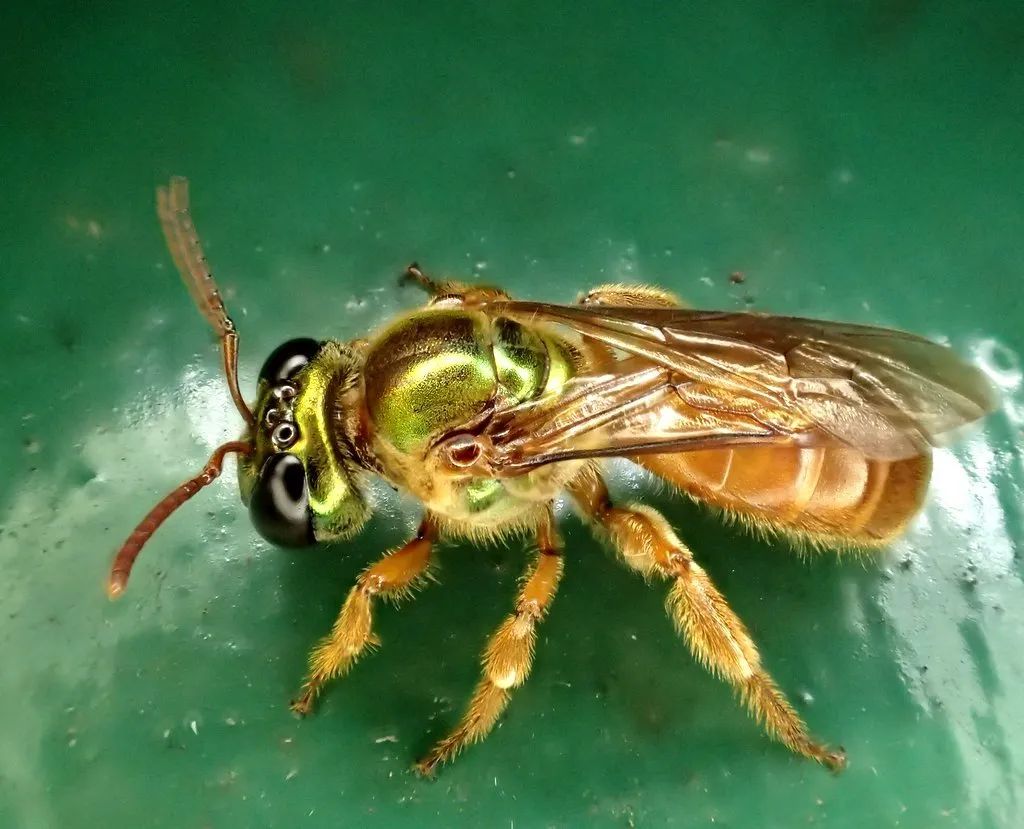
Biologists at the Smithsonian Tropical Research Institute investigated a flexible social bee species, which helps shed light on the evolution of more complex organizational structures among other insects Scientists studied the sweat bee species Megalopta genalis, native to Central and South America. Carmelo Lopez Some types of bees are famous for their complex social structures. Honeybees, for instance, live in colonies with thousands of members, where each insect focuses on a specific job, such as caring for the reproductive queen or her offspring, foraging for food or guarding its home. Queens emit chemical signals called pheromones that play a large part in regulating and coordinating divisions of labor among the eusocial critters. But other kinds of bees have different lifestyles. Those with simple social structures don’t have such rigidly defined roles for each colony member. And in flexible species, females might even choose to leave home to lay their own eggs in solitude rather than staying home to help their mom. In these flexible bee societies, “similar communication systems are still used to structure the colonies,” says Callum Kingwell, an evolutionary biologist at the Smithsonian Tropical Research Institute (STRI) and Princeton University, to Smithsonian magazine. “Paying attention to those queen signals is a way that workers can maximize their own fitness, or likelihood of passing on their genes.” Now, in a study published July 28 in the journal Proceedings of the Royal Society B, Kingwell and colleagues report that queens of the sweat bee species Megalopta genalis produce pheromones that signal their reproductive capabilities and influence whether their daughters stay or go. “Chemical signals like these may stabilize nascent insect societies, buying time for social complexity to emerge over evolutionary time,” says study co-author Bill Wcislo, an evolutionary biologist at STRI, in a statement. “This represents, to our knowledge, the first queen pheromone identified for a flexible social insect.” Researchers collected and analyzed waxy surface chemicals on the bees. Jorge Aleman Flexible social bees like M. genalis can provide insights into the evolution of other insects’ complex social structures because researchers can study the factors that determine whether they cooperate with one another or become loners. Specifically, the team behind the new work wanted to know whether queen pheromones in M. gelanis were “honest” signals—reliable advertisements of a royal’s reproductive capabilities—or whether they manipulate workers into adopting a role in the colony that is suboptimal for them, Kingwell says. So, they examined M. genalis queens and their daughters on Barro Colorado Island in Panama. Across several years, the team placed hundreds of artificial nests in the bees’ natural habitats, recording videos of individual bees’ behavior and noting whether the daughters stayed to work, left to reproduce on their own or even usurped their queen. Chemical analyses of the insects revealed that compounds called methylalkanes were key queen pheromones that influenced what their daughters did. Even without royalty present, exposure to the compounds elicited submissive behaviors typical of workers. Further experiments showed that methylalkanes thwart development of the daughters’ reproductive systems and change their levels of a hormone associated with reproduction. Additionally, the more methylalkanes produced by the queen, the more eggs she later laid and the greater reproductive benefit she provided to workers, hinting that the signal serves as an honest indicator of the royal’s fitness. Higher levels of the queen pheromones in nests also corresponded with more daughters choosing to stay home and help their moms. This probably works because methylalkanes require a specific dietary protein that’s also essential for reproduction, Kingwell explains. “It makes it difficult for queens to dishonestly advertise because their ability to produce the pheromone is limited by the same resource that they need to actually lay the eggs.” An observation nest used in the study Jorge Aleman The new study, with all its experiments to uncover differences in individual bees’ chemicals and behaviors, the chemical pathways that build relevant compounds and more, tells a “complete story,” says Iris Steitz, an evolutionary biologist at Genaxxon Bioscience, a biotechnology company in Germany, who was not involved in the research, to Smithsonian. “It’s always good to have more of these studies on these primitively eusocial species because it’s a good way to get more insights on the evolution of these queen pheromones, and also on a signal hypothesis.” Although M. genalis sweat bees aren’t as famous as honeybees, they continue to help researchers uncover new secrets of the insect world. “I hope that people appreciate that by studying some of the lesser well-known species of bee, we can gain insights into how evolution works and how the spectacular diversity and bee social behavior came about,” Kingwell says. You Might Also Like Get the latest stories in your inbox every weekday. More about: Animals Bees Chemistry Insects New Research Panama Smithsonian Smithsonian Affiliations Smithsonian Tropical Research Institute
In This Bee Species, Why Do Some Daughters Leave Home While Others Stay 'Bee-hind' to Help Mom?
Full Article
Original Source
Read the full article at Smithsonianmag →KhanList aggregates and links to publicly available news content. We do not host full articles from third-party sources. Always verify important information with original sources.