
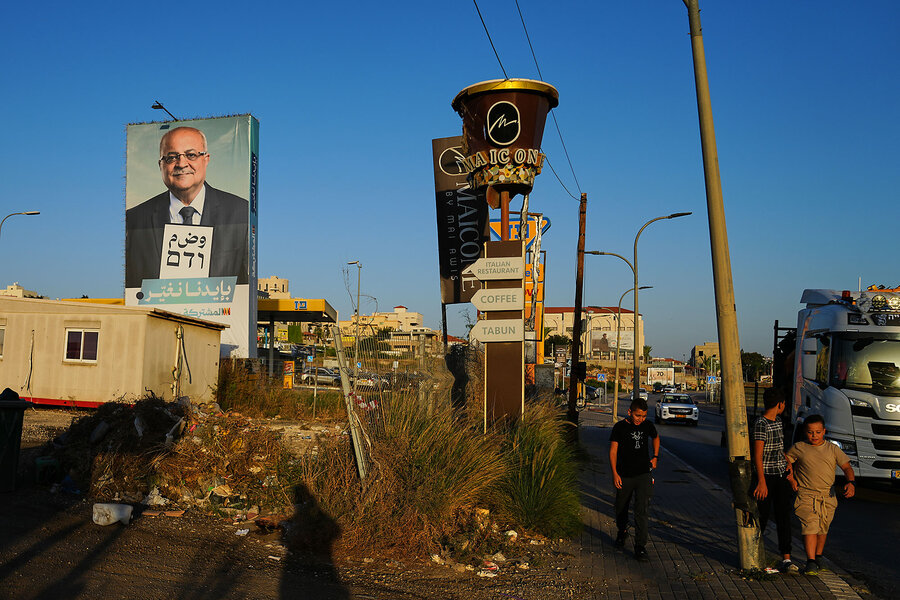
Kabul, Israel | Oct. 21, 2026, 1:13 p.m. ET | 5 min read Ask people here in Kabul, an Arab town of about 13,000 residents in northern Israel, about their quality of life, and one thing tops the list: crime.“It’s dangerous to come home at night, to go out at night,” says Najwan Taha, who’s in her 30s and works with Betna, an Arab youth group in Israel.The town has seen several homicides this year. Organized-crime groups shake down local businesses for khawa – protection money in Arabic. Officers from the Israel Police are nowhere to be seen. And it’s not just in Kabul.Many Palestinian citizens of Israel feel that their government has failed to address skyrocketing violent crime in Arab communities. Polls show that this issue, as it has been now for several years, is their top concern ahead of national elections on Oct. 27. Ilan Ben ZionFarah Ayashe (left) and Rama Murad, with the Betna youth group, hand out flyers encouraging people to vote in the Israeli elections, in Kabul, Israel, Oct. 18, 2026. Before the sun goes down, Ms. Taha and a group of eight high school girls stand at a roundabout near the entrance to town, handing out flyers and air fresheners to passing drivers and encouraging them to turn up on election day.“We can change the rules of the political game if we all vote,” the Arabic flyer reads. Betna is part of a nationwide push by a constellation of Arab civil society groups in Israel to get out the vote. This election is widely regarded here by Arabs and Jews alike as critical for the country’s future. The campaign, called Coalition 2026, has put up billboards in predominantly Arab communities – including a three-story-high banner in Wadi Nisnas, a mostly Palestinian Christian neighborhood of Haifa in northern Israel – telling passersby in Arabic, “It hinges on your vote.”Arabs make up almost 22% of Israel’s 10 million citizens. Unlike fellow Palestinians in the West Bank, Gaza Strip, and East Jerusalem, they have the right to vote in Israeli national elections. Historically, however, voter turnout among the Arab population has flagged below the national average. In 2022’s parliamentary elections, only about 54% of Arab citizens of Israel voted, compared with more than 70% nationwide. Ilan Ben ZionAn Arabic billboard that reads "It hinges on your vote" encourages citizens to vote in the upcoming Israeli elections, in Haifa, Israel, Oct. 7, 2026. Voter fatigue is one factor. The country held five consecutive elections between 2019 and 2022.Yet, in addition to the kind of general apathy common in all democracies, many Palestinian citizens of Israel lack faith in the system, and have a “lack of confidence that one can translate political power into concrete action,” says As’ad Ghanem, professor of comparative politics at the University of Haifa.Until 2021, none of the Arab political parties had ever joined a governing coalition. In part, that’s because nearly every Jewish party has ruled out the idea of aligning with them. In the run-up to this year’s vote, only one of the main opposition parties – the left-leaning Democrats – has openly endorsed doing so.Political infighting among the various Arab factions ahead of the 2022 elections also drove some voters to stay home. That resulted in Balad, a small Palestinian nationalist party, failing to cross the threshold necessary to win any seats in parliament. For this historic election, however, unchecked violent crime, home demolitions, chronic underfunding in their communities, West Bank unrest, and the war in Gaza are all motivating Arab voters. Many want to send Israel’s longest-serving prime minister, Benjamin Netanyahu, and his religious and ultranationalist allies packing.Mr. Netanyahu and his hard-line allies frequently traffic in overt racism against Israel’s Arab minority. One of the prime minister’s campaign posters features the slogan “Right, or Palestine” alongside images of his Jewish and Arab political opponents.For Palestinian citizens of Israel, “the time has come for change – otherwise, we might all be in trouble with a worse government than we have today,” says Firas Khawaled, a manager with Betna. Jess Flom/JNA Press/Nexpher Images/Sipa USA/APArab residents, community leaders, and activists take part in a protest in the city of Lod, calling for stronger action against organized crime and violence affecting Arab communities in Israel. “We want things to get better because we see violence in Arab society, we see how many homes are demolished in Arab society, we see how budgets are cut from Arab society to be used for other things in the state,” Mr. Khawaled says. “All these things are raising people’s awareness to vote.”Around Kabul, banners for the Islamist Ra’am party and the Joint List – a revived merger of three Arab factions – line the streets. Recent polls suggest that these two lists of candidates could win a combined 13 seats in the 120-member Knesset, Israel’s parliament. With the two main blocs – Mr. Netanyahu and his right-wing allies on the one hand, and the prime minister’s Jewish opponents on the other – both projected to fall short of an outright majority, the Arab parties could prove decisive in forming the next government.“We aren’t in anybody’s pocket, and we won’t give the ‘change’ bloc an open check,” Joint List leader Yousef Jabareen said recently, referring to the main opposition parties. “We will demand a substantive alternative to Netanyahu’s destructive policies, with commitments to creating a horizon for a Palestinian state … dealing with crime, investment in youth, and development of Arab towns.”But for any of that to happen, Mr. Jabareen said, Arab citizens will need to get out and vote.That mission depends on activists such as Reem Hasan from the Joint List. A red flag with a hammer and sickle flutters above the Communist Party headquarters, and behind her desk a banner proclaims, “Workers of the world unite!” in Arabic, alongside a poster that says, “Arabs and Jews against fascism.”“We’re a bit worried about a certain percentage of people who are still wondering whether they are going to vote or not,” she says. She and other party members have hit the streets in recent days, distributing flyers and trying to persuade everyone they can to show up on election day.Palestinian citizens of Israel “have been silenced for a very long time, and people are very much afraid,” Ms. Hasan says. “They feel that this is the only right they can actually practice equally.” Deepen your worldviewwith Monitor Highlights.Politics with respectGet political stories with respectful analysis.There‘s a world of new ideas in everyBooks newsletter.There‘s more to life, enrich yours withCulture & Learning weekly.Follow humanity‘s discoveries withScience & Nature stories in your inbox.Gain a spiritual perspectivefrom the stories in your inbox.Want to understand the deeper impact of critical events? Learn the Monitor‘s insight.Already a subscriber? Log in to hide ads. A poll conducted by her party projects that Arab voter turnout will surpass 60% on Oct. 27. That’s higher than the last election, she says, but she’s optimistic their hard work will pay off.“We’re aiming for 70%,” she says. ALREADY A SUBSCRIBER? LoginReal news can be honest, hopeful, credible, constructive.The Christian Science Monitor was founded in 1908 to lift the standard of journalism and uplift humanity. We aim to “speak the truth in love.” Our goal is not to tell you what to think, but to give you the essential knowledge and understanding to come to your own intelligent conclusions. Join us in this mission by subscribing.
In these Israeli elections, Arab citizens could be the deciding vote
Full Article
Original Source
Read the full article at Csmonitor →KhanList aggregates and links to publicly available news content. We do not host full articles from third-party sources. Always verify important information with original sources.