
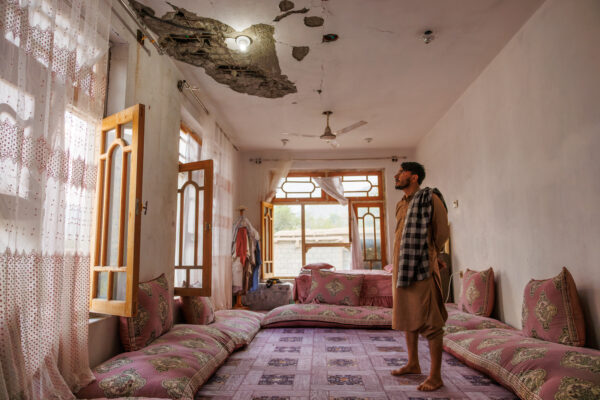
Photo Essays | Security | Society | South Asia Among the bombed-out houses along the border, there was no justice to be found, only ruins, lost lives, and people living in the shadow of conflict. An Afghan resident surveys the damage to his home caused by an artillery attack (Barikot, Afghanistan, June 22, 2026). Credit: Gergely Szabo Hoang Viet Fighting flared again along the Afghan-Pakistani border in early 2026. For weeks, Afghan villages near the frontier came under fire. By the time I arrived in June, the guns had been silent for a while. Families were slowly returning home and beginning to repair the damage. But the calm was fragile: neither side had laid down its weapons; they had only set them aside. Children playing on the wreck of a tank left behind from an earlier war, on the way to Kunar Province (Kunar, Afghanistan, June 21 2026). Photo by Gergely Szabo Hoang Viet. Sometimes They Shoot, and We Shoot Back “There’s no particular reason for the fighting. Sometimes they shoot across the border, and we shoot back,” Ibrahim told me. He was the police commander of a border village in Kunar province. As we stood in the courtyard, he pointed toward the mountains separating Afghanistan from Pakistan. Ibrahim had been fighting since childhood. He fought the Soviets, later the Americans, and now he faces the Pakistani army. I asked him which war had been the easiest. After a long pause, he said, “There’s no such thing as an easy war. They were all bad.” An armed Taliban soldier in front of his unit’s flag (Kabul, Afghanistan, June 26, 2026). Photo by Gergely Szabo Hoang Viet. The Durand Line, which marks the border between Afghanistan and Pakistan, was drawn in 1893 between British India and the Afghan emirate. Shaped by the interests of distant great powers, it cut through Pashtun communities, leaving people of the same ethnic group on opposite sides. The border dispute remains a source of tension, but it only partly explains the renewed fighting in early 2026. Another major source of friction is the Tehreek-e-Taliban Pakistan (TTP), the Pakistani Taliban movement. Islamabad accuses the Afghan Taliban leadership in Kabul of allowing TTP militants to find refuge in Afghanistan and carry out attacks against Pakistan. Pakistan says its cross-border military operations are aimed at armed groups. Afghanistan’s Taliban rulers deny supporting the TTP and regard the strikes as violations of Afghan sovereignty. In early 2026, tensions once again erupted into heavy fighting, with artillery attacks along the border and Pakistani airstrikes on targets inside Afghanistan. Children in a village near the Afghan-Pakistani border. Civilians who had previously been evacuated gradually returned to their homes after the guns fell silent (Kunar, Afghanistan, June 22, 2026). Photo by Gergely Szabo Hoang Viet. The civilian toll extended far beyond the villages of Kunar. According to the United Nations Assistance Mission in Afghanistan (UNAMA), cross-border fighting killed 56 civilians and injured another 129 in Afghanistan between February 26 and March 5, 2026. Women and children accounted for 55 percent of the casualties. When I visited in June, I wanted to see how people in the border villages were living in the aftermath of the attacks. Once I had secured the necessary permits, I made my way into Kunar, the border province battered by the fighting, to report from the ground. The Last Checkpoint It took me nearly a full day to travel from Kabul toward the Pakistani border. I changed cars several times along the way, keeping my cameras carefully hidden. Dressed in local Afghan clothing, I was often mistaken for a local at checkpoints, where guards usually waved us through. But just before Kunar, a soldier stopped my car. He pointed at me, visibly agitated, then ordered me out of the vehicle. I couldn’t understand what they were saying, but the way he studied my papers and shook his head told me something was wrong. A Taliban official in the Kunar River valley at a military checkpoint (Kunar, Afghanistan, June 25, 2026). Photo by Gergely Szabo Hoang Viet. My interpreter later told me the soldier had mistaken me for a member of the local Hazara minority because of my Asian features, which may have made him even more suspicious. He thought my ministry-issued permit was fake and refused to believe I was a foreign national. When the papers failed to convince him, my interpreter took a more pragmatic approach and finally got us out of trouble. He pulled up a photo on his phone of the Taliban official who had issued the permit, then told the guard that if he refused to let us pass, he would tell the official exactly how we had been treated. The soldier promptly waved us away. The Kunar Valley Once inside Kunar, I checked in with the Taliban authorities in town. They offered to clear the way for me to the border. The next day, I bounced along a rough dirt road beside the Kunar River in a Toyota pickup repurposed for military use. Checkpoints grew more frequent as we approached the frontier. With a Taliban official riding with me and several armed men in the truck bed, we were mostly waved through. A temporary home for displaced children in a UNICEF tent (Kunar, Afghanistan, June 22, 2026). Photo by Gergely Szabo Hoang Viet. We stopped at a camp of white UNICEF tents along the road, where children were playing soccer. When we got out of the car, the children gathered around us. We met Farid, who, along with others, cared for and taught the children at the camp. He told us that roughly 300 children had taken shelter there after fleeing the fighting. He said families living on the Pakistani side were not safe either: as the conflict intensified, Pakistani authorities had harassed residents in some villages, forcing them from their homes and across the border into Afghanistan. Children at a refugee camp near the Afghan-Pakistani border. They said they did not want to return to their former homes because they felt safe in the camp (Kunar, Afghanistan, June 22, 2026). Photo by Gergely Szabo Hoang Viet. A double fence several meters high ran along the mountain ridges, marking the border. It was covered in so much barbed wire that one look was enough to put anyone off even trying to approach it. As we passed a bombed-out building, I asked the soldiers whether someone might shoot at us from the other side. They shrugged. No one had fired in weeks, they said, and if someone did start shooting, we would definitely notice. Barbed wire near the Afghan-Pakistani border (Kunar, Afghanistan, June 22, 2026). Photo by Gergely Szabo Hoang Viet. We continued to Barikot, a small Afghan village right along the border. Almost every wall bore marks of the fighting. On the main street, we met Mohamed, dressed in a white coat. He was the only doctor in the area. He welcomed us outside the war-torn hospital. Shrapnel had punched fist-sized holes in the hospital’s iron gate, leaving much of the courtyard visible through them. Explosions had ripped entire window frames out of the wards, cracked walls, and scattered equipment everywhere. The patients had been evacuated before the attacks, but Mohamed had stayed. He told us he had work to do there, even when shells were falling. He could not leave the villagers without medical care. Bullet and shrapnel marks on the gate of the hospital in Barikot. The roof and windows of the building were also badly damaged in the attack; the hospital had been evacuated beforehand, so there were no fatalities (Barikot, Afghanistan, June 22, 2026). Photo by Gergely Szabo Hoang Viet. The shelling was not selective: schools, mosques, and civilian houses were also bombed. Inside the village school, the silence felt bleak in a place that had once been full of children’s voices. Chalk notes were still on the blackboard, and religious books sat on the shelves, but the hallways were empty. One classroom was full of light, but not because the lamps were on. A shell had torn through the roof and blown a two-meter hole in the ceiling, letting sunlight stream straight in. Afghan student shows the damage to the ceiling of a school hit by Pakistani artillery. The shell tore through the building’s roof structure (Barikot, Afghanistan, June 22, 2026). Photo by Gergely Szabo Hoang Viet. That night, we stayed with a local resident who invited us to dinner with the provincial governor. Sitting on the balcony after dark, I could barely make out the silhouettes of the soldiers chatting idly, their weapons resting across their laps. The valley was pitch-black and quiet. The only lights came from those installed by the Pakistani army along the mountaintops, tracing the border. The village’s simple houses among the mountains of Kunar. Residents who had been evacuated earlier returned after the attacks and began repairing their damaged homes (Naveh, Afghanistan, June 23, 2026). Photo by Gergely Szabo Hoang Viet. A Souvenir from Pakistan The next day, we visited Naveh, another small village right along the border, like Barikot. The countryside was peaceful. We passed a goatherd on the road, called out a greeting, and he waved back. But we had to watch where we stepped: half-buried sandbags and scraps of barbed wire jutted out of the ground all around us. A building badly damaged in an artillery attack. Civilians had been evacuated before the attacks, so there were no fatalities at this location (Naveh, Afghanistan, June 23, 2026). Photo by Gergely Szabo Hoang Viet. The village’s modest houses were built from wood, mud bricks, and the remains of military fortifications destroyed in wars over the past few decades. Life here was basic: no utilities, no electric lighting. But according to the villagers, almost every household had a few Kalashnikovs. Officially, they were not supposed to own weapons like these, but in practice it was the norm. They told us they usually went into the woods to shoot in their free time. Around here, a Kalashnikov was as much a part of the home as a family photograph on the wall might be elsewhere. A Taliban soldier with a Kalashnikov. According to local residents, Russian-made weapons are more reliable than American rifles (Kabul, Afghanistan, June 26, 2026). Photo by Gergely Szabo Hoang Viet. Children ran laughing between the houses and the goats. One little boy proudly showed us pieces of shell shrapnel he had collected around his home — “Pakistani souvenirs,” as the villagers called them. More dangerous than those razor-sharp scraps of metal were the unexploded artillery shells embedded in the huts’ packed-earth floors. The children had helped the head of the household dig them out. Children with mortar-shell fragments collected around their homes, which they call “Pakistani souvenirs.” After the fighting, shrapnel was scattered in large quantities among the ruins (Naveh, Afghanistan, June 23, 2026). Photo by Gergely Szabo Hoang Viet. The village sits exposed in the valley, with nowhere for its residents to run when the shelling starts. They had dug a small cavity in the clay soil beneath a house to use as a shelter. Two or three people could crouch inside, but it was not reinforced. If an attack came, it was hard to know what to fear more: the shrapnel or the blast bringing the shelter down on top of them. An Afghan man inside an improvised shelter dug into the ground beneath a house. These cramped shelters were built after earlier attacks and can accommodate only a few people (Naveh, Afghanistan, June 23, 2026). Photo by Gergely Szabo Hoang Viet. When I asked whether they were afraid of another attack, they just shrugged. “If they destroy our home again, we will rebuild it. That’s just how things go around here.” Local residents outside their home, holding an unexploded artillery shell (Naveh, Afghanistan, June 23, 2026). Photo by Gergely Szabo Hoang Viet. A Shrill Whistle That Changed Everything In the morning, we continued along the border toward Asadabad, a larger town in Kunar province that had been hit by rockets during the fighting. A building damaged in the rocket strikes; the force of the explosions ripped the entrance door from its frame (Asadabad, Afghanistan, June 24, 2026). Photo by Gergely Szabo Hoang Viet. We met Ahmad, a local farmer, in the courtyard of a modest house. He recalled the moment the attack began. He was working in the field beside the house when a piercing whistle cut through the silence. A moment later, a massive explosion shook the area. He asked me to photograph him standing in the room, at the exact spot where his wife had been lying. The rocket struck the courtyard. Its shrapnel tore through the window, killing her as she slept. A local man, Ahmad, stands where his wife was sleeping when shrapnel pierced the windows (Asadabad, Afghanistan, June 24, 2026). Photo by Gergely Szabo Hoang Viet. Two streets away lived Mustafa, an older villager who struck me as a proud man who had seen a great deal in his life. He had lost two sons in the rocket strike. As we talked, he picked up his grandchild, little more than a baby. The child smiled at me. I might have smiled back if I had not noticed the deep wound beneath the baby’s eye. A piece of shrapnel had torn across his face, nearly blinding him. “You can repair a house, but you cannot bring back the dead,” Mustafa said quietly. Mustafa holding his grandchild, whose face was injured by shrapnel (Asadabad, Afghanistan, June 24, 2026). Photo by Gergely Szabo Hoang Viet. On our way back from Asadabad, Taliban soldiers at a checkpoint offered us tea and fresh melon in the shade of a bridge. As they prepared lunch, I warned one of them that opening the pressure cooker while it was still under pressure could be dangerous. He laughed. “It will not explode. But when you are in Afghanistan, you should get used to explosions.” Taliban soldiers resting. The armed presence is part of the everyday street scene in the Afghan capital (Kabul, Afghanistan, June 26, 2026). Photo by Gergely Szabo Hoang Viet. At first, I thought they were joking. Then they showed me the large plastic bottles they were using to prepare lunch and told me they had made bombs out of bottles like these to use against the Americans. In the Shadow of the Border At the checkpoint, the soldiers joked about explosions even as they cooked. In the villages, people patched up their damaged houses. But the calm I had seen in June did not last. According to UNAMA, an airstrike in Kunar on September 21 killed at least three civilians and wounded four others. On October 1, further airstrikes in Kunar and Helmand provinces killed at least ten civilians — most of them children — and injured nine others. A local Afghan student outside a school damaged during the fighting (Barikot, Afghanistan, June 22, 2026). Photo by Gergely Szabo Hoang Viet. Among the bombed-out houses along the Afghan-Pakistani border, there was no justice to be found, only ruins, lost lives, and people living in the shadow of the border. On the ground, no one seemed to know who was responsible for starting the fighting. Harder still was knowing who might end it, or whether it would ever end at all. People here have grown used to taking their animals out to graze each morning, then going to bed at night not knowing whether they will wake to the sunrise or to shells crashing into their homes. Still, they did not complain. They buried their dead and rebuilt their homes. That’s just how things go around here. Local children in front of a building marked by shrapnel holes in the village of Barikot, close to the Durand Line (Barikot, Afghanistan, June 22, 2026). Photo by Gergely Szabo Hoang Viet.
In the Shadow of the Afghanistan-Pakistan Border
Full Article
Original Source
Read the full article at Thediplomat →KhanList aggregates and links to publicly available news content. We do not host full articles from third-party sources. Always verify important information with original sources.