
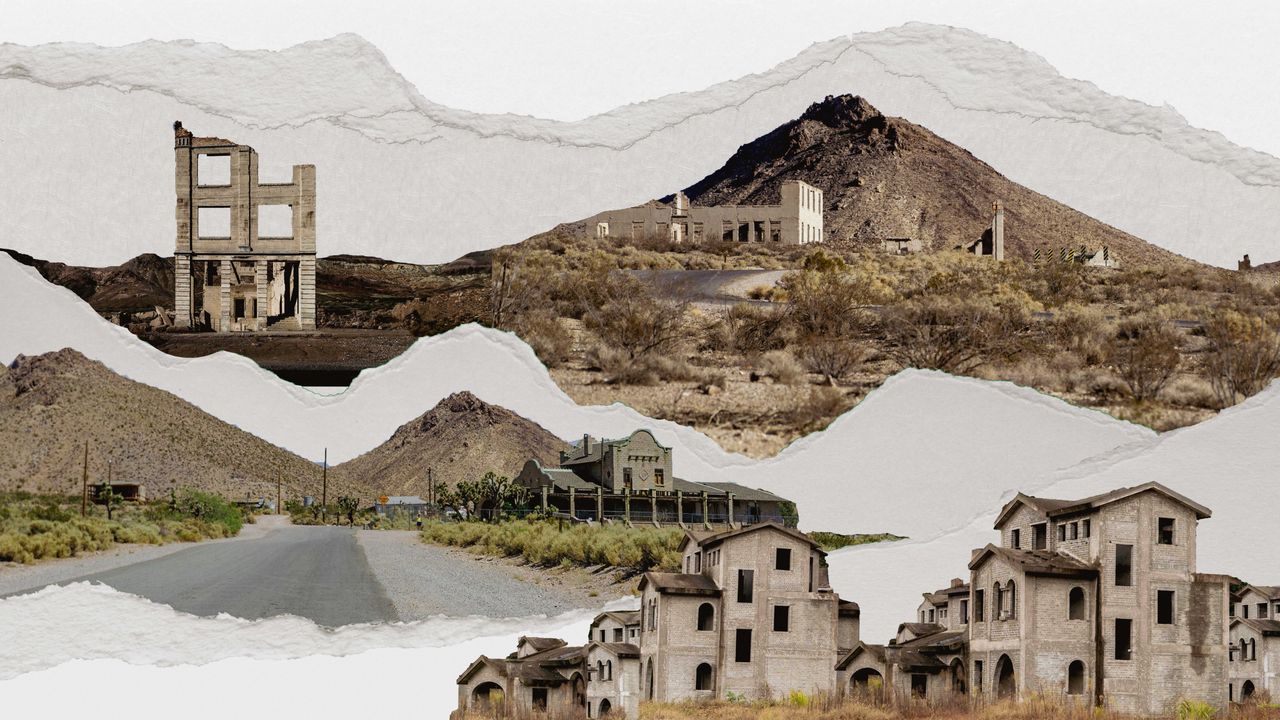
The first ghost towns I ever remember visiting were the abandoned hillside villages high above the Adriatic Sea. My grandparents had a house in a tiny town on the Dalmatian coast, halfway between Split and Dubrovnik, and every summer before the war we would climb the old sheep trails up through the dry yellow grass to the ruins. Along our stretch of coastline, almost every seaside town boasted an abandoned, hillside twin, a relic of times past, when life at higher elevations kept villagers close to the sheep they grazed, and safe from pirates and invading Venetians. Then, as borders were redrawn and enemies dwindled, earthquakes struck and maritime trade took hold, the people of those old villages followed new prospects down to the sea. In their absence, the stone houses fell silent. Hardy vines crept up the walls. Roofs caved in. By the time I was five years old, exploring them in the late 1980s, the villages were largely the province of stray cats. Once in a while, some solitary elder might nod from a porch chair at the sight of my grandfather and I passing.Novelist Téa Obreht spent childhood summers visiting the hillside ruins of abandoned towns along the Dalmatian Coast. GettyEventually as circumstance and opportunity coaxed townspeople to larger hubs, the villages of Obreht's past grew into the province of stray cats. GettyThis early fascination with abandonment and decay is why I have found myself so drawn to ghost towns of the American West. For the past few years, I have lived in Wyoming, a state built from boom-and-bust history, and therefore a place rife with ghost towns. Some of them, like Kirwin—a former gold and silver boomtown deep in the Absaroka Mountains—are impossibly isolated, accessible only by ATV. Others hardly qualify as towns at all, just a smattering of buildings on some gravel road since displaced by a bigger, faster, more serviceable highway.The ruins of the Carissa mine in South Pass City, Wyoming, stand as a vestige of the region's 19th-century gold rush. GettySunrise: A Novel by Téa ObrehtThe most renowned of them, South Pass City, served as a touchstone for my latest novel, Sunrise. It sits in a high-country valley in Fremont County, which along with Miner’s Delight and the still-inhabited Atlantic City, comprises the historic Sweetwater Mining District,a gold-mining region with as Spaghetti Western-ish a moniker as one could imagine for a complex sitting at the threshold of Wyoming’s mighty Wind River range. The town is named for its proximity to South Pass, a route used by the Shoshone, Absaroka, and Cheyenne people for hundreds if not thousands of years, which, once revealed to fur trappers in 1812, accelerated the stream of American settlers on the Oregon and Mormon trails over the Continental Divide. It was always a profoundly isolated and rugged place, even after the 1867 discovery of gold transformed it into a boomtown overnight. The few people coming through South Pass City now—usually tourists heading for Yellowstone, or hikers testing their mettle on the Continental Divide Trail—would suspect that Mark Twain once stopped here on his way west and wrote effusively of being spellbound by the sight of “banks of snow in dead summer time.” Or that women’s suffrage in America was first secured here thanks to a bill introduced in 1869, back when it was called Wyoming Territory. Or that the nation's first female justice of the peace, Esther Hobart Morris, served a term here when her predecessor resigned in protest over the passage of that very bill.South Pass City derives its names from the local route First Nations like the Shoshone traversed for hundreds, if not thousands of years. Courtesy Friends of South Pass CityWhen I came to South Pass City in September of 2015—on the first of many visits—it had emptied out for the off-season and sat drowsily beneath the early autumn mantle of its aspens. I remember drifting down the main drag, peering through the open doors of its meticulously restored buildings: the school, the general store, the boarding house, the jail. Tours of the Carissa mine, whose capricious promises of riches led the town through repeated booms and busts, were over for the season. In one of the exhibits, I was surprised to find the name “Sam Vjestic” attached to the black-and-white photograph of a sunbaked miner with a deeply furrowed face. Later, in the gift shop, a young woman asked where I was from. “That’s a long way from here,” she said when I told her. “Isn’t everything?” I wanted to say. I bought some postcards and a book about the mines and went outside into the golden September afternoon to sit by the creek and listen to the wind ruffle through the treeline as it had a hundred years before. The discovery of a Slavic name all the way out here had moved me. Now I felt an illusory tie to this place, an odd, unexpected little stab of belonging.The former Exchange Saloon & Card Room, a saloon and gambling hall from the hey day of South Pass City. Courtesy Friends of South Pass CityBut that’s how ghost towns trick you: they invite you to play house with the dead. To hear your own footsteps on their boardwalks. To duck under their crooked lintels. To look through their gaping windows and imagine what that same view, in summer or winter, must have looked like more than a century ago. What would it have been like, the ghost town asks, to sleep on some rough little mattress under such a low roof? What would it have been like to snow shoe home, a little tipsy maybe, from some Christmas party between massive banks of hand-shoveled snow? What would it have been like to move here, as somebody’s wife perhaps, only to discover that the mine was already faltering? Would you have stuck around, toughed it out?The American West is peppered with ruins of former boom-and-bust towns like Bodie State Historic Park in Mono County, California. Kate BerryIn the American West, where playing dress-up in reenactments and photo booths and even city streets is already so commonplace, this line of questioning is insidiously limited. The ghost town rarely asks: if you lived here, way back when in what was in all likelihood, a majority white settlement, how would you have felt about treaty violations? If you had opposed them, would you have shared this view with your neighbors? What would you have said if you’d opened the paper to the story of the Christmastime execution of 38 Dakota men presided over by Abraham Lincoln? What would you have taught your children to feel, or say?As a rule, ghost towns are defined by the event that depopulated them. Sometimes, this is a single natural disaster, an act of God—like the avalanche that tore through Kirwin in 1907. Sometimes, as in South Pass City, it is the gradual depletion of the natural resource that enabled the town to thrive in the first place. Wars create ghost towns. Despots create ghost towns. Industrial accidents and failures create ghost towns. No story can stand up to the myth of a defeat so profound that it results in human abandonment. Whatever precedes it is supplanted by the terminating event. The avalanche. The mine that played out. The conflict whose memory the townspeople fled to leave behind.A group photo of a visiting marching band from Rock Springs, Wyoming, in South Pass City Courtesy Friends of South Pass CityComing through the Sweetwater mining district, the gravitational pull those abandoned houses exert on the imagination attempts to erase all other versions of the area—including and especially what came before the discovery of the lodes and the building of the town. Nothing invites you to imagine yourself in those thousands of years of summer hunts and trade routes, when the first people of this nation crossed the Continental Divide, rather than the sliver of time represented by the cabins and the falsefronts. Nothing here designates the discovery of gold as the disaster it was.Ghost towns tell the story of the defeat of enterprise and human dreams. Their existence and demise become the things frozen in amber—a totalizing shared myth that allows no room for what preceded it. Perhaps it’s the responsibility of all of us who choose to blow the dust from these strange, forgotten places, to dig as deeply as we can for what lies underneath the foundations.
In the Ruins of Wyoming's Ghost Towns, Novelist Téa Obreht Plays House With the Dead
Full Article
Original Source
Read the full article at Cntraveler →KhanList aggregates and links to publicly available news content. We do not host full articles from third-party sources. Always verify important information with original sources.