
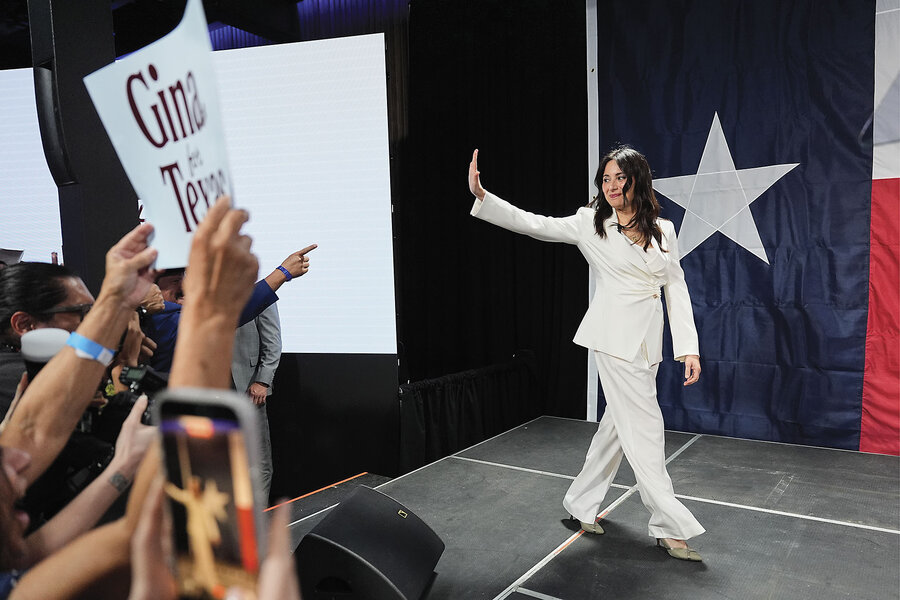
Brownsville, Texas | Nov. 19, 2026, 2:21 p.m. ET | 7 min read In the quiet of an early Saturday morning, vendors at a farmers market raise square tents over their wares in a newly minted cultural district in the heart of this historic border city. It’s just a few days removed from the midterm elections, and the drizzle of rain falling from the sky feels, to some, like a fresh start.After three decades of Republican control, Democrats have swept into power in the country’s second-largest state. This city, the biggest in the Rio Grande Valley, a heavily Latino region on the state’s border with Mexico, has been key to delivering that transformation. It will be key in determining what happens next as well.Dotted with palm trees and blanketed by heavy south Texas air, Brownsville’s location at the southern tip of the continental United States has shaped both its opportunities and its struggles. Its proximity to the southern border and the Gulf of Mexico have made it a vital trading post internationally. Domestically, however, there are few cities more isolated from the rest of America. Like the other cities that form the four-county Rio Grande Valley region, which locals call the valley or RGV, Brownsville exists along a river that has long been a connector instead of a divider. Those connections with Mexico – economic, cultural, and genealogical – have defined the region for centuries. Its residents are similarly transnational. While mostly Latino, some are well-off while others live in trailers without paved roads or running water. Unauthorized immigrants live beside and work for Tejanos whose families have lived in the area since it was a part of Mexico. Older generations remember years of de facto segregation while younger generations have seen a turbulent border and tourists flocking to watch nearby SpaceX rocket launches. At the farmers market, Spanish and English are spoken interchangeably, as they are everywhere here. Shoppers amble between vendors selling artisanal coffees and crocheted toys, chilaquiles and waffles. These are the people who helped deliver Democrats their best election in Texas since Gina Hinojosa, a Brownsville native and now the state’s governor-elect, was growing up here. Henry Gass/The Christian Science MonitorKassandra Chavez (left) and Jade King pose on their way to a farmers market in Brownsville, Texas, Nov. 8, 2026. Both women voted for Democratic candidates in the midterm elections. The Rio Grande Valley swung from voting Republican in 2024 to supporting Democrats. The valley’s voters have traditionally favored the political left, despite also holding conservative views on social issues such as abortion and gay marriage. In recent years, however, the complicated region has given rise to a complicated electorate. After President Donald Trump surprisingly won every RGV county in 2024, voters overwhelmingly swung back to Democrats this year, helping the party take almost complete control of the state government in a revolt against high prices and aggressive immigration enforcement.Latino voters – in the valley and beyond – are starting to reject party loyalties, experts say. Instead, they are making it clear that if elected officials don’t fulfill their campaign promises, they won’t hesitate to vote them out. On her way to the farmers market with a friend, resident Jade King explained why.“I’m a big believer in actions, not words,” she said. “At the end of the day, it’s about who does the best for the valley. That’s what matters.”Political turn in the Rio GrandeIn the midterms this year, Latinos in the valley voted for change. Stunned by aggressive immigration enforcement throughout the community, and worn down by high gas and grocery prices, they called time on Republican political dominance in the state. Of particular joy to them has been Governor-elect Hinojosa’s victory over three-term incumbent Greg Abbott. She will be the first Latina governor in Texas history. She will also form a historic triad of women leading the state government, along with Lt. Gov.-elect Vikki Goodwin and state Rep. Senfronia Thompson, who in January is expected to be elected the speaker of the state House of Representatives.Tony Martinez, a former Brownsville mayor, remembers the last time Democrats controlled Texas, when the state elected moderate liberals like Lyndon B. Johnson and Ann Richards, the state’s last Democratic governor. Mr. Martinez had grown up in Brownsville, a child of first generation Mexican immigrants, at a time when Latinos experienced de facto segregation in the valley. It was a time when Democrats were the only political party with a presence in the area.They were seen as “the only party that represented the people,” says Mr. Martinez. The GOP, meanwhile, was seen as the party of elite, corporate America.“Loyalty is part of [Mexican-American] values,” he adds. For years, Republicans in Texas “tried to get converts from the conservative Democrats.” A “casual drift” to the right first manifested in the early 2000s, he continues. In 2004, then-President George W. Bush, former governor of Texas, enjoyed the best Republican performance in the valley in history, appealing to voters on issues of faith and economic opportunity and winning 49% of the Latino vote statewide. Over the next decade, Latino voters in the RGV began to feel ignored by both parties, however, with poverty levels persistently high and growing perceptions that neither national party understood, nor wanted to tackle, local realities.Still, Mr. Trump’s success here in 2024 caught Mr. Martinez by surprise, when the Republican’s promise of tough immigration enforcement resonated with an electorate that felt abandoned on the front lines of a migration surge into the U.S. during the Joe Biden administration. Henry Gass/The Christian Science MonitorA photo of Texas Gov.-elect Gina Hinojosa (known as Regina, pictured left) in the 1992 yearbook from her senior year at Homer Hanna High School in Brownsville. A broad dealignment Two years later, voters in the valley have flipped again, in large measure because of the Trump administration’s chosen solution to that problem: the mass arrests of noncitizens. With unauthorized labor and families of mixed legal status commonplace in the area, the mass arrests have shocked residents and weakened the economy. Construction has come to a standstill, locals say. Businesses from restaurants to physician offices have closed, with residents tightening their belts amid nationwide stress over the cost of living.“It’s not an exaggeration to say [that] everyone in the valley knows someone who has been deported,” says Efrén Olivares, a civil rights lawyer in the neighboring city of McAllen. “That is directly related to the turnaround in the last two years.”The shift was profound. This year, compared with 2024, RGV counties swung back in Democrats’ favor by as many as 58 percentage points.But as quickly as Latino voters swung back to the left, they could swing back to the right, says Mike Madrid, a political consultant and an expert on Latino voters. Latino voters “don’t believe in or buy into either party’s philosophy,” he says, “We’re in the midst of perhaps one of the broadest dealignments in the last 150 years,” he adds “This new generation of younger voters is saying, ‘We don’t like any of you, and we’ll fire you if you don’t do what we want.’”Valley girlTexas’ incoming governor knows the valley well. The captain of the cheerleading squad at Homer Hanna High School in Brownsville in the early 1990s, Ms. Hinojosa wrote in her senior yearbook that she envisioned herself in 10 years “strategizing my campaign for the next Texas gubernatorial elections.”A few decades past schedule, Ms. Hinojosa ran a campaign perfectly tailored to the average voter in the valley. She embraced the tag of economic populist, focusing on pocketbook issues like high prices instead of cultural issues like transgender rights. (“My pronouns are: mom, Texan, and soon-to-be governor,” she said in one campaign ad.)“The one fight in this country ... is about economic power,” she said in a contentious interview with a New York Times podcast host earlier this month. “We are so caught up in fighting each other [over] social issues and culture wars that we’re all about to lose.” Henry Gass/The Christian Science Monitor Ms. Hinojosa predicted in her yearbook that 10 years after graduation, she would plan a gubernatorial campaign. Unlike most kids in the valley, she grew up in a politically aware family. Her father, Gilberto, was a lawyer, but after she graduated high school, he was elected the local county judge – the leader of the county government – and later, chair of the state Democratic Party.Ms. Hinojosa, meanwhile, moved to Austin. When her son’s elementary school was threatened with closure, she ran for the city’s school board in 2012 and won. A few years later, she was elected a state representative for the city. Public education became her trademark policy area, including helping to block bills to create a private school voucher program three times. (One year, she allied her party with rural Republicans to block the bill.)That kind of bipartisan cooperation will be critical as she leads a state that has the eighth-largest economy in the world and four of the country’s 10 largest cities.An open question is whether she will govern in a bipartisan manner or a postpartisan manner – meaning acting independently of not just Republicans, but of her own party both in Texas and nationally. Her populist campaign, including a pledge to send $1,500 checks to every household in the state, suggests the latter. It’s a message rooted in the valley, where basic needs like shelter, food, and employment override party loyalty. “The electorate in the valley is less partisan than it has been, even as partisanship has been rising around the country,” says Brandon Rottinghaus, a political scientist at the University of Houston.“Economic populism has become more important than traditional party loyalty,” he adds. “Any candidate or party who wants to win Texas has to win the Latino vote.”At the farmers market, as the rain falls a bit harder, Jonathan Martinez eats a chilaquiles breakfast with a friend. He voted for Greg Abbott in the governor’s race, but says he’s “consented” to Ms. Hinojosa leading the state. Deepen your worldviewwith Monitor Highlights.Politics with respectGet political stories with respectful analysis.There‘s a world of new ideas in everyBooks newsletter.There‘s more to life, enrich yours withCulture & Learning weekly.Follow humanity‘s discoveries withScience & Nature stories in your inbox.Gain a spiritual perspectivefrom the stories in your inbox.Want to understand the deeper impact of critical events? Learn the Monitor‘s insight.Already a subscriber? Log in to hide ads. “I pray she focuses on those issues she ran on,” he adds, citing the economy and immigration enforcement.“She’s from the border, and she understands the crisis.” ALREADY A SUBSCRIBER? LoginReal news can be honest, hopeful, credible, constructive.The Christian Science Monitor was founded in 1908 to lift the standard of journalism and uplift humanity. We aim to “speak the truth in love.” Our goal is not to tell you what to think, but to give you the essential knowledge and understanding to come to your own intelligent conclusions. Join us in this mission by subscribing.
In the Rio Grande Valley, Latinos are a rising ‘postpartisan’ voting bloc
Full Article
Original Source
Read the full article at Csmonitor →KhanList aggregates and links to publicly available news content. We do not host full articles from third-party sources. Always verify important information with original sources.