
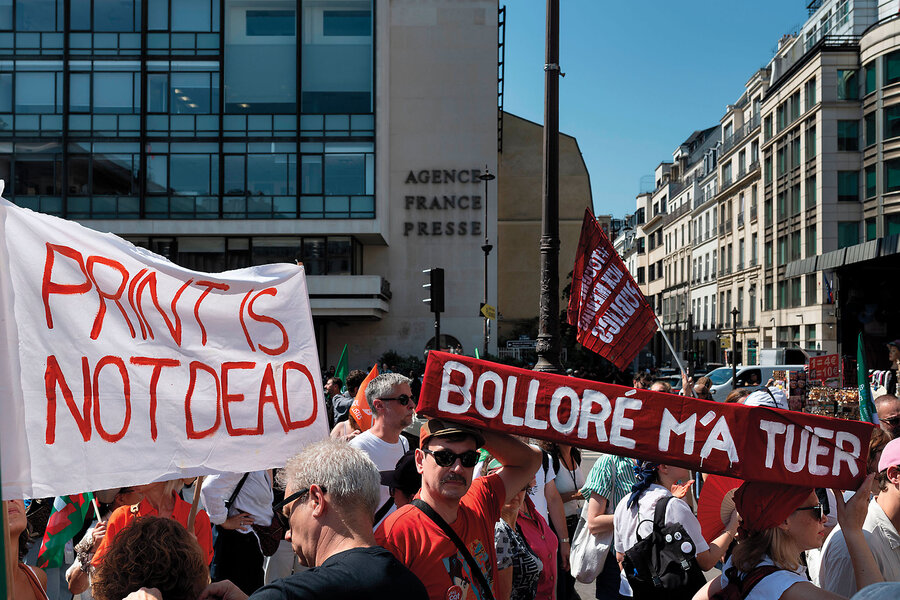
A conservative billionaire is making a play to take over one of the country’s largest media companies. His agenda is under question, particularly due to his connections with far-right politicians. Within the filmmaking community in particular, actors and directors have warned that his plans endanger free speech.This scenario could be describing the brouhaha in the United States with Paramount Skydance CEO David Ellison. The ally of President Donald Trump is overseeing plans to merge his studio with Warner Bros., alarming many Hollywood creatives.But this is France, where businessman Vincent Bolloré has been expanding his companies’ ownership of France’s creative industries, including the media conglomerate Canal+ Group and a plethora of publishing houses. French authors, filmmakers, and actors are outraged. Why We Wrote This Conservative media empires aren’t just an American phenomenon. France is wrestling with its own “Rupert Murdoch” – and the laws that might hamper him. France has long prided itself on its “cultural exception” – its unique appreciation for literature, art and cinema, and the legal protections around cultural output. Contrary to the U.S., French creators have a large stake in their work. Since the French Revolution, art and culture have been enshrined in law and remain a source of national pride.But writers and cinema professionals say Mr. Bolloré’s influence is threatening France’s cultural independence.“It’s unhealthy to have such a high level of control in so many cultural domains, in the hands of one person,” says Sepideh Farsi, a Franco-Iranian film director who was one of 600 film professionals to sign an open letter criticizing Mr. Bolloré’s expansion strategy within Canal+ Group. “Even if it were someone aligned with my political views, I would be saying the same thing.” Adnan Farzat/Nurphoto/AP/File The expansion of the media empire of Vincent Bolloré has been met with resistance from many creative people connected to the businesses he has acquired. Author’s rightsMany of France’s current freedoms can be attributed to the French Revolution, when the French people rose up against the monarchy to create the First Republic based on a set of democratic values. The Declaration of the Rights of Man and of the Citizen, signed in 1789, explicitly stated France’s commitment to freedom of thought and expression.“There is definitely the sense that France is a leader when it comes to freedom of expression as well as our cultural exceptionalism,” says Jean-Yves Mollier, a French historian and author.In 1791, France ratified a law to protect droit d’auteur – author’s rights – which links the rights in a work to its author, not the investor in the work. This differs from Anglo-American copyright law, where the rights in a work are typically handled like property that can be transferred, not a moral investment by a creator.France has also created numerous safety nets to support artists. The Society of Dramatic Authors and Composers and the Civil Society of Multimedia Authors help distribute royalties and provide droit d’auteur protections to authors. (For audiovisual projects, each person who collaborates is considered an author.)Since 1946, the state-run French National Centre of Cinema supports the production of hundreds of films through tax breaks and public funding. Unlike the Hollywood model, French cinema does not rely on private equity and box-office sales to survive.The French cultural support system “was built to protect writers and actors in France,” says Ms. Farsi. “[It] cannot be undone from one day to the next.”Observers say that, alongside those protections, there is a strong public demand for artistic creation in France. “There is also a political will to support it,” says Bruno Péquignot, a sociologist and professor emeritus of arts and culture at the Sorbonne Nouvelle University in Paris.But aspiring media moguls like Mr. Bolloré, who has been called “the French Rupert Murdoch,” can still reshape the output of French creative industries.Over the last decade, the Bolloré group, run by Mr. Bolloré’s son, has expanded its reach across numerous sectors. It currently owns three radio stations, CNEWS – France’s most watched TV news station – and weekly paper Le Journal du Dimanche. Canal+, in which Mr. Bolloré is a majority shareholder, has acquired a 34% stake in film production and distribution company UGC. Further, Mr. Bolloré is the primary shareholder of Lagardère Publishing.For many artists who have protested recently, it is specifically Mr. Bolloré’s ties to the far right that is the concern. Several media outlets have shifted rightward in their editorial stance since his acquisition of them, including Journal du Dimanche and radio station Europe 1. And while Canal+ has not yet shown similar indications of political shift, Mr. Bolloré’s ownership of it and UGC Media creates potential control of the entire production chain. Lionel Urman/Abacapress.com/Reuters One of those businesses, the publishing house Éditions Grasset, dismissed its director, Olivier Nora, this past April. In response, more than 200 authors announced they would leave the publisher in support of Mr. Nora. The writers walkIn April, more than 100 writers quit the Bolloré-owned Éditions Grasset publishing house in a walkout, over concerns that its longtime editor, Olivier Nora, was forced out for ideological reasons. A month later, the film professionals sent their open letter about Canal+ Group. In response, the head of Canal+ threatened to blacklist those who had signed the letter. Mr. Saada on July 28 reiterated his claim that he would not finance films by those who had harmed his company’s image.And creatives see further reasons to worry if the far-right National Rally (RN) comes to power in next year’s presidential election. Mr. Bolloré has spoken favorably about RN in recent years.During the Cannes Film Festival in May, far-right deputies hinted at cutting public spending for the film industry in the future. Some French towns run by far-right mayors have censored books in public libraries.At present, French creatives are testing the limits of Mr. Bolloré’s agenda in court.The Human Rights League and an artists’ labor union filed a civil suit in May against Canal+ alleging discrimination over the company’s threats to blacklist protesters. And Mr. Mollier, the historian, is among 94 academic authors who are part of a class-action lawsuit against their former publisher, Fayard. They’re arguing, based on their droit d’auteur, that they can reclaim from Fayard the publishing rights to their works because the environment in which Fayard first published their books has changed.A need for each otherBut whatever the legal outcomes, arts experts say that the symbiotic relationship between creatives and Mr. Bolloré’s businesses necessitates the two sides finding a common ground.Publishing houses rely on a constant flow of new writers to supplement their available titles, says Mr. Péquignot, the sociologist. If publishing houses can’t entice new authors, they will have to rely on their existing stock, which won’t last forever, he says.Similarly, French cinema risks coming to a standstill if the two sides refuse to cooperate. If actors and directors continue protesting, no films will get made. “Cinema depends on state funding; without it you can’t make a film,” says Mr. Péquignot. “At the same time, if 50% of the cinema world is against Bolloré, he won’t be able to make any films.”Those in France’s creative industries remain uncertain how to move forward, despite all of the protections they enjoy.“I’ve started to be careful about writing about certain topics,” says an author signed to Lagardère Publishing. She requested anonymity out of concerns for her editorial future. “I still feel ownership over what I write, but you don’t know what’s coming next.”
In the land of ‘cultural exception,’ rising media mogul puts French artists on alert
Full Article
Original Source
Read the full article at Csmonitor →KhanList aggregates and links to publicly available news content. We do not host full articles from third-party sources. Always verify important information with original sources.