
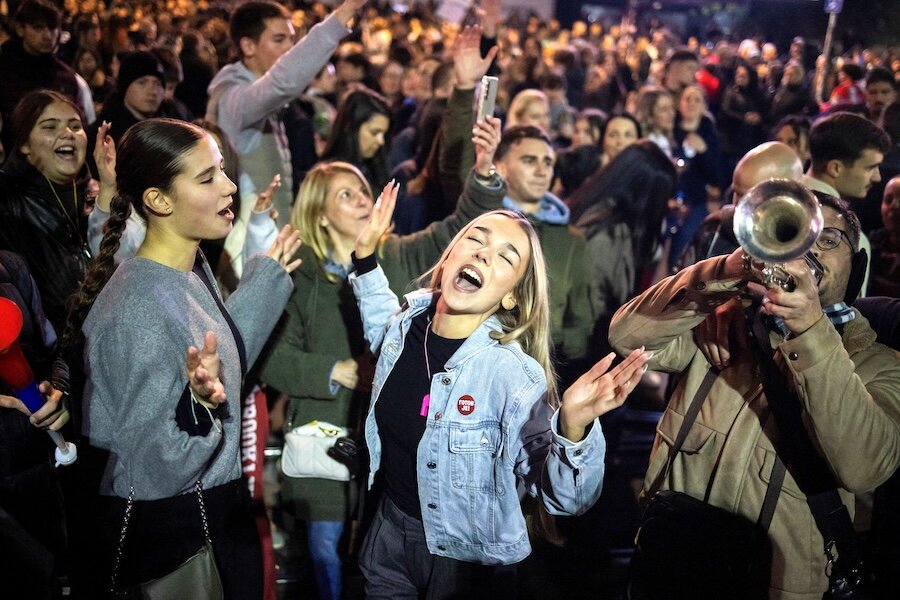
Just three decades ago, Serbia was the most warmongering place in Europe. On Sunday night, its capital, Belgrade, was the scene of a celebration of peace and joy after parliamentary elections turned out an autocratic ruling party, in a win for a student movement that has no leader and largely put up nonstudent candidates. Most of the student movement’s winning candidates hold doctorate degrees, of whom 44% are women. The Student List, as it’s called, now faces the task of bringing transparency and accountability to a government soaked in crony corruption. Its success in better governance could ricochet across the Balkan states after centuries of violent ethnic rivalries. “Serbia is a normal country again,” Andjela Markovic, a nurse from Belgrade, told the London-based Financial Times. “We proved that we can be just like any other nation, where people love their country and love each other even when they disagree.”Reasons for the election victory include a rising disdain for strongman leaders and a preference for the students’ style of grassroots consensus-making. In forming collective decisions, for example, students throughout Serbia took turns speaking in public so that no one of them gained prominence. Personal ambitions made way for a shared wrestling of ideas in democratic assemblies. “The student movement is fully democratic,” Ilija Srdanović, a cardiologist and election winner, told The Guardian. It aims to end Serbia’s legacy of “creating the cult of personality.” The student movement arose just two years ago after the collapse of a train station canopy that left 16 people dead. The incident was widely attributed to the graft-prone Serbian Progressive Party of then-Prime Minister Aleksandar Vučić. In rallying a wide range of Serbs to protest peacefully almost daily, the students displayed an integrity in self-governance that many people now believe will translate to open and inclusive government.The students’ central demand was institutional accountability rather than ideology, wrote EU Today. “By concentrating on corruption, democratic standards and the functioning of the state,” the news outlet stated, “the movement attracted voters with differing views on nationalism, foreign policy and European integration.”Calm deliberation will now be needed for Serbs to work out their differences over issues such as recognizing neighboring Kosovo. But the mental shift has begun. Deepen your worldviewwith Monitor Highlights.Politics with respectGet political stories with respectful analysis.There‘s a world of new ideas in everyBooks newsletter.There‘s more to life, enrich yours withCulture & Learning weekly.Follow humanity‘s discoveries withScience & Nature stories in your inbox.Gain a spiritual perspectivefrom the stories in your inbox.Want to understand the deeper impact of critical events? Learn the Monitor‘s insight.Already a subscriber? Log in to hide ads. “We were a depressed nation, pushed by propaganda into fearing others, but Serbia is breathing easily again,” Ana Mirkovic, a psychologist, told The Times of London. “There is still a lot of trauma, but people in Belgrade were smiling again today, which is an amazing start.” ALREADY A SUBSCRIBER? LoginReal news can be honest, hopeful, credible, constructive.The Christian Science Monitor was founded in 1908 to lift the standard of journalism and uplift humanity. We aim to “speak the truth in love.” Our goal is not to tell you what to think, but to give you the essential knowledge and understanding to come to your own intelligent conclusions. Join us in this mission by subscribing.
In the Balkans, a victory for political humility
Full Article
Original Source
Read the full article at Csmonitor →KhanList aggregates and links to publicly available news content. We do not host full articles from third-party sources. Always verify important information with original sources.