
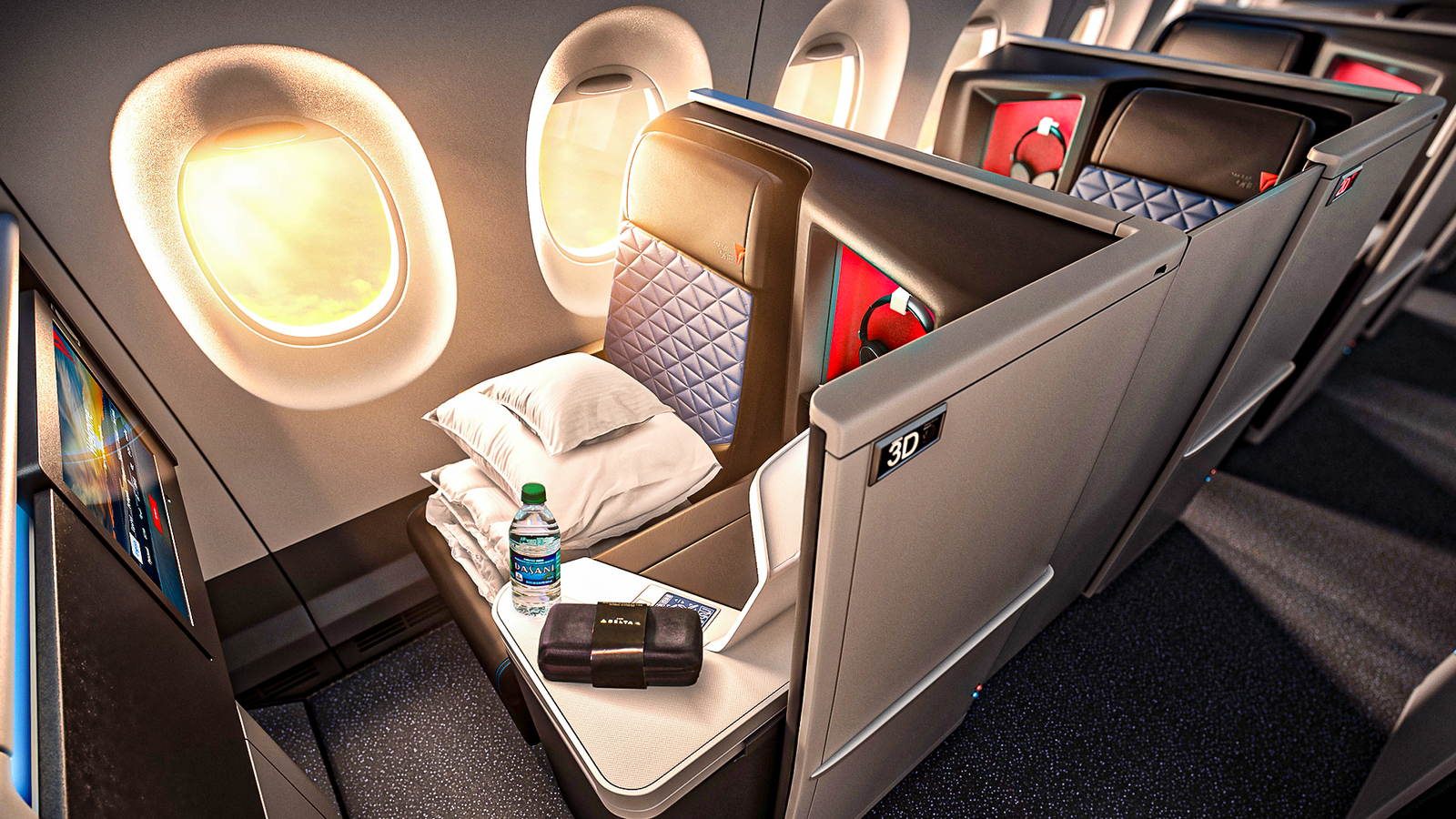
Published Nov 25, 2026, 7:00 AM EST Luke Diaz is a freelance military writer with experience with active duty experience in the US Navy as well as defense and industrial engineering. He is a former Naval Flight Officer who performed tactical air control on the carrier-based E-2 Hawkeye. Surging demand for premium airfare has forced global airlines to rewrite how they operate both inside the cabin and at the airport terminal. Customer demand passed a decisive juncture when Delta Air Lines reported that it made more 2025 Q4 revenue from premium-cabin sales than from main cabin fares for the first time. The landmark shift came as North America and Asia were already tearing out their economy rows while pouring billions into new business suites, satellite WiFi, exclusive lounges, and more perks. That universal push to capture big spenders collided directly with global supply chain bottlenecks, rising oil costs, and certification delays. United Airlines launched its Elevated Boeing 787-9 with Polaris suite doors locked open pending federal sign-off, while Delta installed 44 domestic first class recliners aboard new Airbus A321neos after planned lie-flat pods missed testing. Overseas, Boeing's delayed 777-9 forced Emirates, Singapore Airlines, and Air Canada to spend billions rebuilding older widebodies to keep premium capacity expanding. Every carrier has chosen a unique strategy to balance luxury inflight with terminal perks as passenger spending shifts. In another landmark change, United and American Airlines retired international first class while rolling out oversized business cabins and co-branded credit card clubs, while Emirates and Singapore kept enclosed first class suites alive alongside expanded hub lounges. Even US low-cost carriers scheduled domestic first class seats and airport clubs for 2027, leaving basic economy fliers with tighter legroom and fewer perks. Legacy Carriers Abandon Basic Economy To Chase Bigger Spenders Credit: Wangkun Jia | Shutterstock Delta Chief Executive Officer Ed Bastian explained that the second-quarter milestone by confirming nearly all new seat growth now targets business class and premium economy fliers. American CEO Robert Isom echoed that shift on September 16, admitting his carrier sold too much Basic Economy when just 30% of seats generate half its revenue. Isom told View From The Wing: "Those 30% of seats, they're only going to grow in our fleet. That's demand that's more likely to hold up through economic uncertainty." Delta saw immediate proof of that appetite aboard its accidental 44-seat first class A321neo subfleet flying between Hartsfield-Jackson Atlanta, Los Angeles, and Seattle. Even with undersized galleys and a single forward lavatory, paying passengers filled 80% of those recliners by August. As Delta Chief Commercial Officer Joe Esposito put it to From The Tray Table: "It's a really nice surprise that we've got such high demand for our premium products. We're experimenting with how big a domestic premium cabin can be." American backed Isom's words by removing elite upgrades and frequent-flyer miles from Basic Economy tickets purchased after mid-May, and by using its cheapest fare to direct passengers into more expensive rows. Executives also announced Flagship First's retirement on March 28, 2027, bringing narrowbody premium seating to 40%. Air Canada targeted those same corporate travelers by relocating Boeing 737 MAX 8 jets to Rouge's leisure arm, while reinstating Airbus A320-200 and A321-200 aircraft to regular service. Single-Aisle Jets Gain Flat Beds While Widebodies Squeeze Economy Credit: Air Canada Air Canada introduced lie-flat beds to single-aisle transatlantic flights in June, when it launched its first Airbus A321XLR between Montreal and Toronto before deploying the jet to Toulouse. Alaska and Hawaiian Airlines joined the narrowbody luxury drive later in the year, beginning in 2028 with lie-flat suites on upcoming Boeing 737 MAX 10 aircraft and upgraded Airbus A330-200s. Putting long-haul comfort on smaller jets allows carriers to serve narrower foreign markets profitably while avoiding widebody fuel use. Airlines used different strategies to rearrange their cabins to accommodate large spenders on widebody fleets. In September, American launched its 'Project Olympus' Boeing 777-300ER between New York-JFK and Buenos Aires, eliminating international first class in favor of crammed Flagship Suites. In a similar vein, United expanded Polaris business class and Premium Plus capacity by eliminating dozens of regular economy seats on its Elevated Boeing 787-9. Carrier Premium Aircraft Total Seat First/Business Class Premium Economy Economy United Airlines 787-9 Elevated 222 64 Polaris (8 Studio) 35 Premium Plus 123 (39–48 Economy Plus) Delta Air Lines A321neo (Interim) 164 44 Domestic First 54 Comfort+ 66 Main Cabin American Airlines 777-300ER Olympus 330 70 Flagship Suites (0 First) 44 Premium Economy 216 (30 Main Cabin Extra) Emirates 777-300ER (4-Class Retrofit) 324–332 6–8 First / 38–40 Business 24 Premium Economy 256–260 Economy Singapore Airlines A350-900ULR (Retrofit) 132 4 First / 70 Business 58 Premium Economy Air Canada A321-200XLR 182 14 Signature Suites 168 Economy Even as they rebuilt their fleets, foreign competitors refused to give up on the very front of the aircraft. In July, Emirates launched the 100th aircraft from its $5 billion interior makeover in Dubai. It preserved the enclosed first class suites on all of its Airbus A380-800 and 777-300ER planes while making room for premium economy. With the addition of private first class suites to its ultra-long-range Airbus A350-900ULR aircraft operating marathon runs to New York-JFK, Singapore pushed its own widebody rebuild budget to more than $1.56 billion. Every square inch added to the front of these widebodies forced uncomfortable compromises behind the curtain. Singapore ran into sharp flier pushback after revealing that its retrofitted A350-900s keep older 2017 economy seats without 4K screens or Bluetooth audio. On incoming Boeing 777-9 deliveries, Singapore is also tightening standard economy from nine to 10 abreast in the upcoming 777X, trading away long-praised coach comfort to fund upfront luxury. Credit Card Lounges And Satellite WiFi Split The Ground Game Credit: Daniel L. Locke | Shutterstock As jetliners evolve, airport clubs are becoming increasingly congested as US airlines aggressively entice frequent travelers with co-branded credit cards. In September, Southwest Airlines and Chase announced that their first-ever Icon Lounges would debut in Austin, Baltimore, Honolulu, and Nashville in late 2027. The newly merged Alaska and Hawaiian also announced plans to open new flagship clubs in Honolulu and Seattle in 2028, directly challenging bank-run establishments such as the Chase Sapphire Lounge at Phoenix Sky Harbor. Alaska Chief Executive Officer Ben Minicucci pitched those ground investments as a core part of the travel experience, saying: "We believe premium is more than a seat. It's how guests feel from the moment they book their trip to the moment they arrive at the airport to when they're in the air with us." On the same thread, to keep top international ticket holders out of packed credit card queues, Air Canada opened a seventh grab-and-go café in Québec City in June while offering apron Porsche transfers from its Signature Suites. Singapore took a similar approach at its home hub, spending $34.1 million to expand its Changi Terminal 2 SilverKris lounges by 50% and give paid premium fliers dedicated space away from partner cardholders. Singapore Chief Executive Officer Goh Choon Phong said: "Our customers experience Singapore as one seamless journey, and this significant investment is designed to deliver greater comfort, choice, and convenience at every stage." As construction continues, high-speed satellite internet has become just as essential to winning premium bookings as private terminal clubs. United raced ahead fleet-wide, passing 640 SpaceX Starlink-equipped aircraft in October to lead US carriers in total connected jets. Emirates prioritized raw long-haul bandwidth instead, mounting twin fuselage antennas on every Boeing 777-300ER and three atop each Airbus A380-800, so hundreds of passengers can stream simultaneously above 2 gigabits per second. Crowds Force Banks And US Carriers To Split Lounges Credit: Joe A. Kunzler | Shutterstock In February, Capital One stopped offering free guest and authorized user access on its Venture X card. Instead, it now charges $45 per adult guest unless the member spends $75,000 annually. Even though over 70 new lounges started construction this year, banks and airlines tightened admission requirements due to persistent overcrowding. A few days after restricting access, Capital A's 12,500-square-foot (1,161 sqm) facility was opened, arriving at LaGuardia Airport with faster table turnover and custom-made tapas. Alaska and Hawaiian separated their terminal spaces between domestic crowds and long-haul flyers. Hawaiian broke ground in October on a 13,000-square-foot (1,208 sq m) Honolulu lounge for 200 guests as part of a $600 million overhaul. Alaska simultaneously advanced a 41,000-square-foot (3,809 sq m) Seattle complex for late 2027, splitting a 500-seat standard club from a 200-seat Aurora Lounge for international business-class fliers. United and American answered bank-run clubs with giant hub expansions and quick bypass lanes. United pushed ahead on the 40,000-square-foot (3,716 sq m), 650-seat United Club in Washington Dulles Concourse E after finishing near the bottom of the recent J.D. Power satisfaction rankings. American countered at New York's JFK Terminal 8 with a quick-service coffee and snack counter while reopening its Los Angeles Flagship First Dining room. The next major test for airline ground operations arrives between late 2027 and 2028, when Southwest's Icon Lounges, Alaska's two-tier Seattle complex, and Hawaiian's Honolulu flagship open their doors. Adding thousands of square feet of terminal space will only ease congestion if airlines and credit card issuers keep tightening guest rules. Tracking those openings will grant a glimpse into the next stage of competition in the terminal.
In The Air & On The Ground: How Premium Demand Has Rewritten Airline Operations
Full Article
Original Source
Read the full article at Simpleflying →KhanList aggregates and links to publicly available news content. We do not host full articles from third-party sources. Always verify important information with original sources.