
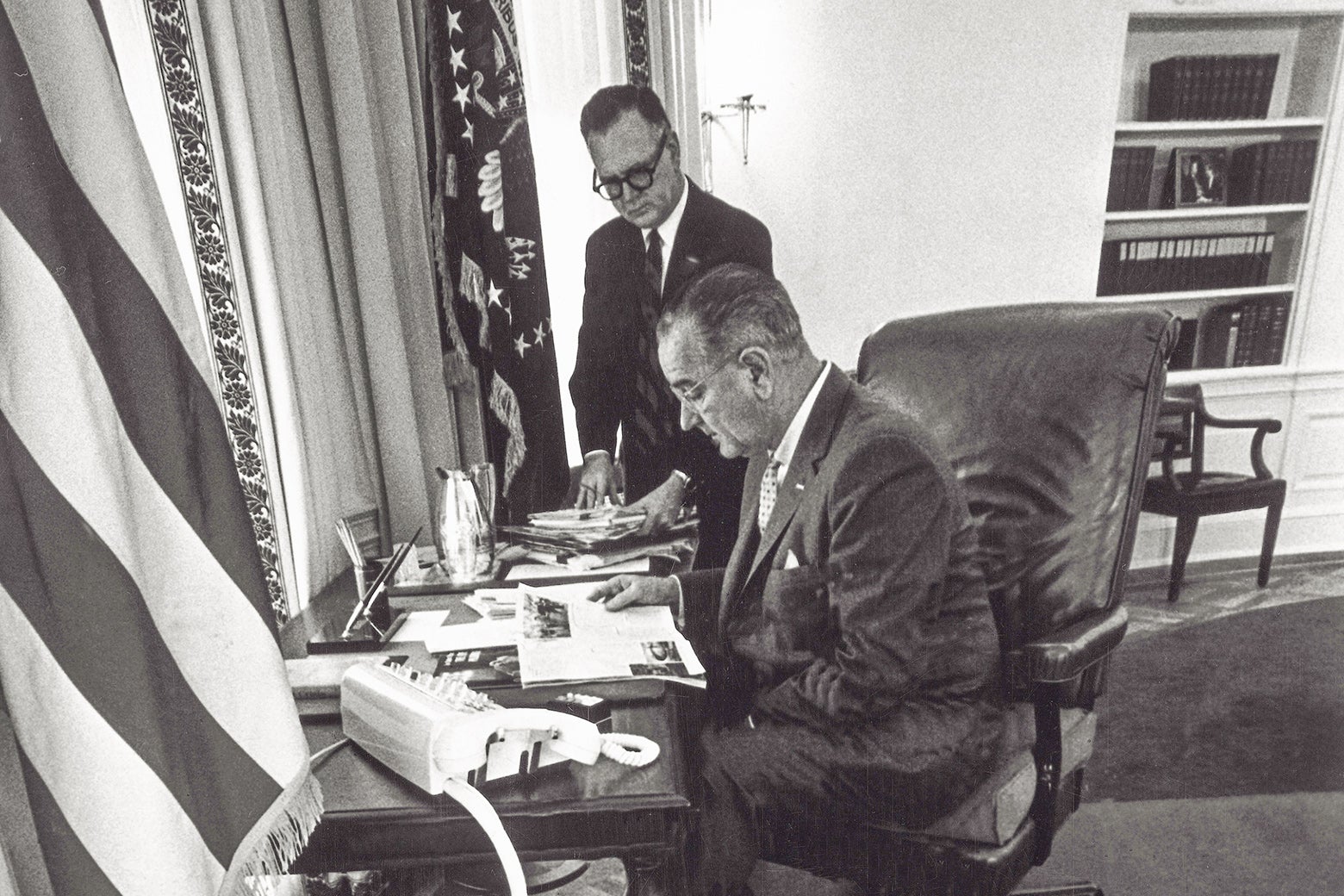
Outward Making Sense of the “Walter Jenkins Affair” When LBJ’s right-hand man got arrested for bathroom cruising, the president could barely understand what that was. Then the story got even weirder. Mondadori via Getty Images) Sign up for the Slatest to get the most insightful analysis, criticism, and advice out there, delivered to your inbox daily. It’s LGBTQ History Month, and that usually means we’re thinking about our community’s heroes and martyrs. But as a queer historian, I believe it’s more important than ever to think beyond those archetypes. The past is full of queer human beings who puzzled their way through lives that were often messy and embarrassing, and they deserve to be remembered—and perhaps learned from—as well. It was fall of 1964, and President Lyndon Johnson was struggling with many things: white backlash, congressional resistance to spending on schools and healthcare, and China’s first nuclear test. But less known is the fact that, alongside the Cold War and the fight for civil rights, he was struggling to understand how restroom arrests worked. On Oct. 14, Johnson had learned that Walter Jenkins, his closest aide for a quarter of a century and a Catholic father of six, had been arrested a week earlier by plainclothes vice officers while having sex with a man in the basement men’s room of the G Street YMCA, two blocks from the White House. What’s more, it was Jenkins’ second arrest in that same men’s room in six years. Johnson was dumbfounded. The news reached him on a campaign trip to New York, and because he taped his phone calls, you can hear Abe Fortas break it to him. National Photo Company Collection, Library of Congress, Prints & Photographs Division A few hours later, you can listen in as LBJ calls J. Edgar Hoover’s top deputy at the FBI and asks him what, exactly, the police had been doing both times they took Jenkins into custody. In 1959, Jenkins had been arrested by a plainclothes officer acting as a decoy. Johnson was baffled that a policeman had detained Jenkins alone: “Why would they pick up a guy if he’s just by himself?” The G-man replied that Jenkins must have been fiddling with his zipper. Decoy stings were one of two main techniques police used to arrest men cruising. The other was clandestine surveillance. That’s what caught Jenkins in 1964: two police officers watched through an architectural transom over the bathroom door as Jenkins entered a toilet stall where another man had been waiting for a sexual partner. This, too, puzzled Johnson. “How would these three policemen be peeping through the door and know he’s there if they hadn’t had some indication?” (In fact, two officers stood on a stool at the transom while two more waited upstairs.) Hoover’s deputy explained that officers staked out places like Lafayette Park and the YMCA men’s room, where “known homosexuals hang out.” I tell the story of Jenkins’ arrest and resignation in my new book, Outed. It was the scandal that first brought queer life into the national political conversation in the 1960s, and the book draws on White House tapes, FBI files, a long-secret investigative report, hundreds of letters to the Jenkins family, press coverage, and interviews with his children to examine “the Walter Jenkins affair.” More than 60 years later, it still unsettles the way we usually tell the history of that heady period: as a march out of the closet, led by people who were ready to leave it. Slate receives a commission when you purchase items using the links on this page. Thank you for your support. Johnson had worked beside Jenkins almost daily since 1939, yet he had no idea how cruising worked or how the police went about catching men who did it, even though Lafayette Park, a center of both, was a two-minute walk from the West Wing. His bafflement was not unusual. For many gay men in 1964, almost nothing about the arrest was surprising: men met in bathrooms, vice officers watched, and the consequences could be anything from a nuisance to a reputational catastrophe. For many straight Americans, including the president, all of it was news. The Jenkins affair marked a watershed in straight Americans’ knowledge of gay life. It raised uncomfortable questions about the queerness of “normal” men—including seemingly straight Catholic fathers—and about the reach of the surveillance state. An Invisible World on the Front Page Walter Jenkins and Lyndon Johnson at the 1964 Democratic Convention. Cecil-Stoughton, courtesy-of-Walter-Jenkins-Jr.-and-Anne-Jenkins-Mauel Johnson had become president 11 months earlier, after the assassination of John F. Kennedy, and was now campaigning to win the office in his own right, with less than three weeks left before Election Day. The timing could hardly have been worse. Since 1953, homosexuals had been banned from all government jobs as potential “security risks”—part of a broader purge of queer people from American life now called the Lavender Scare—and Jenkins routinely attended meetings of the National Security Council. As the UPI wire service broke the story, Johnson abruptly left the Waldorf-Astoria, where he was supposed to speak at a large charity dinner, to pay a “surprise visit” to Jacqueline Kennedy at her Fifth Avenue apartment. The next morning, the New York Times headline “President’s Aide Quits on Report of Morals Case” ran beside a photo of the two of them—in other words, a photo op staged by a president eager to change the subject. Walter Jenkins working in the White House. LBJ Library/Photo by Yoichi Okamoto Jenkins resigned and spent nearly a month in the hospital for what the White House called “nervous exhaustion.” Johnson ordered Hoover to launch an “immediate and comprehensive inquiry”; in just eight days, FBI agents interviewed at least 435 people, including Jenkins in his hospital room. The bureau told the public that Jenkins had not compromised national security, but the full 94-page report remained secret for decades. One section of the report listed 10 men under the heading “Alleged Association With Other Persons With Possible Homosexual Tendencies,” drawn from interviews in Texas and Washington; several of these men, who had gone to school or worked with Jenkins, had likewise seen their careers ended by morals charges, though often with no publicity. In a national poll that October, 88 percent of respondents had heard of “the Jenkins case.” What they learned cut against the premise of the Lavender Scare, that homosexually inclined people couldn’t be trusted in sensitive roles. Here, after all, was a man who engaged in same-sex acts yet succeeded at the very center of power. What came next was more surprising: The scandal opened the door to serious, even sympathetic, press coverage of gay life. Shortly after LBJ’s inauguration in January 1965, as Congress convened to create the Great Society, the Washington Post ran Jean White’s five-part series on gay Washington, all but one installment on the front page. She suggested the Jenkins case was part of the impetus for the series: Americans’ comments on his arrest, she observed, “showed restraint, decency, and compassion.” White foregrounded the everyday problems of gay Washingtonians, emphasizing the stigmatizing effects of antigay laws rather than psychiatric theories about homosexuality’s root causes. She gave the first in-depth, sympathetic mainstream coverage to the critique of the federal employment ban by Frank Kameny, the first gay employee fired during the Lavender Scare to sue. She cataloged criticisms of decoys and peepholes—and a police spokesman, now on the defensive about time spent in public bathrooms at taxpayer expense, insisted officers spent minutes, not hours, catching cruisers. More Jenkinses Than Kamenys Marjorie and Walter Jenkins. Courtesy of Beth Jenkins Bromberg We tend to picture the pre-Stonewall closet as a waiting room, full of gay people biding their time until liberation let them out. Jenkins doesn’t fit that mold—nor did a great many of the men who had sex in “tearooms,” as public restrooms were known in gay slang, during the postwar years. To wit: Jenkins married in 1945 and was, in Luci Baines Johnson’s words, “a Roman Catholic steady Eddie,” and he stayed married until his death in 1985. The Jenkins episode offers a rare view of what the closet meant before Stonewall. Much of what we know about gay life in those years comes from people who came to identify as gay: activists, plaintiffs, oral history narrators. Jenkins never became any of those. The phrase “coming out of the closet” did not catch on until the turn of the 1970s. In 1964, when hundreds of strangers wrote to the Jenkins family—letters preserved in Jenkins’ personal papers, which his family made available to me—they did not ask whether Walter was a homosexual. They asked whether the marriage would survive. “Over the years I have had two friends who had and survived catastrophes worse than Walter’s,” one man wrote. “In both cases they did so only because their wives stood like rocks.” Gay activists like Kameny shaped American sexual politics in the years before Stonewall. But there were many more Jenkinses than Kamenys: men whose same-sex encounters remained secret, whose identities remained ambiguous, and whose place in queer history has often gone unacknowledged. For these Americans, Jenkins’ downfall illustrated the real costs of exposure: arrest, job loss, family rejection, expulsion from schools, or loss of child custody. “My prayers for you,” a father of four wrote him anonymously from Cleveland, “are joined with those of the many thousands of other good, church-going family men who have lived your torture but who have had the good fortune to escape public notice.” For every Jenkins, there were countless quiet resignations and close calls. Decades later, I wanted to know how his family had lived with that silence. I cold-called Jenkins’ eldest daughter, Beth Jenkins Bromberg, who had been a 17-year-old freshman at Marquette University in 1964. She agreed to meet at her lake house in the Hill Country outside Austin, where her younger brother Walter Jr.—16 at the time—joined us. While her husband barbecued brisket, Beth and Walt spoke candidly. Their father, Beth confirmed, had never come out or identified as gay. “Walt and I have never discussed this with my father, as a matter of respect,” she said early in our conversation. I soon learned they had barely spoken of it with each other. “I just compartmentalized it,” Walt told me. “I didn’t really talk about it with anybody much and was very successful at that.” Everyone who knew Walter Jenkins had carefully avoided saying aloud, in his lifetime, what Beth and Walt now acknowledged: that the YMCA men’s room may have been a place he returned to, and one that had felt safe. When we imagine men like Jenkins as simply waiting for the door to open, we miss how much of their lives was organized around keeping it shut. And as we celebrate this LGBTQ History Month, we should make room in our history for people who never came out, yet whose lives shaped the world around them all the same. Outward History LGBTQ+
In the 1960s, a Shocking Event Brought Queer Life to National Attention for the First Time. It’s Not the One You Think.
Full Article
Original Source
Read the full article at Slate →KhanList aggregates and links to publicly available news content. We do not host full articles from third-party sources. Always verify important information with original sources.