
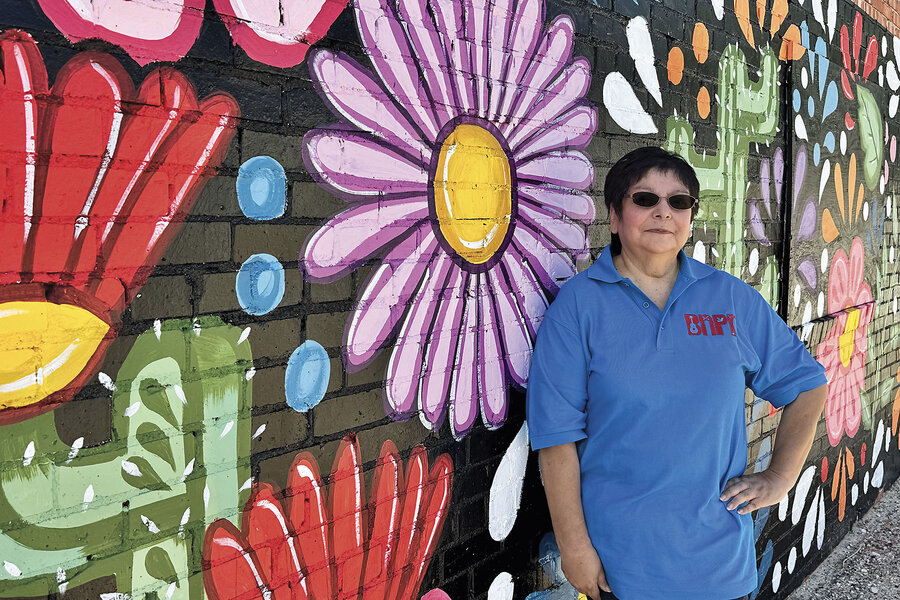
David Rosas turns off Arthur Avenue and starts walking through the old Mexican American Barrio of his childhood.The first landmark is an empty lot.His grandmother’s house once stood here, Mr. Rosas says. It was a place where relatives streamed in and out, coffee seemed always to be brewing, and everyone came to learn the family news. He has called it the family’s “bank, library, meeting place.” Why We Wrote This Many American neighborhoods carry the history of the people who built them and helped them flourish. When time erodes the bonds that define a place, new energy can help a place like the Barrio in Amarillo, Texas, renew itself. He remembers the railroad men walking home for lunch, then heading back to work. Afterward, his grandmother and a neighbor would pull out flour, water, and lard and begin making tortillas, the kitchen filling with the familiar rhythm of the rolling pins.“I wish I could hear it right now,” he says. Walking down the street a few blocks, he passes a funeral home. But Mr. Rosas knows the building by an older name: El Salón Mexicano.His grandfather, Mateo Lopez, a Santa Fe railroad worker, helped build the neighborhood hall with other residents in the 1930s as a place for dances, weddings, and quinceañeras. “The Barrio is a town within a town,” Mr. Rosas says. “We didn’t travel far.”The short walk amounts to a century of Barrio history, a story about how American communities are made, and often remade in order to endure. In the late 19th century, Mexican railroad workers, brought in through programs of the Santa Fe Railway, arrived with their families and built homes, businesses, and a Catholic church – a world within a world, shaped partly by the segregation and discrimination that kept them apart from much of the city’s wider civic life. But the Barrio can be seen, too, as a recognizable American story of frontier towns in which neighbors helped out neighbors, and civic services became a fully communal affair.Like so many small towns along Route 66, old boundaries have loosened, and families have scattered as regional economies reshape where people work and live. But the neighborhood is being rebuilt again. Their challenge is no longer how to create a community within those boundaries, but how to carry forward the belonging that grew there.There is a Route 66 irony embedded in the Barrio’s story. Its 10th Avenue was part of the original highway in 1926 – the road Americans would celebrate as the “Main Street of America.” It was rerouted north in 1932.Yet on the other side of Amarillo’s railroad tracks, Mexican American families kept building their version of the Main Street ideal: businesses, places to gather, familiar families, and a commitment to one another.■ ■ ■For Mr. Rosas, that older Main Street can be measured less in storefronts than in relationships.“Back then when you met somebody, an elderly gentleman, they asked you who your parents were,” he says. He would give his name, and the older man would begin placing him.Lupe’s son. Mateo’s grandson. Then would come the stories: Your father helped me with this. I knew your grandfather. “Being recognized by your parents and your grandparents, it’s a big deal,” Mr. Rosas says. “I mean, it carried weight.” Harry Bruinius/The Christian Science Monitor David Rosas (left) and Richard Reynoso gather at Our Lady of Guadalupe Catholic Church in the Barrio neighborhood in Amarillo, Texas, in August. His grandfather was one of the first pillars of the Barrio. His father, Lupe Rosas, carried that ethic into a different era. A World War II veteran who later worked at Amarillo’s veterans hospital, he was one of the first members of the NAACP. In the 1950s, he and two Catholic priests conducted a sit-in at one of Amarillo’s whites-only restaurants.Lupe also became one of the people neighbors sought out when they did not know how to navigate institutions beyond the Barrio. Someone needed help with a Social Security form. Someone had a problem with the city. Someone needed to know whom to ask.“When people had problems, nobody had a lawyer,” says Mr. Rosas, who dropped out of school in the eighth grade and went on to spend four decades selling cars. “My dad could figure something out. And I do that for a lot of people.”Mr. Rosas holds no public office. But neighbors call him when trash is not picked up or a dilapidated property becomes a problem. He goes to city meetings, pushes officials for neighborhood investment, and says Amarillo’s current mayor takes his calls.People sometimes call him the “mayor of the Barrio.” Mr. Rosas has given himself an arguably grander title, printed on his business card: H.M.I.C. – “Head Mexican in Charge.”His charm and levity, however, belie his seriousness. In 2017 he became part of a neighborhood revitalization process.For him, the effort is about more than getting sidewalks or city money. His grandmother’s house is gone. Relatives have scattered across Amarillo and beyond. Mr. Rosas himself lives about five miles from the Barrio.The old social geography is harder to see. “It’s getting lost,” he says.■ ■ ■Teresa Kenedy turns off Arthur Avenue onto 10th and drives slowly toward the railroad tracks, narrating the Barrio almost block by block.There are the murals marking the entrance to the old neighborhood. Then the new trees. Banners celebrating Día de los Muertos with sugar skulls. Street lamps. Bike racks. Nine street benches painted in reds, blues, and greens. Most noticeably, there are sidewalks – wide, wheelchair accessible stretches of concrete in a neighborhood where, away from the businesses, sidewalks are scarce.“What you’re seeing – none of that was here prior to April of this year,” says Ms. Kenedy, now the president of The Barrio Neighborhood Planning Committee, on which Mr. Rosas serves, too. For the old main street, it amounts to a $6.1 million makeover the organization helped facilitate.But Ms. Kenedy does not describe the project as an attempt to make 10th Avenue look new. She talks instead about making the street announce where it is – and what came before.For Mr. Rosas, the Barrio is an inheritance. He can walk its streets through generations of his own family. His argument for rebuilding the neighborhood begins with memory, but becomes a claim on the larger city: “We’ve paid taxes forever,” he says. “I want some of that money back here.”Ms. Kenedy’s attachment is chosen. She did not grow up in the Barrio, but in tiny Snowville, Utah, near the Idaho state line, where hers was the only Hispanic family for about 20 miles. Her father died when she was age 2, leaving her mother to raise seven children. Ms. Kenedy says everyone chipped in; she began working at age 9, first as a babysitter and then as a dishwasher.She arrived in the Amarillo area for college at age 20, studying to be a social worker, “connecting people with resources.”Her biography appears almost geographically during the drive. She passes Caprock High School, where she worked for 13 years in drug prevention, and then Bowie Middle School, where she spent another seven.Then she became the coordinator of a federally funded program to place the children of migrant farmworkers in school, even though they might remain for only weeks or months before their families moved on.When she retired in 2015, Ms. Kenedy, a widow with no children, committed to volunteering in the Barrio, her home for over 45 years.Together, she and Mr. Rosas represent the challenge facing the Barrio now. The first generations built a community from the ground up. Their descendants inherited its stories and obligations. The work of this generation is different: to turn that inheritance into something sturdy enough to survive change.In 2018, Ms. Kenedy became something of the Barrio’s historian. She led a task force that interviewed older residents for a book that would preserve the neighborhood’s collective memory.She conducted many of the interviews herself. When the group needed someone to turn the interviews into a book and nobody volunteered, Ms. Kenedy did that, too.The book was also part of the committee’s effort to put together a historical map. The map and the memories fed into a neighborhood plan.And the plan, eventually, became the trees, benches, and lights along 10th Avenue.Memory, in other words, became infrastructure.■ ■ ■More than a century after an earlier generation built El Salón Mexicano because the Barrio needed somewhere to gather, Mr. Rosas and Ms. Kenedy are trying to create another such place – not to restore the confining boundaries of the old neighborhood, but to give its communal life a place to flourish again.The group calls it La Plazita. Right now it’s an empty lot, but they are planning to turn it into a community park with a stage. Mr. Rosas was the one who spotted the property for sale. The city ultimately acquired it and deeded it to the planning committee.For now, there is a mural, several benches, sponsored paving stones, and a storage building. Ms. Kenedy envisions a performance stage, food trucks, mariachi musicians, folklórico dancers, pop-up markets, movie nights, quinceañeras, and wedding receptions. There will be free Wi-Fi. The committee has already begun holding events on the unfinished lot so people will get used to coming there.As she walks through the unfinished La Plazita, she also mentions the legacy of Mateo Lopez.“Here’s someone who came as a young man with his wife from Mexico to the United States, came to Amarillo, helped build this railroad, helped build a community center – and his grandson is now helping renovate this neighborhood. It came full circle, right?”
In Texas, a historic Route 66 neighborhood taps its deep roots for a revival
Full Article
Original Source
Read the full article at Csmonitor →KhanList aggregates and links to publicly available news content. We do not host full articles from third-party sources. Always verify important information with original sources.