
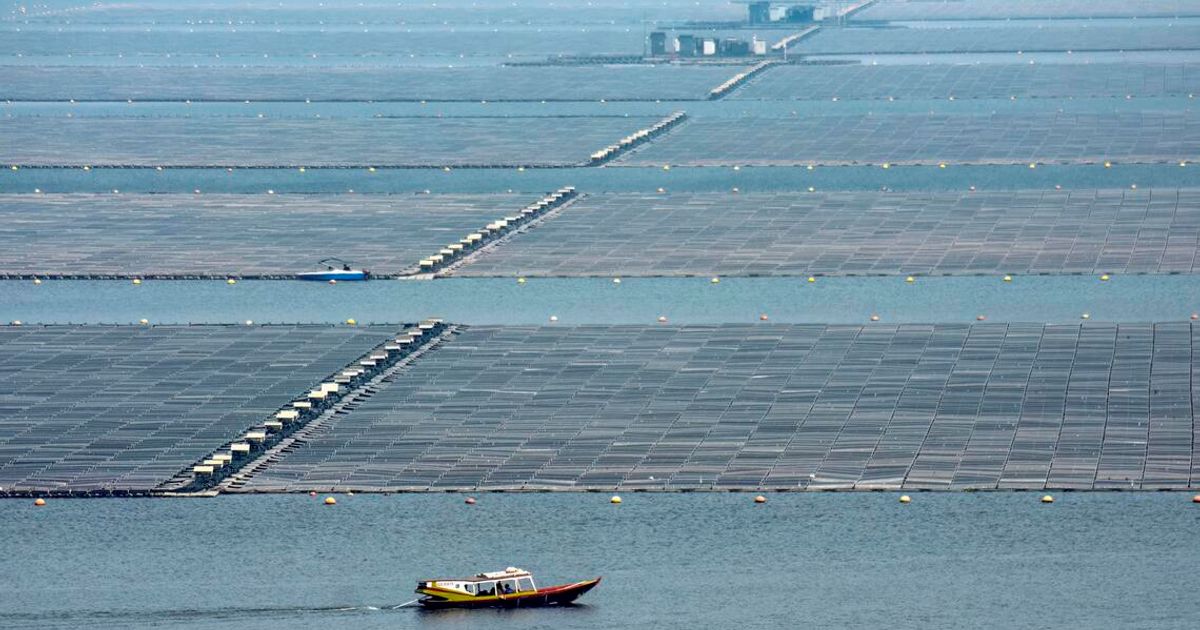
JAKARTA – An Indonesian maker of components for floating solar farms says he has had to close his factory in Batam and move back to Java, as uncertainty over renewable power exports to Singapore and over rooftop solar at home scares off investments.An executive with the company, which makes anchors, pontoons and other equipment used to build floating photovoltaic plants on reservoirs and other bodies of water, spoke on condition of anonymity as he did not want to be seen criticising the government.“What we need is certainty. Whether it’s for the domestic market or for export, we don’t mind,” he told The Straits Times in a phone interview earlier in November.“But exports aren’t clear, and the domestic market isn’t clear either. That’s a real problem for us.”His remarks came after Energy Minister Bahlil Lahadalia declared that Indonesia could not yet export electricity from Batam, reflecting a dispute over who has the authority to decide whether Indonesia should export electricity to Singapore.Bahlil said he had told sovereign wealth fund Danantara – which President Prabowo Subianto put in charge of the Singapore power trade in July – not to let itself be lobbied, adding that electricity export permits come from his ministry, not Danantara.“I put the nation’s sovereignty first, and its dignity first,” Bahlil told a mining conference in Jakarta on Nov 2.The dispute puts at risk billions of dollars of planned investments in large-scale solar and battery storage projects that Singapore needs to meet growing electricity demand and to reduce reliance on gas for power generation.“Bahlil’s overreaching stance actually damages Indonesia’s reputation in the eyes of the international business community,” Yusri Usman, executive director of the Centre of Energy and Resources Indonesia, a Jakarta-based think-tank, told ST.“Selling and exporting electricity from Indonesia to Singapore is a business-to-business matter. Those investing in solar power plants in the Riau Islands are private companies,” he added.The export plan dates back to former president Joko Widodo’s administration, and Prabowo has carried it forward. At their annual Leaders’ Retreat in Jakarta on July 6, Prabowo and Singapore Prime Minister Lawrence Wong reaffirmed their commitment to cross-border electricity trade, and Prabowo assigned Danantara to spearhead it.Under the plan, Indonesia is to supply at least 3.4 gigawatts (GW) of low-carbon electricity to Singapore. The Republic has awarded Conditional Approvals to 13 projects to import 9.25GW of low-carbon electricity from Australia, Cambodia, Indonesia, Malaysia and Vietnam. Six of these projects from Indonesia have advanced to Conditional Licences, Singapore’s Ministry of Energy, Trade and Industry says.These connections would be key to the long-planned ASEAN Power Grid, which aims to connect South-east Asia’s economies to meet rapid growth in energy and electricity demand.ST understands the maker of floating solar farm components is not the only investor hoping to tap opportunities from Batam’s solar farms. Others include giants in the electric vehicle (EV) supply chain, such as BYD, the world’s largest EV maker, and CATL, the world’s biggest EV battery maker, both of which have set up production plants in Indonesia.Both companies are capable of supplying battery energy storage systems, which store electricity when supply is plentiful, such as from solar panels during the day, and release it to the grid at night.CATL’s Indonesian joint venture has recently completed a plant in Karawang, West Java, that makes both battery cells and modules. It started construction in June 2025.Also eyeing Batam is a joint venture involving China’s Trina Solar, Indonesian conglomerate Sinar Mas and a unit of state utility PLN. It soft-launched a solar cell and panel plant in October 2024.Bahlil said after the July retreat that Singapore and Indonesia were still negotiating the price, and that Indonesian regulations give the government the authority to set it.He has insisted that any deal must be “win-win”, and has framed his caution as following Prabowo’s directive to put national interests first.Power playBahlil held back power export permits in early 2025, asking what Singapore would give Indonesia in return, before signing agreements on cross-border electricity trade with Singapore’s Minister-in-charge of Energy and Science and Technology, Tan See Leng, that June.On Oct 1, 2026, Prabowo appointed Bahlil as Indonesia’s first Coordinating Minister for Downstreaming and Energy Transition. He also remains Energy Minister.Eddy Soeparno, a deputy speaker of the People’s Consultative Assembly, told ST on Nov 4 that the June 2025 electricity pact with Singapore had yet to be followed by an implementation agreement. Eddy, from the National Mandate Party in Prabowo’s ruling coalition, previously served as deputy chairman of the parliamentary commission overseeing energy.The 2025 pact was signed alongside agreements on a joint industrial estate and carbon capture and storage, he said, adding that he believed the energy ministry was still evaluating power exports to Singapore.“I feel that whenever we have sufficient power for our domestic use, we obviously are able to export power elsewhere,” he said in an interview with ST.Solar struggleEven as negotiations on the export of green electricity remain ongoing, meeting domestic demand for solar power is also proving to be a challenge.And this is holding back domestic investment in solar power, which is potentially an even bigger market for investors than exports.Solar power, for example, has plenty of growth potential in Indonesia. At end of March 2026, only about 1.6GW of Indonesia’s power generation came from solar energy, or 1.5% of total power generation capacity, according to Jakarta-based think-tank Institute for Essential Services Reform. Polluting coal accounts for about two-thirds of total power generation.The solar equipment supplier’s complaints also extend to the home market. Under a 2024 energy ministry regulation, households and businesses wanting grid-connected rooftop solar panels must secure a share of capacity quotas, with applications accepted only twice a year, in January and July.The rooftop solar quota limits how much new rooftop capacity, measured in megawatts, can be connected to the national grid system each year. Separately, households or businesses with rooftop panels no longer get any credit on their electricity bills for surplus power they send to the grid.PLN’s quotas are set over a five-year window – totalling 5,746MW for 2024 to 2028 – and the twice-yearly quota allocation is meant to manage grid stability.But the company executive, who wanted to remain anonymous, said PLN had yet to open the July quota of the initially proposed 229MW, citing a lack of agreement with the energy ministry, leading to uncertainty for some investors.Owners pay for the systems and use the power themselves, the executive noted.“It’s their own money, for their own use,” he said. “To this day, it still hasn’t been sorted out.”The slow additions of solar power are in stark contrast to Prabowo’s ambitious plan to build 100GW of solar capacity nationally within three years.The plan, launched in Bali in August 2026, is potentially a far bigger market for suppliers, but faces hurdles of its own.Achieving the 100GW target will require large areas of land and in locations with lots of sunshine.Eddy said PLN was still selecting sites, including in Bali and parts of East Java and Nusa Tenggara, which get Indonesia’s strongest sunlight. “Obviously, it is not a matter of slow progress, but it is a selection process that PLN has to undertake, including the procurement process,” said Eddy, who stressed he was not speaking for the utility.Indonesia already has large-scale solar panel production. Energy ministry data as at September 2026 shows that Indonesia has about 25 domestic solar module manufacturers with a total annual production capacity of 4.8GW.A large percentage of the panels were initially meant for the United States. But after steep US tariffs hit those exports, the panels can be used to ramp up Indonesia’s solar power output instead, Eddy said.But demand would have to rise in step, he said, and the grid would need to handle solar power, which behaves differently from the coal-fired generation it now carries.“Will we be able to conclude the entire process within a three-year timeframe? I think it’s going to be challenging,” Eddy said. “Anywhere between four and five years would be more reasonable, in my opinion, simply because of the demand, the grid infrastructure to be developed, as well as the right incentives to be put in place.”The solar supplier executive who requested anonymity had set up the Batam plant to tap the plan to export solar power from the island to Singapore.At the time, it could make floats for 20MW of floating solar farms a month, with plans to more than double that. He said his company still has buyers, but has moved to Java because the work in Batam has dried up as the Singapore solar power export projects stall.“There’s no certainty, so even if we want to invest, we’re afraid to,” the executive said. “It’s difficult when there’s no certainty like this.”
In sunny Indonesia, a power struggle over solar energy exports risks hurting investors
Full Article
Original Source
Read the full article at Straitstimes →KhanList aggregates and links to publicly available news content. We do not host full articles from third-party sources. Always verify important information with original sources.