
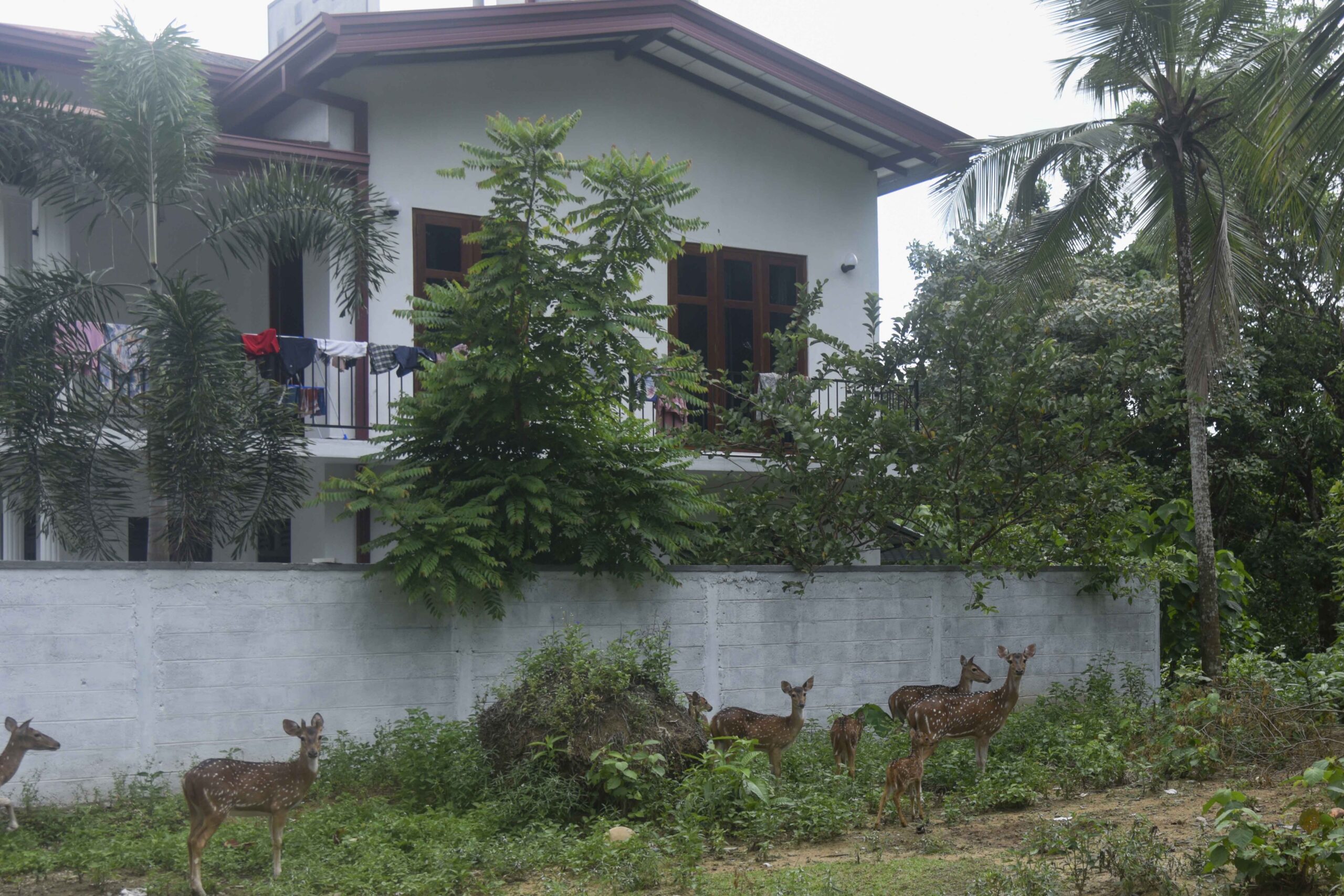
Habitat fragmentation, a constant search for food sources and a decline in predators are collectively contributing to wild animals moving into more urban areas, experts say, leaving them vulnerable to conflict with humans.Since 2018, veterinarians have observed a spike in air rifle attacks on monkeys rescued from the island’s commercial district, Colombo.Meanwhile, primatologists warn that feeding primates such as purple-faced leaf langurs and open dumping of waste in urban areas may encourage pest behavior, driving human-wildlife conflict.Among the animals increasingly sighted in these environments are Ceylon spotted deer, which are proving increasingly vulnerable to road accidents, according to wildlife authorities. COLOMBO – It was a surprise for Mohamed Fareed, a resident of Jawatte, an upscale neighborhood in Sri Lanka’s commercial capital Colombo, to find a peacock near his house back in 2020. Today, there are at least 12 peacocks, including peahens roaming the area. “In the mornings and evenings, we hear their loud and piercing calls and now the neighborhood is used to their presence,” he told Mongabay. “Sometimes we see them on rooftops. Children are quite excited to see them. These peacocks frequent the area near the mosque to feed on pigeon feed inside the Jawatte mosque.” Peacocks have been frequently spotted in densely populated areas such as Kollupitiya and Mount Lavinia and, similar to Fareed, many residents are seeing peacocks near their home for the first time in their lives, and the numbers are increasing. Change in territory According to Sarath Kotagama, a professor of environmental science and former head of the Department of Zoology at the University of Colombo, historical reasons linked with environmental parameters such as temperature may confine an animal to the dry zone – which roughly covers two-thirds of the island across its northern, eastern, and southeastern regions, characterized by low annual rainfall and long dry seasons –or the wet zone, characterized by high year-round rainfall, lush tropical rainforests and major tea and rubber plantations. “In Sri Lanka, peacocks were mainly found in the dry zone and not the wet zone,” he told Mongabay. “But if conditions in the wet zone change to help or change to an extent that becomes conducive to the bird, there’s no reason why it cannot come into that location.” Primates are often seen in Colombo in troops. This mother looks straight into the camera while holding her offspring securely from a tree top. Image by Dilrukshi Handunnetti. He noted that people have changed the landscape by felling trees, clearing forest patches and changing the distribution of vegetation types, enabling peacocks to move into the wet zone. “Another primary reason is temperature,” he said, Secondly, if it feeds on grains and foliage, and if it becomes available in another location, there’s no reason why it can’t go there and survive by feeding on it,” he said. Expanding road network Another contributing factor is improved road connectivity. It is much easier to move to the wet zone, according to Kotagama, due to the expansion of the road network, mainly the expressways. Roads did exist in the past, but the roads of yesteryear are extremely different to today’s expressways, he said: “On either side of the Southern Expressway, there’s an area that had been cleared. This has created at least 300 meters [984 feet] of a clear path from the dry zone all the way to the wet zone. “So, an open habitat is going to connect the whole country, and it is a different habitat in every sense. This clear strip of land would enable peacocks and even other animals having the ability to adapt, to move from the dry zone to the wet zone easily.” Scientists note that Leaf monkeys are regularly seen in home gardens in Colombo and its suburbs as their natural habitats become fragmented and they search for new habitats. These visitors sometimes turn aggressive and destructive, they say. Signboard along the Southern Expressway cautioning travelers about an area frequented by peacocks. Image courtesy of Katrina Willis. Charmalie Nahallage, a primatologist and a professor at the department of anthropology, University of Sri Jayewardenepura, told Mongabay that monkeys that used to live in forests are losing habitats due to various developmental activities. This has resulted in leaving only small forest patches in Colombo and its suburbs rather than continuous forest canopies once inhabited by a variety of species, she said. “Purple-faced leaf langurs are an arboreal species and they live on trees,” she said. “When there is no way to move from tree to tree, they use rooftops, electric and telephone wires to aid their movements.” According to Nahallage, macaques are urban primates and their lifestyles are completely different. “Macaques prefer to live close to human settlements,” she said. “The purple-faced leaf langurs have no other place to live except in people’s home gardens, temples and lands with large trees. They don’t want to live close to humans but due to habitat destruction, they are forced to do so.” The reason why primates such as macaques and purple-faced leaf langurs turn into pests is due to people feeding these animals, driving behavioral change, she added. Another driver is the haphazard dumping of garbage into open spaces, specially food waste. Then there are species one cannot imagine meeting in the heart of a commercial district in Sri Lanka, but now possible to occasionally find, such as a spotted deer. The history of the spotted deer (Axis axis ceylonensis) roaming Homagama, a suburb of Colombo, dates back to the 1950s. According to local media, the Department of Wildlife Conservation (DWC) has said a colony of around 1,500- 2,500 individuals are currently found in Homagama and nearby towns. Peahens at a neighborhood in Mount Lavinia, a Colombo suburb. Image courtesy of Thuwan Mansoor. According to Kotagama, spotted deer is primarily a dry zone species found in open landscapes such as Yala in the South and Wilpattu in the island’s North. They need shade for daytime protection and grasslands for feeding. Caring for the animals Urban wildlife living in highly populated areas are vulnerable to road accidents and other human-related consequences such as air rifle attacks. The Attidiya Wildlife Rescue and Rehabilitation Centre is one of the main centers that treat wild animals daily. In 2025, the Attidiya center received a total of 4,855 cases. These include 1,822 mammals such as deer and monkeys, 1,879 birds and 1,154 reptiles and other species. The number of species that had recovered from treatment include 643 mammals, 675 birds and 848 reptiles, totaling 2,167 animals that were eventually released back into their habitats or the wilds. Pramuditha Devasurendra, wildlife veterinarian and officer-in-charge of the Attidiya center said that generally 80% of cases are due to electrocution and road accidents. The center has observed a spike in air rifle attacks on monkeys since 2018, he said. “Monkeys also attack one another and get injured,” he said. “We get a considerable number of such cases. During the rainy season, animals develop diarrhea,” he said. A deer carcass recovered from Homagama, a Colombo suburb. Image courtesy of Bimal Shyaman Jayasinghe. Explaining fatalities of other animals, Devasurendra said that birds encounter electrical wires and kite strings. Treating injured birds is one of the most frequent tasks the center has, he said. “Turtles are mostly injured after they get entangled in fishing nets,” he added. “In the case of tortoises, they are kept as pets and are sometimes given to us. In most cases, their shells have been damaged due to road accidents. Some animals such as rattlesnakes and reptiles are affected by melting asphalt on roads especially in April-May when it’s warmer.” He noted that the center mostly receives chronic cases for treatment and that the recovery rate has increased compared to a few years ago. Th e recovery rate of serpents and reptiles is about 70% while for monkeys, it is about 20-25%, he said. Interventions by wildlife authorities Speaking to Mongabay, Hasini Sarathchandra, media officer at DWC said that spotted deer have become increasingly vulnerable to road accidents over the years. Injured animals are sent to the Attidiya Wildlife Rehabilitation Centre for treatment and, once recovered, the animals are released to the wilds. “While the animals are under treatment, their health conditions are closely monitored,” he told Mongabay. “We should be very vigilant about their health conditions. We check whether they have developed zoonotic diseases or whether they have bugs prior to releasing them to the wild.” Recovered animals are transported to the Udawalawe National Park, approximately 118 kilometers (73 miles) southeast of Colombo, and released to the wild. According to Sarathchandra, translocation initiatives for spotted deer have so far been successful. Clear strips of land along expressways would allow more animals to move from the dry zone to the wet zone. Image via Maga Engineering Facebook page. Sarathchandra said part of the problem, however, lies elsewhere. For example, the spike in the number of peacocks is linked to a decline in the jackal population, she said: “Jackals used to feed on peacock eggs. Without jackals, the number of peacocks in urban areas have spiked.” Primatologist Nahallage points to a stark reality: When food chains and food webs are disrupted, it can create an imbalance in predator-prey populations. “Apart from jackals, even rattlesnakes used to feed on peacock eggs,” she said. “But now you hardly see rattlesnakes in urban spaces they were once easy to find.” Coexistence is only possible if people accept that these animals are not pests, professor of environmental science Kotagama said. Banner Image: Spotted deer is primarily a dry zone species but since the 1950s, deer herds have roamed Homagama in Sri Lanka’s Western Province. Image courtesy of Akila Jayawardena. Credits Topics
In Sri Lanka, human actions are driving wild animals into cities and suburbs
Full Article
Original Source
Read the full article at News →KhanList aggregates and links to publicly available news content. We do not host full articles from third-party sources. Always verify important information with original sources.