
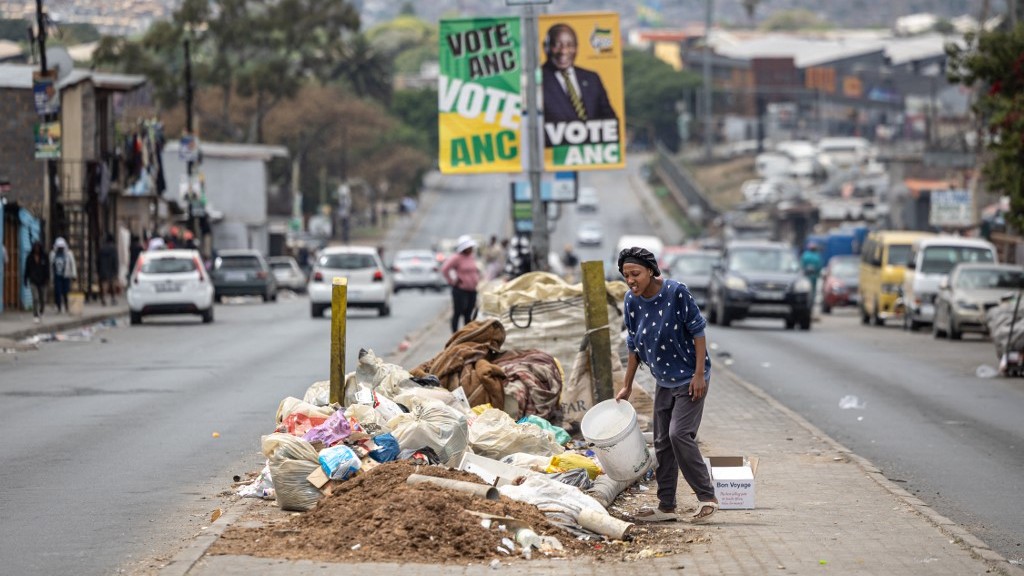
On 4 November, millions of South Africans will head to the polls to elect municipal councils, choosing representatives tasked with keeping the water running, collecting rubbish and fixing potholes. But amid deteriorating infrastructure, rising costs, and frustration with local government, Israel’s genocide in Gaza has become another dividing line for some voters preparing to cast their ballots next week. Although South Africa took Israel to the highest court of the United Nations, the International Court of Justice (ICJ), in December 2023, on the charge of violating the genocide convention in the Gaza Strip, not every political party supports the case or agrees with the characterisation of genocide. The Democratic Alliance (DA), which governs alongside the African National Congress (ANC) in a government of national unity, has yet to congratulate South African jurist Navi Pillay on her Nobel Peace Prize awarded three weeks ago, with senior leaders describing her work on genocide as "divisive". Pillay currently serves as a judge at the ICC. The pro-business, pro-Israel DA was formed in 2000 through an alliance with several parties, including the successor to the National Party, which governed apartheid South Africa. New MEE newsletter: Jerusalem Dispatch Sign up to get the latest insights and analysis on Israel-Palestine, alongside Turkey Unpacked and other MEE newsletters The disagreement has left many voters with a conundrum. Amid an economic downturn, astronomical inflation, and corruption, they are being asked to choose between parties that have failed to deliver basic services and those that promise change but hold weak positions on the genocide in Gaza, where over 74,500 people have been killed to date. Nowhere is that tension more apparent than in Johannesburg, the country’s economic engine. Here, residents are being urged to rescue their city from years of mismanagement, corruption and decay by handing it over to the DA, which runs the Western Cape, including Cape Town. The suggestion that the DA offers Johannesburg its best chance of recovery has sparked fierce debate among activists and academics, exposing divisions over the weight voters should give the party’s position on Gaza. 'Saints and sinners' Last week, Adam Habib, the South African vice-chancellor of SOAS University of London, urged Johannesburg residents to back Helen Zille, the DA's candidate for mayor. Habib wrote on X that he was shocked by the state of the city during a recent visit and argued that Zille, who was mayor of Cape Town between 2006 and 2009 and then premier of the Western Cape between 2009 and 2019, offered the best plan of recovery, despite his personal objections to her position on Gaza. The DA came to power in Cape Town as part of a coalition in 2006, before winning an outright majority in 2011, and has governed the city since. Residents fill up buckets of water from a communal tap in Alexandra, near Johannesburg, on 5 October 2026 (Emmanuel Croset/AFP) As several cities run by the ANC or coalition governments have fallen increasingly into disrepair, Cape Town has developed a reputation for competent governance. “We are not choosing between saints & sinners. There does not have to be a trade-off, but there is one now. I would prefer my mayor to pronounce on genocide, but if I had a choice between a corrupt mayor & an honest one who cannot pronounce genocide, I will take the honest one,” Habib wrote. “Zille is the only candidate if we want power, water, services & honesty & competence. Zille is the only candidate if Johannesburg is to survive.” 'Our hardwon Constitutional values and rights are not middle-class luxuries' - Irfan Mangera The country's richest city has had seven mayors over the past five years, as coalition governments have quickly unravelled. But activists in Johannesburg and Cape Town argue that, beyond the moral bankruptcy of ignoring Gaza for the sake of streetlights and smooth roads, Cape Town’s reputation as the country’s best-run city is at best a myth sustained by its wealthiest residents. They reject Habib’s argument - shared ostensibly by middle- and upper-class South Africans - that a leader can deny genocide and still be considered honest. "The people of Johannesburg deserve functioning services by honest and capable leadership and leaders whose moral compass does not disappear when confronted with injustice (past, present and future)," Irfaan Mangera, a member of the Rise Mzansi National Leadership Collective, told Middle East Eye. Mangera said Habib's comments "lacked political imagination" and constructed "a false dichotomy between administrative competence and moral conviction as though the two cannot coexist", adding that demanding functioning services should not mean lowering political expectations of local leaders. "Our hard-won Constitutional values and rights are not middle-class luxuries," Mangera said. While the DA has received a battering for its ostensibly “neutral” stance on Israel and Palestine, critics argue that the ANC has used the government's decision to take Israel to the ICJ to distract from its incompetence. For all its talk of commitment to redistributing wealth, other observers say the ANC's embrace of neoliberal economic policy, including prioritising privatisation and bending to corporate power, has severely limited its ability to address the needs of the poor and reverse the inequities created by apartheid. Myth of 'good' governance Near the southernmost tip of the African continent, Cape Town is considered a tourist’s paradise. Its affluent city centre, leafy suburbs and manicured gardens, shadowed by cliffs that hang over the Atlantic Ocean, have earned it a reputation as one of the world’s most beautiful cities. But that beauty conceals deep inequality and divisions still shaped by apartheid. A general view of Devils Peak (L), Table Mountain and the city center (C), and Lions Head (R) in Cape Town, on 13 June 2024 (Wikus de Wet/AFP) Beyond the Instagram-ready images of Cape Town’s mountains and beaches sit townships where sprawling informal settlements house hundreds of thousands of people, many of whom are the workers who sustain the city’s service economy. Here, the city's services are either non-existent or too costly to access. Colombia stopped energy exports to Israel - so why did South Africa and Brazil not do so? Read More » Elethu Nkala, programme manager at the Pivot Collective in Cape Town, told MEE that calling Cape Town the best-run municipality in the country was "a bold claim", given the living conditions of people in the townships and how the city deals with areas deemed poor or dangerous. "The development policies it pushes are concerning. There is a disconnect between the people and the way the government approaches development," Nkala said. In January, the city proposed a series of measures, including the N2 Edge safety project, which would involve building a wall to improve safety along a nine-kilometre stretch of highway. Activists immediately compared the project with the apartheid wall in the occupied West Bank and called on the city to tackle the root cause of crime instead, and invest in improving the quality of life for residents living in the informal settlements. A soldier from the South African National Defence Force stands on a slide in a playground during a patrol in Mitchells Plain, near Cape Town, on 1 April 2026 (Rodger Bosch/AFP) Likewise, earlier this year, the city faced criticism for deploying heavily equipped SWAT officers and military-style vehicles in the Cape Flats area to address gang violence. Opposition parties and activists say the approach would only further militarise communities and that it failed to address the underlying causes of crime, including inequality, which remains among the highest in the world. 'They are importing Israeli logic into South Africa to reinforce spatial apartheid in Cape Town and then calling it effective governance -PSC spokesperson "They are neglecting their community development mandate and overemphasising and overfunding their policing mandate," Brett Herron, GOOD Party mayoral candidate, told local media. Likewise, a spokesperson for the Palestine Solidarity Campaign in Johannesburg said the turn to "building walls" and "deploying troops" to “fix” social, political and economic inequalities had a distinctly Israeli ring to it. "They are importing an Israeli logic into South Africa to reinforce spatial apartheid in Cape Town and then calling it effective governance," the spokesperson said. A 2023 study by the Human Sciences Research Council found that almost 40 percent of the residents in the poorest neighbourhoods in Cape Town could access water outside their properties - at communal taps - whereas 36 percent relied on communal shared toilets. Whereas Cape Town is also generally seen as safer than other cities in the country, townships within the city experience "among the highest levels of violent crime in the country, including gender-based violence, drug dealing, gangsterism, vigilantism and murder", the report found. The report concluded that solving crime would involve "building a common commitment across different groups to narrow the gap between neighbourhoods and to expand the economy in an inclusive manner". It urged the city to "rethink its approach to service delivery and collaborate with communities, civil society organisations and the private sector to empower people to rebuild their troubled communities". Children play football outside an informal settlement in Clare Estate, Durban (Azad Essa/MEE) 'Tangible connections' The city of Durban, on the east coast, is routinely beset by water cuts, sewage spills and a severe housing shortage. Here, residents squeeze into informal settlements in a city where pre-apartheid inequalities regarding access to services, transport and economic opportunities persist. Children play in sludge from unseasonal rains amid rotting garbage strewn across pavements and driveways. Navi Pillay, eminent South African jurist, awarded the 2026 Nobel Peace Prize Read More » Young, unemployed men loiter around small "spaza" shops, local parlance for convenience stores, and hang around hardware stores, looking for part-time work. In Durban, too, promises to repair the city have become entangled with the debate over Gaza. Last week, Hossain Haniff, the DA's mayoral candidate in Durban, said at a debate that he would be open to inviting Israeli Prime Minister Benjamin Netanyahu, if his visit would benefit the people of the city. His comments elicited outrage among civil society groups and activists who say that it is impossible to separate domestic politics from international crimes of dispossession because these acts of erasure would influence how cities are governed and whether rights are ultimately upheld at home. South Africa has faced pressure from both the US and Israel over its stance on Gaza, including its decision to take Israel to the ICJ for violations of the Genocide Convention. US President Donald Trump cut aid to South Africa in February 2025, citing the genocide case and its land reform policies. He has also falsely accused Pretoria of carrying out a genocide against white farmers. "These matters are connected. And it's not some romantic idea of solidarity or morality. There are tangible connections between what is happening in the municipalities in South Africa and what is happening in Palestine," a spokesperson for the Palestinian Solidarity Campaign in Gauteng told MEE. "Inequality in South Africa is a municipal issue and a national issue, and this issue is also connected directly to the genocide," the spokesperson said.
In South Africa, municipal elections collide with solidarity for Gaza
Full Article
Original Source
Read the full article at Middleeasteye →KhanList aggregates and links to publicly available news content. We do not host full articles from third-party sources. Always verify important information with original sources.