
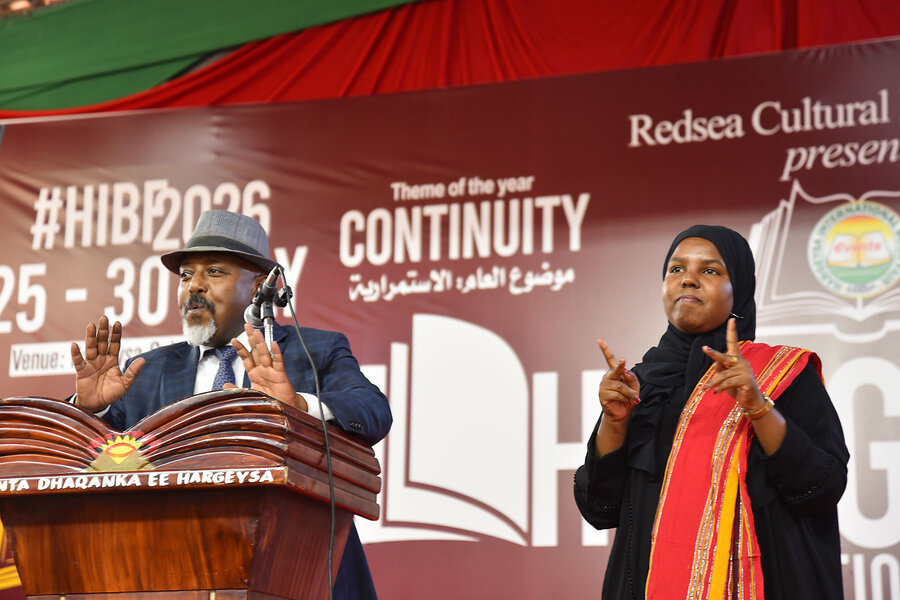
On an evening in late July, poet Suhaib Faro stood on stage at the Hargeysa International Book Fair and began to tell a love story.Sitting in tight rows of plastic chairs, members of the audience sipped cups of coffee with camel milk as Mr. Faro spoke lyrically of beauty and lifelong devotion. “I was raised to protect the inviolable, to take pride in your nobility, to swear against [your] humiliation,” he intoned.The subject of his adoration was not a person, but Somaliland itself. Poetry, Mr. Faro says, “is the easiest way to express the love of country.” And this particular ballad punctuated an unprecedented turn in Somaliland’s history. Why We Wrote This In Somaliland, a major book fair is putting the unrecognized country on the literary map. Since declaring independence from Somalia 35 years ago, Somaliland has lived and breathed as its own nation, with a government, tax system, and currency. But until recently, no other country had ever formally acknowledged its existence. That changed last December, when diplomatic recognition from Israel brought Somaliland to the cusp of a new chapter in its history – one its young writers hope to help shape with their words.“We are a nation of poets,” says storyteller and curator Muna Ahmed Omer. “If someone wants to understand the people of Somaliland, they should read and see the people through poetry.” Suhaib Faro, a poet from Somaliland, writes about subjects ranging from patriotism to heartbreak. “Food for the mind”For the book fair’s founder, Jama Musse Jama, art is essential to the building of a nation. Somaliland, he argues, “still struggles to explain to the world where we are coming from ... and what we imagine for the future.”Dr. Jama himself vividly recalls where the country came from. In the 1980s, after decades of neglect, Somalia’s northernmost territories rose up against the government in Mogadishu. The military government put down the rebellion with brutal force.By the time Somaliland declared independence in 1991, Hargeisa – as the capital is usually known in English – had been flattened, with at least 70% of the city destroyed. Many Somalilanders lacked basic needs like shelter and food. But Dr. Jama, a mathematician who spent the war years in Italy, wanted to make sure the artistic scene was resurrected, too. “You [also] need food for the mind,” he says. Without that, he says, you risk losing “what makes human beings humane.”Dr. Jama began by creating an archive to help Somalilanders remember the war they had lived through, and to preserve the cultural identity that the Mogadishu government had tried to destroy. “Art, literature, and culture should be part and parcel of state building,” he says. And so he collected everything from rugs and court documents to recordings of Radio Hargeysa broadcasts.The radio broadcasts and other recordings captured the sweeping role oral poetry has long played in Somali societies, where it is a vehicle for everything from matters of the heart to matters of taxation, nepotism, and political freedom. “The country teems with ‘poets, poetasters, poetitos, and poetaccios,’” wrote British colonial explorer Richard Burton after visiting the region in 1850, noting that Somali language “abound[ed] in poetry and eloquence.”Despite its rich oral tradition, however, there was no standardized way to write in Somali until 1972. By the time Dr. Jama established his archive in the 1990s, there were fewer than 200 Somali-language books in print. Ryan Lenora Brown/The Christian Science Monitor/File The war memorial in central Hargeisa commemorates the sacrifices of Somalilanders during the Somali civil war in the 1980s. The center of the memorial is a MiG-17 fighter plane from the Somali Air Force, which crashed during a government bombing campaign of Somaliland in 1988. “When we lose a poet,” he says, “it is like burning an entire library.”He set out to change that, organizing his first book fair in 2008. Its slogan captured the entanglement of politics and literature in Somaliland: Gobannimo bilaash maaha – “Sovereignty is not free.”Since then, the fair has grown into a major venue for Somaliland to broadcast its existence to the world. For one week every July, thousands of local and international attendees fill Hargeisa’s usually sleepy hotels and cafes with excited chatter about the arts and politics. Between book launches and poetry readings, they attend traditional dance and music performances. Although the book festival is one of the largest in the region, Somali-language literature remains its heart. In particular, the fair offers a platform for young Somalilander writers to tell their stories in their own language – something many here see as fundamental to the country’s identity.“Let reading be your foundation. Let writing be your voice,” said former minister of foreign affairs, Edna Adan Ismail, at the festival’s opening. “Let knowledge be your contribution to the peace and development of our nation, Somaliland.”Somaliland to the worldWhat Somaliland’s young writers want to say goes well beyond politics.After Mr. Faro delivered his poem about Somaliland, he recited an ode to a woman who left him. Not every piece of writing needs to be about sweeping subjects like nationalism, he says: “The country is at peace, and we are a new generation.”The book fair also saw the launch of “Baadi Goob” – “The Search” – a novel about the challenges faced by a young man as he moves from the countryside to the city. It was loosely inspired by writer Khalid Mukhtaar Bade’s own life.A student of computer science, Mr. Bade writes late at night in his bedroom. Publishing his first book, he says, “makes me feel proud of myself. I am giving back to the community and to the people.”But telling Somaliland’s stories is not easy. There are only a handful of publishers in the country, and authors must pay to have their manuscripts printed. It costs even more money to have those words translated and shared with the non-Somali-speaking world.Still, new bookshops and galleries are springing up around Hargeisa, which many see as a hopeful sign for the future of literature here.“I have seen a lot of people who are falling in love with books,” says Ms. Ahmed Omer with a smile.
In Somaliland, a book fair is writing a nation into existence
Full Article
Original Source
Read the full article at Csmonitor →KhanList aggregates and links to publicly available news content. We do not host full articles from third-party sources. Always verify important information with original sources.