
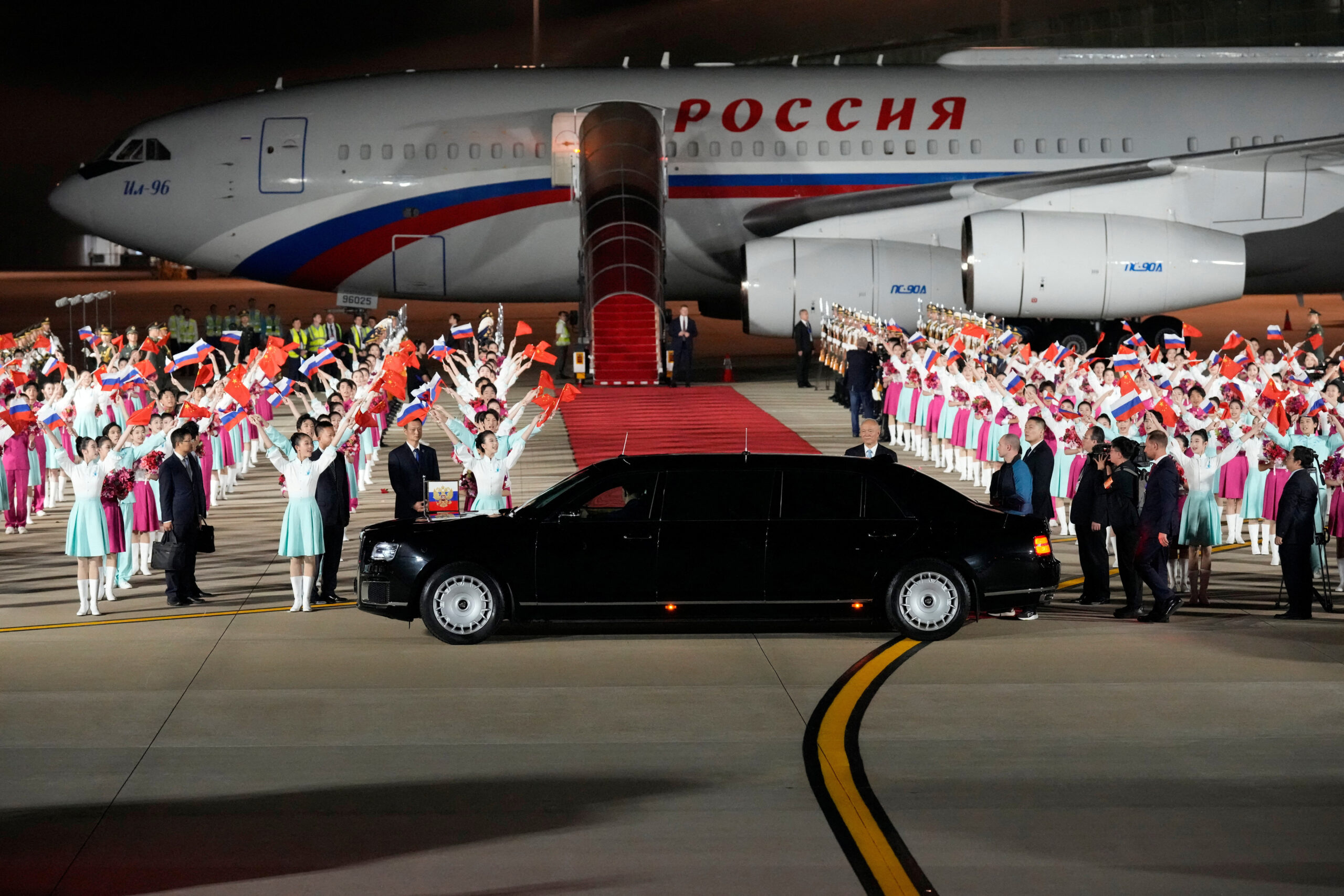
In the southern Chinese city of Shenzhen tomorrow, three of the world’s most powerful men will come together for a meeting without precedent. US President Donald Trump, Russian President Vladimir Putin, and Chinese President Xi Jinping command the world’s most formidable military powers and possess vast nuclear arsenals. Each harbors an outsized ambition to leave his mark on history. Even so, what makes this gathering so extraordinary is not these men’s strengths but their weaknesses. Because of that, Shenzhen won’t be the birthplace of a new world order. Rather, it will provide further evidence and perhaps mark the acceleration of the old order’s unraveling—without any consensus about how to replace it. The big three Look at the three participants. Trump’s authority has been shaken by his party’s midterm election setbacks, by mounting fiscal pressures, and by growing doubts among allies about the United States’ reliability and strategic purpose. Putin’s war on Ukraine, now into its fifth year, has drained the Kremlin’s resources, resulted in an estimated 1.5 million Russian casualties, deepened Moscow’s dependence on Beijing, and exposed the limits of Russian power. Xi comes to Shenzhen in the strongest position of the three, backed by historic economic and technological gains. Yet his economic miracle is faltering amid a property crisis, demographic decline, sluggish domestic demand, and international distrust. “It’s really a summit of the three weaknesses,” Italian Senator Carlo Calenda told the Wall Street Journal’s Yaroslav Trofimov. “Russia is economically broken, and militarily experiencing a disaster. Trump is now a lame duck with a difficult situation at home. And China is facing grave economic difficulties. All three are in a much more precarious position than it seems.” Nevertheless, some experts are comparing this week’s meeting to Yalta in February 1945, where the “big three”—Franklin Delano Roosevelt, Winston Churchill, and Joseph Stalin—discussed the postwar reorganization of Germany and Europe. Shenzhen will be nothing like that. This summit is at once less promising and more dangerous than Yalta. It is less promising because the three leaders lack any common vision or potential roadmap deserving global attention. (Which is not to say they can achieve nothing. While unlikely, it would be a positive outcome if China for the first time agreed to nuclear arms talks, or if the three could chart some way forward on Iran.) At the same time, Shenzhen is more dangerous because both China and Russia, for their separate reasons, wish to replace the global order of rules and institutions that the United States and its allies constructed after World War II with something of their own making. The US president, for his part, has shown too little determination in preserving that order or pushing back on Sino-Russian ambitions. “Yalta is on analysts’ minds because it has long been a dream of Russian imperialists to restore Moscow’s control over Eastern Europe that was lost at the end of the Cold War,” says the Atlantic Council’s John Herbst. “But the difference now is Russia is enervated by its aggression in Ukraine. In 1945, Russian armies were on the ground throughout eastern Europe; dislodging them would have required a new war. Putin is now trying to take by guile with the White House what Stalin took with many divisions of the Red Army.” Foreign affairs columnist Gideon Rachman of the Financial Times puts it this way: “A potentially tragic outcome from the Shenzhen summit is also easy enough to envisage. If things go badly wrong, the three leaders could end up agreeing to recognize each other’s ‘core interests,’ to use a phrase China is fond of. They could endorse a Russian view of the Ukraine war and a Chinese view of the future of Taiwan. Trump might be given some help over Iran or some ‘wins’ for the US economy.” Rachman is right that “the brevity and structure of the meeting” make any such far-reaching agreements unlikely, and a domestically challenged Trump would have greater trouble now getting acceptance at home for anything too broad in scope. Trump administration advisers have long entertained the ambition of luring Russia from China’s embrace, but Moscow and Beijing have grown far too close, and the former far too dependent on the latter, for that to happen. Different men, different ambitions Trump, Xi, and Putin arrive in Shenzhen with contradictory incentives that lack complementary ambitions. Trump has spent much of his second term seeking to renegotiate the United States’ obligations and enhance its advantages without embedding those moves in any larger strategic vision. Putin seeks to overturn fundamental elements of the European security architecture that arose after Soviet collapse and Cold War defeat. His goal is to reestablish Russia’s privileged sphere of influence, beginning with a settlement of its war against Ukraine that leaves all its options open. This past weekend, the New York Times broke the story on a list of demands Russian negotiators shared during the recent talks in Abu Dhabi that only underscore Moscow’s revanchist goals. Xi is the most globally ambitious of the three, seeking to reshape international institutions and power relationships to reflect China’s rise, with Taiwan as the ultimate prize. It will be enough for him in Shenzhen to buy time and win Trump’s agreement on extending the two countries’ trade truce and the US pause on arms deliveries to Taiwan. What he won’t want is any surprise in the trilateral meeting from an unscripted Trump or an overly ambitious Putin to distract from his successful convening of the Asia-Pacific Economic Cooperation summit. Shaken assumptions, new constraints Shenzhen also will be the world’s first chance to see how the dynamics among these three leaders might be shaped by events this month in the United States that have changed the global landscape in significant ways. I have just returned to Washington from nearly three weeks of travel to Europe, the Middle East, and China. In that time, the political trajectory of the United States and the country’s technological future have been thrown into question. First, American voters delivered a midterm electoral rebuke to Trump, handing Democrats control of both houses of Congress. Then Jensen Huang, reeling from revelations of an affair with an alleged Chinese spy, resigned as CEO of Nvidia, the multi-trillion-dollar company that has become synonymous with the artificial intelligence (AI) revolution. The US midterms have raised the question of what impact American democracy’s course correction might have on its international strategy and relationships with adversaries and allies. The Nvidia leadership shakeup underscored a different question: Is the extraordinary concentration of technological power in a handful of US companies and American individuals sustainable, and what happens to the global AI race when that leadership changes? Both the midterm results and Huang’s departure could contribute to greater US-Chinese tensions. The US and China could become even fiercer competitors now in the tech space, as Washington—under growing pressure from Congress—is likely to crack down more on sales of the most advanced semiconductors to China, to which Beijing would likely respond by imposing new limits on the sale of rare earths to the United States. That brings us back to Shenzhen. Some of the summit’s significance will lie in what it reveals about the calculations, constraints, and ambitions of the three leaders in this new context. Will Trump emerge strengthened by the encounter or diminished by the political verdict at home in a manner that leaves him vulnerable to Xi and Putin? Will Xi act in a way that more aggressively exploits American vulnerability or continue his efforts to stabilize relations? Will Putin use the meeting as another chance to divide Washington from its European allies over Ukraine? All three men are driven by grand historic ambitions, yet each confronts a widening gap between what he seeks and what he can deliver. Shenzhen is worth watching for clues as to whether their shared vulnerabilities encourage accommodation or confrontation. Whatever the specific outcome, weakness rather than strength may prove the most consequential force in Shenzhen.
In Shenzhen, weakened giants navigate a dangerous, disorderly world
Full Article
Original Source
Read the full article at Atlanticcouncil →KhanList aggregates and links to publicly available news content. We do not host full articles from third-party sources. Always verify important information with original sources.