
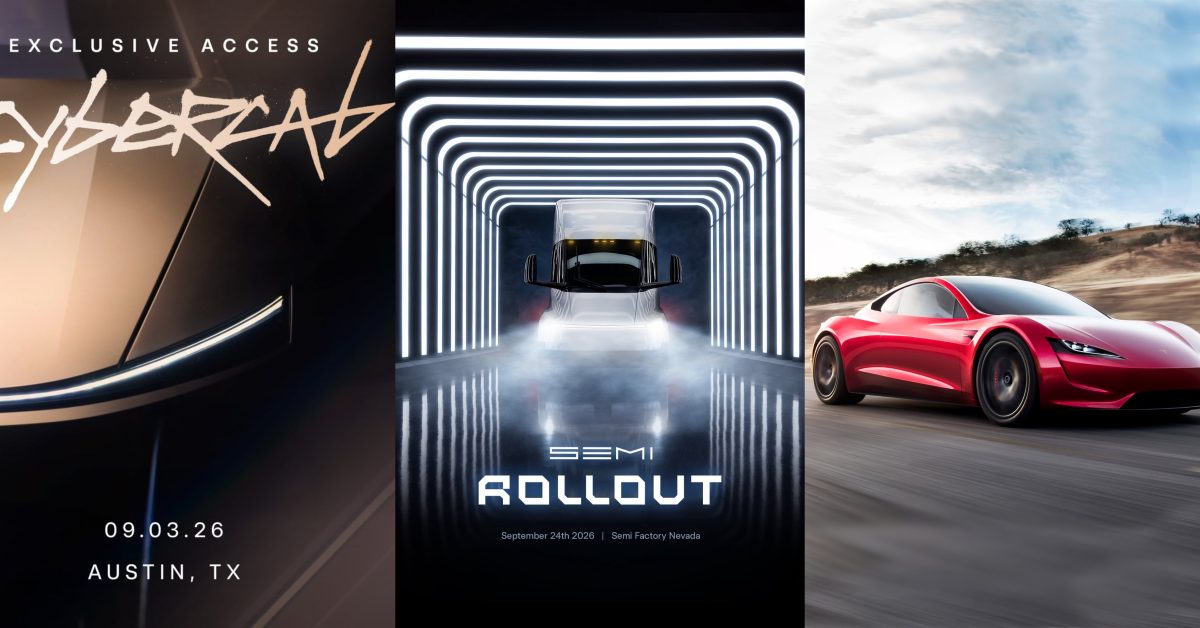
Tesla has a packed September ahead of it, with two confirmed and one rumored product launches. For a company that has gone so long without new products, it would be a big month… if all three of those products hadn’t been launched years ago already. It’s September 2026, and we’ve got a lot to look forward to in the EV space. First up, we’re finally going to see the launch of the Tesla Cybercab this Thursday, September 3. The Cybercab is a small, two-seat vehicle intended to be used fully autonomously as a robotaxi, and doesn’t even have a steering wheel or pedals, as it’s meant to operate without a driver at all times. Second, Tesla has confirmed that late this month it will roll out the Tesla Semi, a fully-electric heavy duty semi truck. This promises to make goods delivery more efficient, which is important given that larger vehicles are responsible for well more than their fair share of the pollution that harms human health. There are other electric semis, but Tesla claims to offer a better value proposition than the rest of them. Finally, there’s the specter of the next-gen Tesla Roadster. While nothing is announced yet, Tesla designer Franz von Holzhausen said the Roadster is coming “very soon,” and we have heard some rumors suggesting the month of September. The Tesla Roadster is meant to be a fully electric hypercar with bonkers performance specs, which CEO Elon Musk has said will be the “last best driver’s car” but also says that it will be able to “fly” (which doesn’t make sense). It would be an exciting month… if we hadn’t been hearing about all of these products for years now. Cybercab unveiled in 2024, but the idea is much older The Cybercab is the newest of the three, having been originally revealed in 2024. That’s an acceptable time between reveal and production, if actually even a little quick (well, as long as we’re not comparing to China’s EV timelines). But that ignores the years of robotaxi-related talk from Musk, who originally suggested way back in 2016 that Tesla owners who purchased FSD (software which the company sold for as much as $15,000 and still has not delivered) would be able to send their cars out as autonomous taxis to make them money. At the time, this was meant to apply to Tesla’s consumer vehicles, and Tesla called the concept “Tesla Network.” Now, it’s branding it as “Robotaxi,” and Tesla has sent out its own vehicles to make money using FSD, but still won’t let you do it, despite that it sold software on the promise that you could (and that this software would turn cars into an “appreciating asset” due to gradual technological unlocks). Tesla even cancelled the planned Model 2, an affordable consumer vehicle, to make room for the stripped-down Cybercab, which we have no indication will be purchaseable by consumers. And don’t forget: Tesla has not solved self-driving. Neither the consumer-available FSD nor the Robotaxi-exclusive version that allows operation without someone in the driver’s seat is truly capable of unattended operation at all times, or even in more than a few geofenced areas. Releasing a car with no steering wheel makes no sense before you solve that problem. So while we’ll soon see the Cybercab in some sort of action, it is based on a concept that is more than a decade late, it still doesn’t deliver on its promises, and Tesla turned it from something that would be publicly-available and that people spent tens of thousands of dollars on into something that Tesla alone can operate and potentially profit on, while consumers are restricted from doing the thing they were promised when they bought their product. Tesla Semi was first shown in 2017, almost a decade ago The Tesla Semi does stand to revolutionize trucking – or at least, it did 9 years ago when it was first shown with a planned 2020 release. Electrek attended that event, and heard the pronouncements about how the Semi would take over trucking. It would beat diesel trucks in all-in cost per mile, so there’s really no reason a fleet manager should bother buying a diesel truck ever again. Except, of course, that the Semi has not been available. Despite a whole bleacher full of fleet managers being invited to that event for dealmaking purposes, the Semi took its sweet time to get to scale. Tesla did deliver its first Semis in late 2022, late but not so late, and that first batch went to PepsiCo and its subsidiary Frito-Lay. And then… not much happened. We didn’t get official counts, but by looking through recall paperwork, it was clear that Semis were being assembled at a glacial pace, if at all. Since 2021, Tesla has also said that a dedicated Semi production line was being worked on at its Nevada battery factory. Over the years there has been progress on that line, but it has been quite slow. Finally, this year, the first truck rolled off the dedicated high-volume line, and Semis have been trickling out to other customers over time (and we finally got to ride in one at ACT Expo last year). So Tesla’s new event to “rollout” the Semi is a little confusing, given that the truck was already unveiled at an event in 2017, delivered at an event in 2022, and the factory started working in April 2026. We’re not really sure what the purpose is for this event, although the next product might give us more of a hint… The Roadster might get launched, or might get pushed back… for stock pumping reasons The Roadster is another continually delayed product. First unveiled in the same event as the Tesla Semi in 2017, it was promised to be the car that gave a “hard-core smack down to gasoline powered cars.” But now in 2026, we still don’t have a definitive idea of when it will be released. Now, perhaps you’ll say that the Roadster doesn’t fit in this article, since there’s no announced launch in September like the other two products. But there was supposed to be a demo in August, which ended yesterday, and a demo has been announced and pushed back many times prior. (But even if we do skip the Roadster, we could throw in FSD being able to avoid potholes as a planned product upgrade, which was first announced in 2019, and which Musk said this week is “coming soon”) But more importantly, another recent statement from a former Tesla president could shine some light on the real reason for all these events: that the Roadster delays have all been about bringing Tesla and SpaceX closer together. The connection is particularly clear in the case of the Roadster, which Musk said early on would be available with a “SpaceX package” to increase performance further, which Musk said would be demonstrated by “the end of next year” in 2019 (hmm, where have I heard that phrase before…). Originally, that SpaceX package was marketed as using cold gas thrusters to help performance. This is theoretically possible and could be beneficial, if they were used for lateral thrust or additional downforce and if weight was kept down. But later Musk started saying nonsense like the car would be able to “hover” or “fly“, which does not actually provide a performance benefit (nobody is ever looking for “upforce”). We’ve found other performance patents that would actually be kind of cool, but all the rhetoric has been about SpaceX, flying, rockets and so on. So why talk about all this stuff if it doesn’t help performance? Well, maybe it’s about a different kind of performance: stock performance. This is all probably about a merger, which in turn is about getting Musk more money and power As time has marched on, and especially after SpaceX’s recent IPO, it has become more and more apparent that Musk’s goal is to merge SpaceX and Tesla. This would be beneficial for him personally, because it would allow him to cheat on the goals laid out in his ridiculous stock packages, giving him potentially trillions of dollars in stock value without meeting any of the operational milestones attached to the stock grants that shareholders unwisely voted to adopt. And if that’s the goal, then there needs to be both a reason for this to happen, and hype that makes investors in one stock want to be involved in the other. Marketing the Roadster as something that could only be achieved by closer collaboration between the companies offers a possible reason for the merger to happen, and other product unveilings are necessary to give the impression that a company that has only delivered one new product in the last 5 years(and it’s a huge flop) has something going for it in the future. And the more buzz associated with both companies, the better off Elon Musk will be. The companies won’t necessarily benefit from it – usually in an all-stock merger (as is expected), you want your company to have more value and the other company to have lower value, so you’re getting a better deal; if both go up in value, you’re not really gaining anything. But Musk benefits from higher market caps, because that’s what triggers his stock awards. The higher the market cap, the more stock he gets personally, and the more every other shareholder’s stake is diluted in order to pay out the worst and most overpaid employee at either company (or any company, for that matter). It would be one thing if that dilution came only from the pockets of shareholders who voted against their own interests. But due to the size of each company and Musk’s questionable finagling to get SpaceX added to the Nasdaq 100, a lot of retirement account holders who may not know they have Tesla or SpaceX exposure will have some of their accounts drained away and put into the pockets of someone who has more than enough money and is actively using it to make the world worse. So, think about this overarching goal when you witness these product announcements this month (or “soon” after). One product isn’t capable of doing the things it’s built and marketed for (and represents a betrayal to customers who purchased software on a promise), one product has already been out for years and the event is just for glitz and glam, and one product has continually been pushed back with little to show except continued promises of SpaceX collaboration. But all three of them do still serve a purpose: allowing Musk to take more of your money for himself. Charge your electric vehicle at home using rooftop solar panels. Find a reliable and competitively priced solar installer near you on EnergySage, for free. They have pre-vetted installers competing for your business, ensuring high-quality solutions and 20-30% savings. It’s free, with no sales calls until you choose an installer. Compare personalized solar quotes online and receive guidance from unbiased Energy Advisers. Get started here. – ad* FTC: We use income earning auto affiliate links. More.
In Sept, Tesla will re-launch 3 products it launched a decade ago, for a stock pump
Full Article
Original Source
Read the full article at Electrek →KhanList aggregates and links to publicly available news content. We do not host full articles from third-party sources. Always verify important information with original sources.