
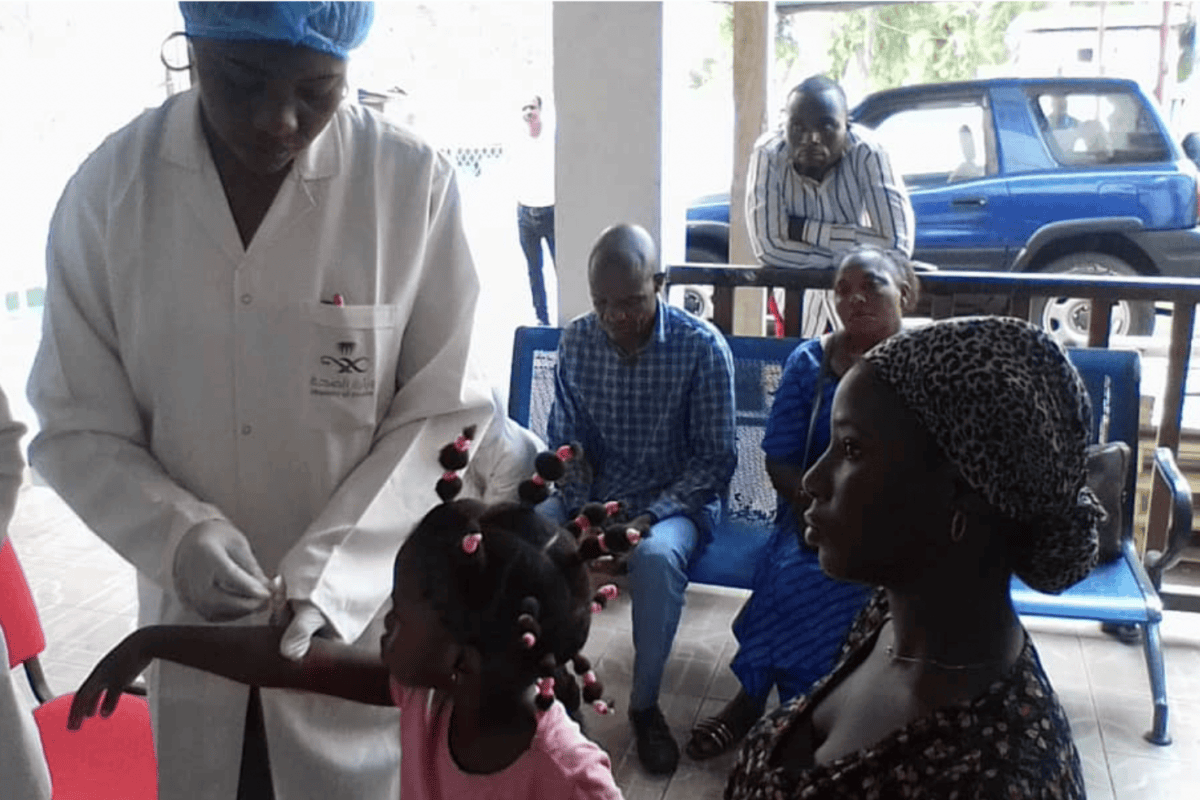
Nearly 120 residents of Vindoulou, a neighborhood in Pointe-Noire in the Republic of Congo, filed a civil claim in October 2026, seeking compensation and medical care after years of suspected lead exposure allegedly linked to the Metssa Congo battery recycling plant.Blood tests conducted in 2023 with support from Amnesty International found lead levels in the blood samples of residents, including children, far above the WHO’s reference level.In 2026, residents worked with Columbia University researcher Alexander Van Geen to test soil around the former plant: Of 49 samples, 41% exceeded the U.S. Environmental Protection Agency’s threshold for safe levels for residential soil where children play.Although the plant closed in 2024, residents say no cleanup has taken place and researchers say that the contamination is serious but geographically limited. Nearly 120 residents of Vindoulou, a neighborhood in Pointe-Noire, Republic of Congo, have filed a civil claim before the city’s High Court in relation to pollution allegedly caused by a foundry. “We want tests, but also compensation for damages and losses,” Cyrille Traoré Ndembi, a plaintiff and president of the Vindoulou Residents’ Collective, which represents people living in the working-class neighborhood, told Mongabay on the phone. The civil case, filed in October, is the latest in a series of actions taken against Metssa Congo, a foundry that opened in the neighborhood in 2013.The facility recycled, among other things, car batteries, extracting lead and turning it into lead bars for export. The plant is part of the Metssa Group, an industrial metals trading company based in the United Arab Emirates. The battery recycling process can pose serious health risks. According to the WHO, lead can be released in the form of fumes, particles and dust at every stage of the process, from draining and dismantling to smelting and refining. Environmental contamination from recycling can be substantial, exposing workers and nearby communities to significant levels of lead, the health agency says on its website. According to Traore Ndembi, residents of Vindoulou soon experienced this reality first-hand, complaining about toxic fumes coming from the plant. In 2019, they decided to register their discontent over pollution. “We wrote to the public authorities, to the departmental director of health,” Traoré Ndembi said. “We also wrote to the local environmental authorities but they said there was no pollution. The health authorities in the Kouilou department then carried out medical tests like chest X-rays to prove that the area was not polluted. Their findings said we were not sick, that there was nothing wrong. So we decided to take matters into our own hands.” To provide scientific evidence to support their complaint, in 2023 the communities, with the help of NGO Amnesty International, conducted blood tests on a small group of residents, including both adults and children. The results were unequivocal: The people tested had blood lead levels far above the threshold recommended by the WHO, namely 5 micrograms per deciliter (µg/dL) or one-tenth of a liter. While there is no known level of safe exposure to lead, the health agency recommends taking action when levels cross this threshold. In some cases, the levels detected were 10 times higher. The situation was alarming, according to the human rights organization, and the findings proved decisive for the communities. The residents’ collective won its first legal battle: The administrative court of Pointe-Noire ordered the company to suspend its operations and the government instructed the operator to fund site decontamination and medical care. Blood tests conducted on residents in 2023 to detect lead levels. Image by Cyrille Traoré Ndembi. ‘I can’t keep [the children] locked indoors’ Yet, two years later, Traoré Ndembi, who still lives in Vindoulou with his wife and children, remains worried. “The authorities are not telling us anything,” he said. “It is true that the plant has closed, but nothing has changed on the ground since then. Nothing has been cleaned up. We are still living in an area that has been polluted for years.” “Closing the plant is not enough. The medical test results confirmed that we had been poisoned by lead, so we need to receive medical care and treatment! And the plant must clean up and decontaminate the site,” he said. “Because what guarantees that, even though it has stopped operating, it is no longer polluting? I don’t feel at ease when my children play outside, but I can’t keep them locked indoors either.” Alexander Van Geen, a research professor specialized in environmental contaminants and member of the Earth Institute faculty at Columbia University, told Mongabay in a phone interview for a previous article about possible contamination from the Metssa plant that he had been shocked by the blood test results obtained by Amnesty International. “I have to admit that when I first saw the data, I thought, ‘This can’t be possible.’,” he said. “I thought that at levels this high, children would be dying or suffering from terrible tremors. I was horrified.” According to the WHO, exposure to lead is highly toxic and can cause lead poisoning, a serious condition that affects the brain, liver, kidneys and bones. The U.N. agency estimates that lead exposure caused more than 1.5 million deaths worldwide in 2021, mainly through cardiovascular effects. Aware of the scale of the problem, Van Geen told Mongabay in early 2026 that “something needs to be done.” A new round of testing His words were followed by action. After Mongabay published its article, he contacted Cyrille Traoré Ndembi and the Vindoulou Residents’ Collective to carry out another round of tests, this time on the soil. “It was important to me that the affected communities carry out their own measurements,” he said after the new round of tests. “I thought that if blood lead levels were high, the lead had to be coming from somewhere. So, we began looking at the soil.” Using his own money, Van Geen sent soil sampling and analysis kits to the community members by post. The colorimetric kits were based on the method described by Samantha S. Moura and Daphne van der Molen in a study in 2025 and are designed to measure the presence of lead in soil. There is no need to dig: The tests focus on the upper layers of soil, the surfaces people walk on and where children play, which are therefore particularly important for human health. Once the kits had been sent, Van Geen conducted remote training sessions to teach residents how to use them. “We were in regular contact,” Traoré Ndembi said. “He gave me precise instructions, and I followed them to the letter.” Van Geen asked him to download an app, SurveyCTO, onto his smartphone to record the geographical coordinates of each sampling location and take photographs of every sample and of the on-site test results, depending on the equipment we had. In May 2026, Traoré Ndembi installed the data collection app and collected 49 soil samples considered valid by Van Geen, starting immediately around the former plant and extending to a distance of approximately 300 meters (984 feet). “I then sent the samples to the professor in the United States so that he could analyze them as well,” he said. At Columbia University in New York, the samples were re-analyzed using X-ray fluorescence, a more precise analytical method. Using the samples and the geographical data collected, the Van Geen produced a map showing lead contamination around the plant. “The soil immediately surrounding the former METSSA Congo SARLU plant is heavily contaminated with lead,” the analysis noted. Of the 49 samples almost half exceed 200 milligrams per kilogram (mg/kg), the U.S. Environmental Protection Agency (EPA) threshold for safety for residential soils where children play. “Seven samples (14%) exceed that threshold by more than tenfold. The highest concentration is close to 10,000 mg/kg.” The mapping showed that contamination was most severe close to the plant, with lead concentrations decreasing rapidly with distance. This led the researcher to a conclusion that could offer some hope, provided government authorities and industrial operators decide to tackle the problem. “The problem is therefore serious but localized, and consequently remediable,” the report says. The area affected outside the plant covers approximately 25,000 square meters (269,000 square feet), according to the analysis, which says that removing the top 10 centimeters (4 inches) of soil would represent about 2,500 cubic meters (88,300 cubic feet) of earth —a volume that could be addressed “through a relatively modest, properly supervised cleanup operation, at a much lower cost than decontaminating the plant site itself.” The soil test results have since been shared with the country’s health and environmental authorities, as well as the plant’s management, civil society organizations and several specialists, including Jacques Gardon, a research director at the French National Research Institute for Sustainable Development (IRD) and an expert on mining and industrial pollution. “To me, this is proof that there is a danger,” he told Mongabay in a phone interview. “It’s simple: we have a clear diagnosis of environmental pollution. We have evidence that lead is present, and lead is harmful to health.” “Now we need blood lead tests to determine the extent of contamination among the population. And obtaining blood lead measurements is relatively straightforward, it only requires a blood test but financial resources must be made available.” In 2023, Traoré Ndembi said he paid approximately 45,000 Central African francs (about $75) per person to have blood lead tests carried out. This represents a considerable amount of money in a country where the average Congolese person earns around $2,000 a year. “But even with these figures alone [the soil test results], we already know there is a health risk, particularly for children, and that action is required,” Gardon added. The exterior of the Metssa Congo factory, a foundry located near Pointe-Noire in the Republic of Congo. Image by Cyrille Traoré Ndembi. After the results For civil society organizations, these findings offer an opportunity to bring the issue back into the spotlight. “These results confirm the concerns we continue to have,” Abdoulaye Diarra, Amnesty International’s researcher in the Republic of Congo, told Mongabay via a phone interview. “They also confirm that we must keep demanding the complete decontamination of the site, new health tests and medical care for nearby residents. “It has now been almost two years since operations were halted, and finding traces of lead in dust is alarming. It means that children who played nearby, as well as adults who breathed in that dust, are still at risk.” Diarra has followed the case for several years and assisted the communities in their legal battle. “We are continuing our campaign and our advocacy with the authorities,” he said. “The residents are brave and continue to fight for their rights. We hope their determination will help bring some change.” The plant’s representatives no longer respond to his requests for comment, he added. Mongabay contacted the Congolese environment minister, the management of Metssa Congo and the ministry’s focal point for the case of Metssa Congo v. Vindoulou Community. However, none had responded by the time this article was published. Traoré Ndembi said he is not surprised by their silence: “The authorities are deliberately allowing the situation to deteriorate. This is neither fair nor acceptable, an entire population is being abandoned to its fate. The case has not been discussed again. It has simply been shelved. “When we presented the blood test results, they did nothing, so I don’t see why things would be any different with the soil analysis. These are irrefutable pieces of evidence, scientific evidence that cannot be disputed.” He said it is important now to file an official and legal complaint: “If the courts issue a ruling, the authorities and the company will have no choice but to act. We want a conviction, compensation for the harm we have suffered and, naturally, the area to be decontaminated.” The collaboration between Van Geen and Traoré Ndembi has also led to a new project: Training more community members to conduct this type of analysis themselves, so they can gather evidence whenever pollution is suspected. “Cyrille is going to approach the school just to the north of the plant, and we hope to conduct a higher-resolution survey of say 300 samples this fall, soon after school resumes,” Van Geen said. “This low-cost model could be applied to many other locations where soil contamination with lead is suspected. Mapping this way is important. Results so far show that mapping doesn’t require costly outside expertise. School participation will increase awareness and hopefully incentivize decision-makers, plant owners and the government to do something.” To support this work, Van Geen has sent Traoré Ndembi another batch of kits. On the ground, Traoré Ndembi is trying to persuade other communities and schools to join the sampling effort, but said he is encountering some reluctance. Although the Republic of Congo has significant natural resources, particularly oil, a large part of its population lives in poverty. Critics say this reflects the mismanagement of national wealth and endemic corruption among the country’s ruling elite. The country has been led by Denis Sassou Nguesso since 1979, apart from a five-year interruption. His presidency has repeatedly been accused of suppressing political opponents and dissenting voices. In this context, Traore Ndembi explained that collecting samples and launching a legal action despite the environment ministry’s previous decision could be interpreted as a way to challenge the government. “People are often afraid, afraid of reprisals,” Traoré Ndembi said. “Some thought they could be prosecuted or arrested, or something like that, because they know how things work here. These people [at Metssa Congo] were able to operate with complete impunity for an entire decade. They didn’t do that by chance. They must have had support, because there is a lot of money involved.” Banner image: Blood tests conducted on residents in 2023 to detect lead levels. Image by Cyrille Traoré Ndembi. Citation: Moura, S., Van der Molen, D., & Van Geen, A. (2025). A simple kit to detect extractable lead concentrations in soil. doi:10.2139/ssrn.5317187 FEEDBACK: Use this form to send a message to the author of this post. If you want to post a public comment, you can do that at the bottom of the page. Credits Topics
In Republic of Congo, residents and a scientist take on a fight against lead pollution
Full Article
Original Source
Read the full article at News →KhanList aggregates and links to publicly available news content. We do not host full articles from third-party sources. Always verify important information with original sources.