
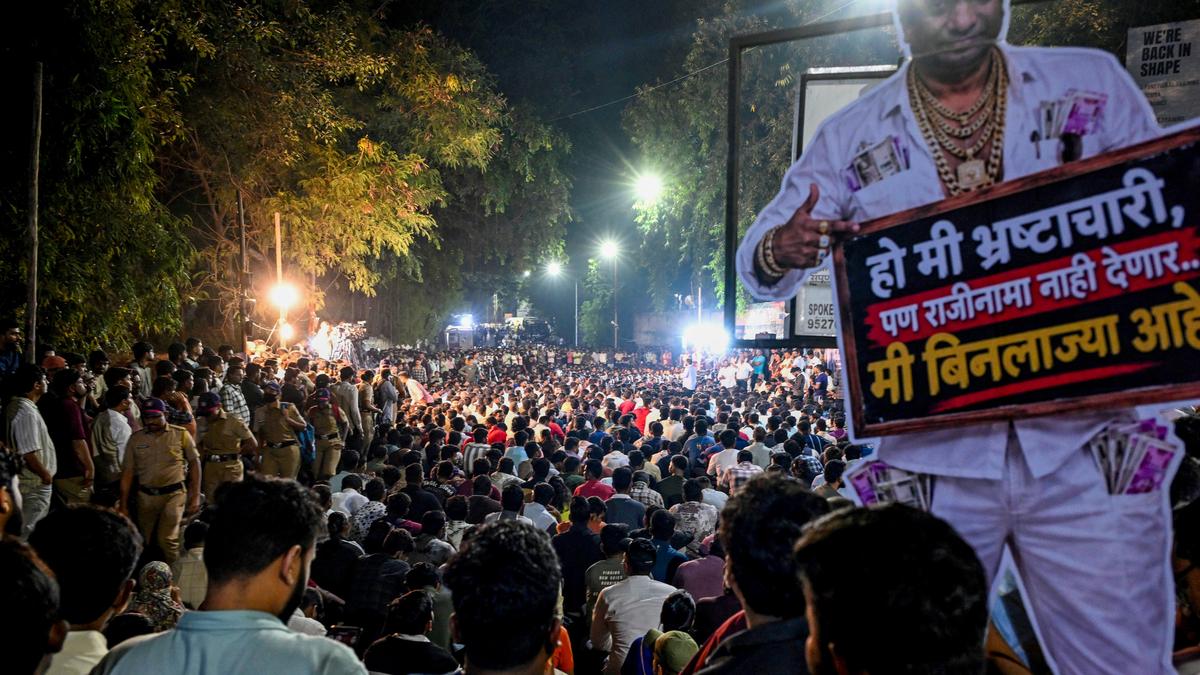
At 2 p.m., the protest site in Pune is close to empty. An hour later, around 200 people gather, many grouped under trees flanking Pune’s S.M. Bridge. The crowd comes with the evening, as does a breeze. With the ebb of the day’s studying, women and men in their 20s begin to arrive. By night, Rushikesh Dhode, 25, estimates that between 500 and 700 students have gathered on the bridge over the Mutha river.Students sit and stand on one half of the bridge, facing a stage, where seven people are on hunger strike. Many of the women don’t want to be photographed or quoted. “Our families do not know we are here,” says one, asking not to be named.Two or three people say plainly: if a photograph is published, and they go on to clear the Maharashtra Public Service Commission (MPSC) entrance exams and reach the interview stage, an officer on the panel might recognise their face from a protest. That would be “very, very problematic,” says a man.Aspirants to the MPSC-conducted entrance exams, which are a gateway to government jobs, are here to protest against corruption in the recruitment process. They began protesting on October 1. “We are demanding the resignation of the MPSC chairman (Vivek Bhimanwar) on moral grounds, just as Nipo Nabam in Arunachal Pradesh had given his resignation on moral grounds,” says Akshay Kamble, one of the protest organisers. He speaks of the chairman of the Arunachal Pradesh Public Service Commission who had resigned after a paper leak in the State in 2022. Kamble is one of the 15 organisers against whom the Pune Police has filed first information reports citing laws related to unlawful assembly and being a public nuisance.The protesters also demand that 70,000 vacancies be filled, and that Maharashtra adopt a system like Rajasthan, which allows applicants to take four exams for ₹100.Every year, MPSC conducts exams for jobs in various departments and different levels in the Maharashtra government. In 2026 alone, three exam papers have been leaked: two for 5,707 Group C posts (clerk, peon, havildars in the Home Guard or Maharashtra Police) and 109 medical drug inspector posts (Group B). In the Group B exam, all three levels of exams had been taken and the results declared, when students came to know of the paper leak.Across the world, student protests are on the rise: in France, students are voicing dissent against failing school systems; in Argentina, students are demanding a reversal of funding cuts to public universities; in Chile, students and teachers are marching against education budget cuts.In India, protests in June and July took place against paper leaks, demanding Education Minister, Dharmendra Pradhan’s resignation, which took place. This was followed by school children across the country, predominantly in Madhya Pradesh, Uttar Pradesh, and Rajasthan, demanding better schools. In Maharashtra, this August, students from Scheduled Tribes asked for humane hostels. Students protest against Maharashtra Public Service Commission Chairman Vivek Bhimanwar in Pune. | Photo Credit: Emmanual Yogini The arithmetic of a shared room“Fifty study centres got notices from the police via (social media platform) Telegram, telling them to ask students not to take part in the protest. They said this is now anti-social activity, as permission for the protests had only been obtained for three days,” says Vivekananda Patil, one of the students at the protest.Once darkness descends, people let their guard down. Where protests around the country have seen sloganeering and tongue-in-cheek commentary, here, life is a ledger of accounts: of rent and mess fees, of years spent studying for the exam, of what a family can, but more importantly, cannot afford. The anger on the street, they say, had two sources: a leaked paper and a calendar that shifts each time there is a paper leak. This shifting calendar of exams means more money must be spent.Drought, say students, has thinned incomes in the villages that send them to Pune. It has raised the price of a plate of food in the cluttered lanes where they live. The protest sits where governance, politics, and household economics meet.Amol, 24, is from Akola in Vidarbha. He came to Pune in 2022 and has since lived the way many aspirants here do: three to a room, on a budget that has to be redrawn every few months. When he arrived, he needed ₹8,000 to ₹9,000 a month for all his expenses. Now, he says, with inflation it is ₹11,000 to ₹12,000.His mess fee has risen from about ₹2,800 to about ₹3,200. “I study for MPSC full-time. I don’t have a part-time job,” he says, which means that money has to come from home. Home is a railway family. His father, once a porter, was made permanent in the railways in 2011 and now works as a trackman (in the Group D employment category). Amol is the last of five children, with four older sisters, all married.In his first year he took classes from a teacher who charged him ₹50,000 for that year. Now, he studies on his own, primarily because it’s just too much money to spend, but also because he understands the pattern now. He got a degree through an online course, studying for the MPSC exam side by side, but wasn’t able to pass it. Now he says, “Mala kamit kami ek post kadhaychi aahe, angavar khaki vardi hech they dheyya aahe (I want to get at least one post, but my ultimate goal is to wear the uniform).” Amol avoids using his surname so he is not easily identified. He says this has been his dream since he was a young child.Many aspirants treat jobs such as havaldars as stepping stones to officer-level posts. Anyone with a degree can sit for the examination, but for many, entering technical universities was not an option, because they could not pay for the science stream at the junior-college level. Maharashtra’s schooling system takes students from class 10 to junior college for two years, before they enter their degree courses. These are the students who flock to Pune to study.Night shifts and a library floorDhode’s story begins with less. He lost his father when he was in the fifth standard. His mother, a farmer, raised him alone, and he worked beside her on the farm. He says he did the rest of his schooling on his own. He was eligible to sit for the MPSC examination in the final year of his degree, and decided to come to Pune in 2022. He brought with him savings of ₹80,000 and moved into a one-room-kitchen flat with five other students. Six students, one room, one kitchen.The savings lasted two years. After that, he had nothing in hand. He stopped taking classes for the MPSC and began working nights at a clothing store, cleaning and organising stock for ₹4,000 a month. At night he stays in a library, cleaning it in exchange for shelter. “I am a single mother’s child, and I feel we will be financially stable only when I get a government job. Whatever the salary, at least it will be regular,” he says, also hinting at a rise in social status in his village.His mother owns 3 acres of land in Maharashtra’s Latur district, where she sows soybean every kharif season. This year, with the drought across the State, he does not expect much. “I expect only about half the usual harvest,” he says.Vaishnavi Jadhav, a farmer’s daughter from Marathwada, came to Pune in 2024 and has been preparing for the MPSC since. She was among those who spoke on stage at the protest. “While preparing for the exam, the paper was leaked,” she says. “Marathwada is in trouble,” she says, contextualising her worry. “A transparent examination is the one route by which ordinary people like us can enter the administration. If the process is flawed at the start, how will we get selected?” She worries about her future and India’s future.“We are a country of youth,” she says. “If we have to protest like this, when will we study?” She appeals to the government to treat students as a responsibility, not a liability. “Whatever work you do, do it for the students,” she hopes, from them.Pune Police Commissioner Amitesh Kumar says all the students’ demands had been met, yet they continued with their protest. “In their letter dated September 24, the students had put forth four main demands. We facilitated a meeting with the Chief Minister on September 30, and all the demands submitted to us were fully met. The students gave us a letter saying their planned agitation on October 2 stood postponed. Suddenly, on October 1, a crowd gathered and began marching to S.M. Joshi, where they started an agitation.” He says the police issued a letter informing the students that the agitation was illegal, but they chose to ignore the instructions.The matter subsequently went to the High Court. Kumar says the students’ advocate had told the Court that they would seek an alternative venue that would not cause traffic congestion and that the agitation would remain within the legal framework. The police subsequently rejected their application to hold the protest at S.M. Joshi and suggested two alternative locations. “In complete disregard of these lawful instructions, they have continued with the agitation,” he says. “We did not want to set the law in motion, but a week has passed and we had to. We have noticed multiple violations,” he says, adding that some people were inciting the students to continue their protest.Politics at playAbhijeet Dipke, founder and convener of the Cockroach Janta Party, extended his support to the agitating MPSC aspirants in Pune, demanding the removal of the State recruiting body’s chairman and asking for comprehensive reforms for fair examinations, while urging students to remain firm.Accusing Chief Minister Devendra Fadnavis of “pretending to be deaf” to their demands, Shiv Sena (UBT) leader Sanjay Raut alleged that the government is attempting to create a division among the protesters instead of holding a dialogue with their representatives. Initially three factions emerged in the protest. Each had slightly different demands, but it is predominantly a single faction on ground now. He warned that the agitation could intensify and spread across Maharashtra, making it difficult for the Chief Minister to leave his official residence.Chief Minister Fadnavis has proposed to Governor Jishnu Dev Varma that a committee headed by a retired High Court judge be set up to examine the conduct of former and incumbent chairpersons and members of the MPSC.Rohit Pawar, an MLA from the NCP (Sharadchandra Pawar), who is part of the Opposition, and with the students, says “Mr. Bhimanwar was a friend of Mr. Devendra Fadnavis from college… He was directly promoted as IAS officer on the recommendation of Devendra Fadnavis.” He implies that this is a conflict of interest. He also alleges that when Bhimanwar was transport commissioner, corruption allegations against were to the tune of ₹2,200 crore. “We are asking for the government not to keep the person on this post when the investigation is on.”chinmay.r@thehindu.co.in
In Pune, the long wait for a government job
Full Article
Original Source
Read the full article at Thehindu →KhanList aggregates and links to publicly available news content. We do not host full articles from third-party sources. Always verify important information with original sources.