
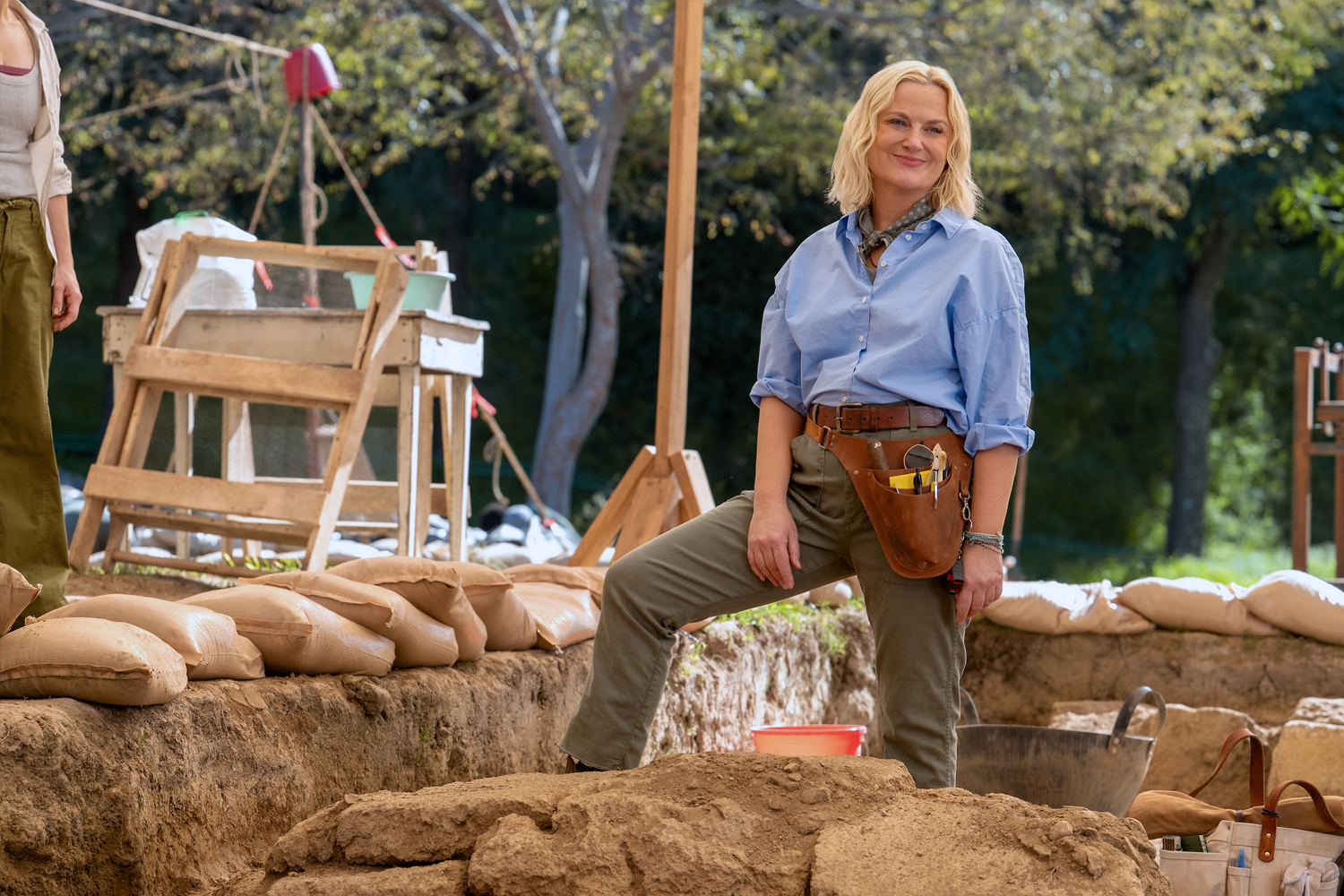
Co-created by Michael Schur, the show is based on Kate Myers’ 2023 novel, “Excavations.” All ten episodes will be available to stream on November 23 November 20, 2026 7:45 a.m. Amy Poehler as Elise in Peacock's "Dig" Colleen Hayes / Peacock With their beloved NBC workplace comedy, “Parks and Recreation,” actor Amy Poehler and series co-creator Michael Schur did the impossible. They turned the thankless work of civil servants in the fictional small town of Pawnee, Indiana, into an endearing laugh riot. Now, the pair want to do the same for a workplace that couldn’t be farther from Middle America: an archaeological dig site in Greece. In the new Peacock series “Dig,” Poehler plays Elise, the long-serving second in command of a university-sponsored excavation, who is eager for her boss, Neville (Hugh Laurie), to retire. After Elise and three of her female colleagues uncover a generation-defining artifact, they unexpectedly find themselves embroiled in an international conspiracy. “Dig” is based on Kate Myers’ 2023 novel, Excavations, which Poehler brought to Schur for potential adaptation. The writer jumped at the chance to explore his fascination with the ancient world and the people charged with rescuing it from obscurity. Schur had previously brushed up on his Greek knowledge while filming the final episode of his NBC philosophical comedy, “The Good Place.” Shooting scenes in the Athenian Agora, he was struck by how much ancient history coexists alongside the present-day city. DIG | Official Trailer | Peacock Original “You walk around Athens and you just turn to your left, and there are some still-extant columns from a structure that was built in the fourth century B.C.,” he says. “It’s incredible.” While working on “Dig,” Schur realized that the field of archaeology is similar, in a way, to the work performed in municipal buildings in small towns around the world. It’s essential and often underappreciated. “This slightly arcane discipline that not that many people go into, that isn’t very glamorous and doesn’t make people famous and rich, it’s such a vital thing,” he says. “It’s such a humanist thing. It’s people trying really hard to help us understand who we are and how we got here and where we came from. That work is so noble to me that I just thought it would make for a good TV show.” Here’s what you need to know to differentiate between fact and fiction ahead of the series’ arrival on Peacock on November 23. Dig, sieve and roll When Joseph Rife, a classicist and social historian at Vanderbilt University, was hired as the historical consultant on “Dig,” he stuck to what he knew: overseeing university-sanctioned digs in Greece. “I love working with undergraduates in the field, teaching them about the importance of the past firsthand, giving them that unique, immersive experience of living overseas and doing advanced research,” he says. “This show is both a story about how we deal with the past and how we find ourselves. It was for me, at least, because I’ve worked in Greece since 1990, when I was an undergraduate.” Aerial view of the Temple of Hephaestus in the ancient Agora of Athens George Pachantouris via Getty Images Multiple generations of archaeologists are represented in “Dig.” But the story starts with a new batch of undergraduates arriving for a summer program at the fictional Simantikos dig site, which is home to the ruins of a coastal village dated to the 12th century B.C.E. “I talked to the producers about the flow of a work site, and what roles students play, because some people are pushing wheelbarrows, while others are working with sieves to look for artifacts in the dirt, and others are actually digging,” Rife says. As Elise explains to the new arrivals in the first episode of “Dig,” archaeology is hard work. “Undergraduates are always your labor on an excavation,” says Maria Liston, an emeritus skeletal biologist and archaeologist at the University of Waterloo in Canada. “You’ll have some Greek workmen, too, who are dealing with more skilled and potentially more dangerous tasks. But the nitty-gritty labor is undergraduates, and good excavations work hard to teach them and help them get better.” Need to know: The inspiration behind Excavations Myers’ novel was informed by her own experience as an undergraduate archaeology student. In the summer of 2008, she participated in a dig in Greece led by archaeologist David Gilman Romano. With her book, Myers wanted to challenge the “male-dominated” nature of the field. “It was a great chance to explore what if that were different and it was more female-dominated,” the author told the Daily Pennsylvanian in October. “I hadn’t really seen it explored in archaeology before.” When Liston watched the trailer for the series, she was impressed by the showrunners’ realistic representation of excavation trenches and the conditions faced by archaeologists. (Liston wasn’t involved in the creation of “Dig,” but she has participated in excavations in Greece since 1987.) “The shade canopies and the equipment in the background” caught Liston’s eye, she recalls. “Every generation says the current diggers have it much cushier than we did. But it’s true. We never got shade. Now that is standard. Those built shelters are because insurance companies and university lawyers don’t like it when you have people dropping from heat exhaustion.” Liston also took note of the stray dogs that frequent the Simantikos site in “Dig.” “Do not feed the dogs—ever,” Elise says in the show’s trailer. In real life, Americans rarely listen to such warnings. “Athens has lots of stray dogs, and they all get named, and they do get fed,” Liston says. Location, location, location Although “Dig” keeps the exact location of the Simantikos dig site vague, Rife says that there was no confusion behind the scenes. “It’s in southern Greece, the Peloponnese, which is a region where we have some of the oldest and richest Greek sanctuaries,” he explains. What audiences see on screen, however, isn’t exactly authentic to the region: “It’s way too green,” Liston says. “There is way more rainfall where this is being filmed than in southern Greece.” (The bulk of the show was filmed in California, with some exteriors recorded on location in southern Italy and Athens.) She adds: “It’s very dry there, very arid—not desert exactly, but rain is something that only falls in the winter and fall. The shots of those excavation trenches, the soil and all the trees” are more characteristic of northern Greece. Hugh Laurie as Neville and Amy Poehler as Elise in "Dig" Colleen Hayes / Peacock Within the “Dig” universe, the Simantikos excavation is clearly a permanent endeavor. But an American dig site can’t just pop up on a whim anywhere in Greece, which restricts foreign countries to three independent dig sites at a time, plus three in collaboration with local archaeologists. “For the most part, you get a permit to excavate for three years,” Liston says. “In theory, it’s renewable for two more years, but then you go to the back of the queue. Each foreign school can also be granted three survey permits, so that means you’re out walking the ground, picking up stuff on the surface, but you’re not digging.” Permanent dig sites are far rarer. Prominent examples include the French School at Athens’ work in Delphi, the German excavations at Olympia, and the American digs at ancient Corinth and the Athenian Agora. Corinth claims one of the United States’ three permits. But the country’s enduring presence at the ancient gathering place in Athens stems from a separate process. Greek legislators granted the U.S. permission to excavate the agora in 1929—a permanent greenlight made possible, in part, by the significant financial contributions of John D. Rockefeller Jr., the American philanthropist. The agora is still an active excavation site today, operating under the auspices of the American School of Classical Studies at Athens. “Everyone else gets angry at the Americans because we technically have four excavation permits,” Liston says. Aerial view of a temple to Isis and a later Roman basilica at Kenchreai, the eastern port of Corinth. Joseph Rife has directed excavations at the site since 2002. C. Messier via Wikimedia Commons under CC BY-SA 4.0 The archaeological find of the century In the premiere episode of “Dig,” Elise cautions her latest group of undergraduate students that they will likely spend their summer sifting through dirt, only to find “old Nazi stuff and boring pottery” shards. This assessment rings partly true, according to Liston. She notes that artifacts dating to Nazi Germany’s occupation of Greece are rare today, mostly because metal detectors have made it easier for civilians to scavenge the upper layers of dirt. But pottery fragments are the most common finds by weight and volume. Many depictions of archaeology in popular culture, including the Indiana Jones franchise and the movie The Mummy, suggest that excavations unearth groundbreaking artifacts every day. That simply isn’t the case. “Most people would go through their entire careers without ever finding even a piece of a statue,” Liston says. “A piece of a clay figurine is about as good as it gets most of the time.” In Excavations, Elise and her team are decidedly luckier: They find a trophy referencing Hera, the Greek goddess of marriage, women, family and childbirth, which seemingly confirms their suspicion that Simantikos once hosted an all-female athletic competition that predated the ancient Olympic Games. The TV adaptation of Myers’ novel goes even bigger, with Elise revisiting a previous dig site to find an enormous, fully intact statue of Hera. This marble bust of Hera, found in the Heraion of Argos, dates to around 420 B.C.E. George E. Koronaios via Wikimedia Commons under CC BY-SA 4.0 “It’s a cult statue, or what we often refer to as a colossal statue,” says Rife, who researched writings and lettering of the time to create an inscription on the base of the figure. “It is a larger-than-life-size rendering of the goddess. It would have been a visual, physical focus for people who came to worship and offer sacrifices to the goddess but also a kind of metaphor or a symbol of the divine presence herself.” The choice of Hera is certainly no coincidence. Her presence in the book and the Peacock series is a notable metaphor for the female friendships that anchor the story: In “Dig,” Poehler’s Elise works closely with Clare (Antonia Thomas), the head preservationist at the dig site’s lab; Dylan (Geraldine Viswanathan), a flighty former student who returns to Simantikos after a five-year absence; and Patty (Fina Strazza), a Midwestern farm girl and Neville’s newest undergraduate assistant. The quartet’s find is understandably extraordinary in the series, and it sets off a chain of events that brings both hilarity and high-stakes danger. For real-life archaeologists, however, “it is extremely rare to find intact statues, in part because the early Christians made sure they didn’t stay intact,” Liston says. “At the very least, they broke off their heads, but they also tended to turn them into lime plasters. You break it up into chunks, you burn the marble and you make plaster out of it.” In a twist straight out of fiction, archaeologists at Corinth recently discovered two oversize, Roman-era marble statues of Asklepios, the Greek god of healing, and Hygieia, the Greek goddess of health. The exceptionally well-preserved figures “would have symbolized the restorative powers of bathing and cleanliness,” excavation leader Christopher Pfaff writes in a newsletter. L to R: Fina Strazza as Patty, Antonia Thomas as Clare, Amy Poehler as Elise and Geraldine Viswanathan as Dylan in "Dig" Colleen Hayes / Peacock Navigating the antiquity black market While “Dig” is first and foremost a comedy about the act of excavation, the show also wades into the question of what happens after an artifact is found. In Greece, dig sites are meticulously monitored and cataloged each day in accordance with permits granted by the Ministry of Culture, meaning it would be difficult for Elise and her colleagues to sneak away and make a landmark discovery, as they do in the series. “There is a representative of the Greek Archaeological Service on site at all times, who has to talk to all of the trench supervisors every single day,” Liston says. “They are taking notes and reporting to the ephor, the regional supervisor, on a daily or weekly basis.” Moreover, if a discovery of great magnitude isn’t reported immediately, it can result in dire consequences for the person who concealed it. “If you hide a find, you would likely be arrested, or at best deported and never let back in the country and never [allowed to] work in Greek archaeology again,” Liston says. View of a slide used to remove excavated earth and spoil during excavations at Delphi between 1892 and 1903 French School at Athens via Wikimedia Commons Beyond those stakes, archaeologists have to consider the threat posed by looters and black-market antiquities dealers. “If you find something like that statue [of Hera] and you can’t get it out of the ground that night, you have to keep people at the site to watch it,” Liston says. “Normally, the ephor may demand that there be a police presence there. But at the very least, you’ve got to have people there because it will [otherwise] get stolen.” Rife says that one of the reasons he wanted to be involved in the series is to shed light on the challenges faced by archaeologists. “Dig” getting its hands dirty (metaphorically speaking) means more eyes on these scholars’ diligent work. “This is a small field, the study of ancient Greece,” he says. “It’s a field of humanistic study, and in the world today, it is as important as ever to study the past, to learn from it and to preserve this cultural heritage. As a professor who sits in Middle Tennessee and teaches students in a classroom, I am absolutely thrilled to see this brought to life in a popular medium, because it can only help people learn more about the importance of the past and the work.” You Might Also Like Get the latest History stories in your inbox. More about: Ancient Civilizations Ancient Greece Archaeology Art Crimes Based on a True Story Dogs European History Greece Movies Pop Culture Television Women in Science
In Peacock's 'Dig,' Amy Poehler Plays an Archaeologist Who Discovers an Extraordinary Statue in Greece. What Do Real Experts Think of the TV Series?
Full Article
Original Source
Read the full article at Smithsonianmag →KhanList aggregates and links to publicly available news content. We do not host full articles from third-party sources. Always verify important information with original sources.