
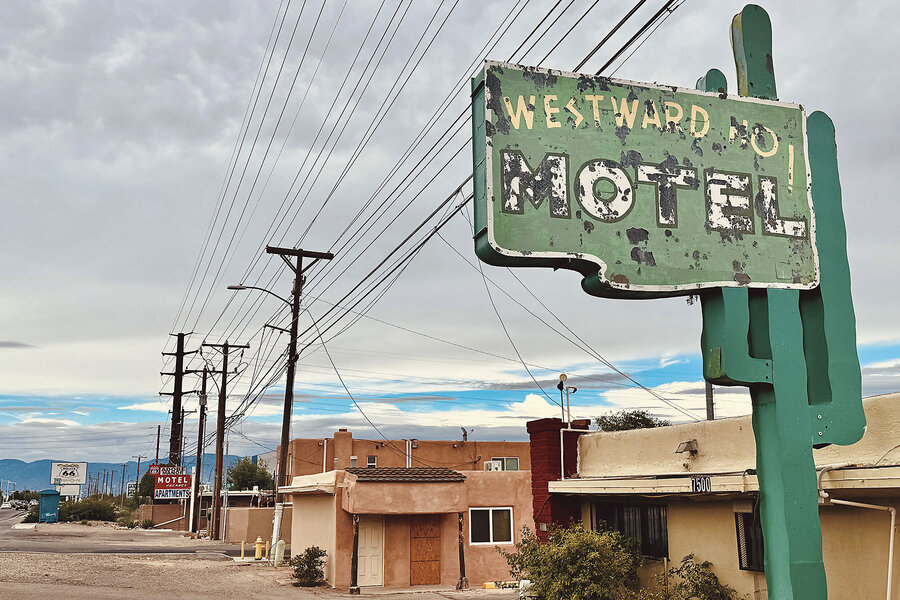
Albuquerque, N.M. | Oct. 06, 2026, 1:08 p.m. ET | 6 min read Karina Chavez’s father, a U.S. citizen, had been an architect in Mexico when economic collapse in 1994 sent the family to America and, eventually, to Albuquerque.His degree didn’t transfer, so Richard Chavez began to sell houses. When the real estate industry went digital, he needed his daughter to step in to help. They worked side by side for 15 years, and they became especially close.He died two years ago. His photograph is still on her business website, the two of them arm in arm, and a crystal locket etched with their faces hangs from her SUV’s rearview mirror. “I can’t bring myself to bring the picture down,” she says. “Everything I know is from him.”What she took from him, along with the trade, was a conviction that a city ought to have room for the people who keep it running. And what she discovered – what is simultaneously a business plan and a strategy to chip away at Albuquerque’s housing shortage – was that an obsolete building may be housing stock in disguise.■ ■ ■ The image of the motel is fixed in the old American view of the road: a low court of rooms bent around a lot, cars nosed up to nearly every door, a red neon sign promising “vacancy” over an Aqua Velva blue pool.The word motel itself was coined in 1925, a year before Route 66 became a part of the map, and the two grew up together. A family could drive until dusk and find shelter blinking just over the horizon.Then the interstates came. Route 66 was struck from the federal map in 1985. The motels it fed were left to whatever the market would bear. Some remained extended-stay rooms rented by the week, then by the hour, then not at all. Roadsides were thinned to a scattering of survivors.Albuquerque once had almost 100 of them. By one estimate, perhaps 40 now remain.A few have been restored, neon relit, as tourist draws. Some are boarded shells. Some were razed. But others have been sliced into something new: small apartments for Albuquerque’s low-income residents who often struggle to find somewhere to live. ■ ■ ■Ms. Chavez has done that three times in five years. These investments are not acts of charity. They are private investments expected to produce rental income, although tenants can use Section 8 housing vouchers. One of her properties received a low-interest loan via the state’s Ventana Fund, which helps affordable housing projects.She believes community purpose and profit can occupy the same room. “The reason we do this is because we want to make Albuquerque better, and we want to create affordable housing, and we want to make sure everybody has a home,” Ms. Chavez says.She and her husband first bought Adobe Manor, a vacant 16-room motel on Route 66, in 2023.A waiting list for Adobe’s studios led Ms. Chavez to acquire two more motels along the old highway’s path: Route 66 Headquarters and Rainbow Apartments, bringing her total to 47 studios. Harry Bruinius/The Christian Science MonitorKarina Chavez stands in the renovated Motel Hacienda on Route 66 in Albuquerque, New Mexico, Sept. 2, 2026. At first, she thought they would provide homes for refugees. As an immigrant herself, she said, “I was like, ‘Oh, it’s going to be like my karma, pay it forward.’”But the studios proved too small for many families. “So we house mostly veterans, and we house a lot of single mamas, and we have a lot of partnerships with Cross of Hope and Catholic Charities,” she says.Utilities and Wi-Fi are folded into the rent. “Otherwise, separate bills just makes it harder for them,” she says.The units are plain and durable; the numbers have to work for her tenants.Forty-seven apartments can matter greatly to the people living in them. Against an Albuquerque shortage estimated at roughly 20,000 affordable rental units, however, they also reveal the scale of what remains undone.■ ■ ■That scarcity is national. The National Low Income Housing Coalition estimates that the U.S. lacks 7.2 million rental homes affordable and available to extremely low-income households.There are examples of similar projects around the country. California’s publicly financed Homekey had awarded $3.6 billion by 2024 to 259 projects encompassing nearly 16,000 homes, including motel and hotel conversions. In Denver, the nonprofit Colorado Coalition for the Homeless converted a former hotel into 139 furnished studios for people emerging from homelessness. In Madison, Wisconsin, a private developer turned a Super 8 into 129 compact studios without public subsidy – a model closer to Ms. Chavez’s investment. Albuquerque has tried to close that gap one project at a time. The city has financed conventional apartment developments, preserved older affordable complexes, loosened rules for backyard casitas and small cottage developments, and encouraged developers to turn motels, hotels, and offices into homes.Along Central Avenue, the nonprofit New Life Homes rehabilitated Luna Lodge into 30 affordable apartments in 2013 and reopened the Sundowner as 71 mixed-income apartments the following year. Both projects combined tax credits, public money, and nonprofit development.More recently, Albuquerque bought the former SureStay hotel in 2023 and reopened it in late 2024 as Los Altos Lofts, 90 city-owned affordable apartments. That year, Albuquerque also offered $4 million in gap financing for conversions, though it ultimately went to two office projects.Renia Ehrenfeucht, a professor of community and regional planning at the University of New Mexico, sees such projects as pieces of an incremental strategy – necessary, in part, because Albuquerque is not a boomtown.“We can have a housing crunch even without having a growing population,” she says. More people are living alone, the population is aging, and some older homes become uninhabitable. At the same time, sluggish growth makes new projects harder to finance, particularly at rents that lower-income residents can pay.That helps explain the appeal of motel conversions. They appear to be “a fairly cost effective way to get small efficient units,” Ms. Ehrenfeucht says. Walls, utilities, and private bathrooms are already there, though developers may need to add kitchens, storage, accessibility, and the privacy that turns a room into a home. Most affordable developments require public subsidy or nonprofit support. What is less common is the private developer, like Ms. Chavez, who can look at comparatively modest rents and say, in Ms. Ehrenfeucht’s words, “I can make this pencil.”The realtor’s private projects cannot erase a 20,000-unit deficit. But to dismiss them on that ground, Ms. Ehrenfeucht says, would mean “there’d never be any good project because it’s never enough.” Courtesy of Karina ChavezKarina Chavez and her father worked together to renovate shuttered motels. Richard Chavez insisted on keeping this tree in the new Hacienda plaza, even though it presented a challenge to builders, who predicted it would not survive the renovations. The tree is thriving. ■ ■ ■The Route 66 anniversary calls attention to the neon, the commerce, the open road. But, Ms. Ehrenfeucht says, “the bigger question is about all these multiple histories and multiple futures the road has to offer.”Ms. Chavez’s fourth motel is one of those futures.When she found the old Motel Hacienda for sale, Ms. Chavez expected a fourth studio conversion. The other conversions had waiting lists. Her business model worked.“I brought my father here and I said, ‘Oh, affordable housing,’” she says. “He’s like, ‘No, we need a community place.’” Her father, one of 10 children, grew up in Guadalajara, where Sundays meant church, a park, and a family meal. He imagined such a place for southwest Albuquerque, where families could gather and local entrepreneurs could own businesses.“My dad’s idea was like, ‘Hey, if my mom wants to go get her nails done, I can go sit there, watch the game at the sports bar, the kids can go have a paleta,’” Ms. Chavez says.This is now a different kind of transformation of an old Route 66 motel. The U-shaped court is becoming a series of restaurants, as well as a nail salon, barbershop, and paletería (ice-pop shop). One of the bars was painted blue to match pieces of the old swimming pool uncovered beneath the parking lot.The transformation required new sewer lines, an upgraded water meter, and a transformer. Her father died as work was underway; his best friend, the majority investor, helped her continue.She has had second thoughts.“Sometimes I’m like, should I have just left it as the motel and just kept making money, or did I do the right thing?” she says. But then she goes there and feels her dad’s spirit. Deepen your worldviewwith Monitor Highlights.Politics with respectGet political stories with respectful analysis.There‘s a world of new ideas in everyBooks newsletter.There‘s more to life, enrich yours withCulture & Learning weekly.Follow humanity‘s discoveries withScience & Nature stories in your inbox.Gain a spiritual perspectivefrom the stories in your inbox.Want to understand the deeper impact of critical events? Learn the Monitor‘s insight.Already a subscriber? Log in to hide ads. Early in the project, plans called for an accessible sidewalk to pass the property’s only tree. Everyone said to remove it. Her father told them: “That tree stays.” They bent the sidewalk around it, cutting one root to make room. Everyone warned the tree would die. The next year, it came back thriving.“We were like, OK,” Ms. Chavez says. “He was right.” ALREADY A SUBSCRIBER? LoginReal news can be honest, hopeful, credible, constructive.The Christian Science Monitor was founded in 1908 to lift the standard of journalism and uplift humanity. We aim to “speak the truth in love.” Our goal is not to tell you what to think, but to give you the essential knowledge and understanding to come to your own intelligent conclusions. Join us in this mission by subscribing.
In New Mexico, housing shortage finds a fix on Route 66: Renovated motels
Full Article
Original Source
Read the full article at Csmonitor →KhanList aggregates and links to publicly available news content. We do not host full articles from third-party sources. Always verify important information with original sources.