
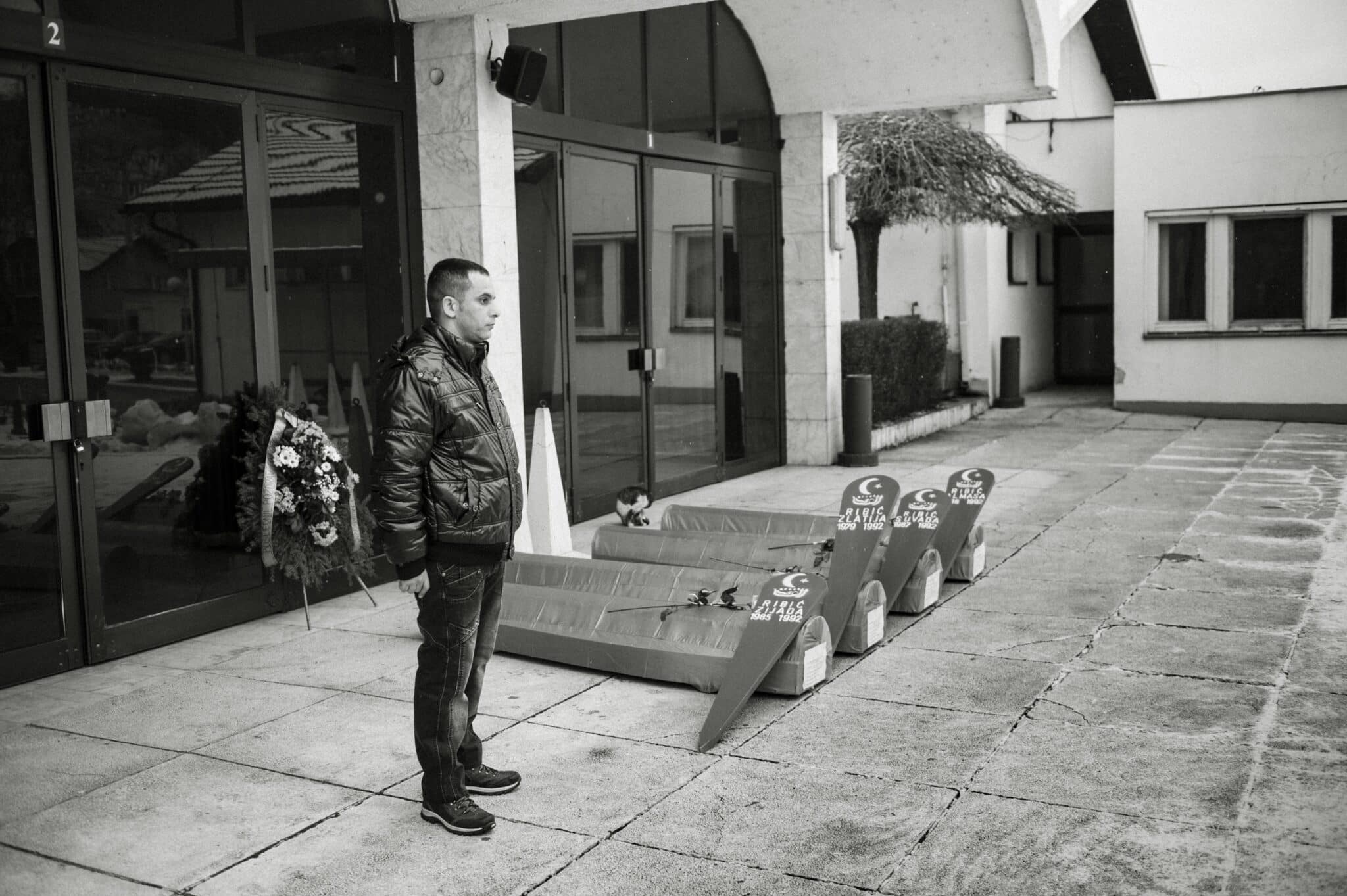
Aged eight, Zijo Ribic survived the massacre of his entire family by Serbian paramilitaries in the first months of the Bosnian war. In a new book, he speaks of survival, suffering, and an embrace of love and humanity. Over the past decade, Zijo Ribic has buried his parents, five of his sisters and his brother. One sister still waits to be laid to rest alongside the rest of the Ribic family, her remains yet to be found. Ribic’s six sisters, Ismeta, Zlatija, Zijada, Zlata, Suada, and Almasa, his two-year-old brother Sabrija, and their parents Ismet and Sevka, who was heavily pregnant at the time, were killed on July 12, 1992, in the village of Skocic near Zvornik, northeastern Bosnia and Herzegovina, by members of a Serbian paramilitary unit known as ‘Simini Chetnici’ [Sima’s Chetniks]. Before she died, 13-year-old Zlatija was beaten and raped twice. Ribic, eight years old at the time, witnessed these assaults. “I survived, so I can tell the story,” he told BIRN on the occasion of the publication of a book in which he tells his story of survival in Croatian, Roma, English and German. I Do Not Hate: The Story of Zijo was launched on July 13 in the Bosnian city of Tuzla. No one has ever been convicted of killing his family. In 2018, after eight years of legal proceedings, the Belgrade Court of Appeals acquitted members of the paramilitary unit of killing 28 Roma civilians in the villages of Skocic, Malesic and Setic, near Zvornik. “The court sent a message that no one was responsible for killing Roma people, as we were not people, as we do not exist,” said Ribic, now 42 years old. Surviving a massacre Zijo Ribic. Photo: BIRN.Ribic was shot and stabbed but survived by sheer chance. Believing him dead, members of the Serbian paramilitary unit tossed him into a pit with the rest of his murdered family, a grave they had dug beforehand. Ribic lay motionless, pretending to be dead until the paramilitaries left. Then, covered in blood, he climbed out of the pit and fled. He was eventually found by two Serbian soldiers. When Sima’s Chetniks demanded him back, the soldiers refused, almost certainly saving his life. “Some Serbs tried to kill me, others saved me. How can I hate Serbs as a people? I cannot. I have always judged people by whether they are good or bad, never by their ethnicity, religion, or the colour of their skin,” said Ribic. It is a tragic irony that the Ribic family had originally fled for time to Serbia to escape the first wave of ethnic cleansing in eastern Bosnia, carried out by Bosnian Serb forces and paramilitaries from Serbia in early 1992. Ribic’s father, Ismet, later decided they should return to their home in Skocic, believing the Roma had not harmed anyone and so had nothing to do with the war engulfing Bosnia. They went back home on July 12, 1992, the day they died. The Skocic massacre is the most notorious crime committed against the Roma during the Bosnian war, but far from the only one. Atrocities were also committed against Roma civilians in the settlements of Sase and Perici and the towns of Foca and Bijeljina. In April 1992, members of the Roma community were killed in Srebrenica and Bratunac, and many Roma died in the Srebrenica genocide of July 1995, primarily because they were Muslims. It was only through later research, largely based on victims’ surnames, that many of those killed were identified as members of Roma. The first comprehensive study documenting the suffering of the Roma in Bosnia was published only last year, focusing on the persecution of Roma in the Podrinje region – which Skocic is part of – between 1992 and 1995. Their wartime ordeal, however, remains largely overlooked, the story of one of the most marginalised communities in Bosnia still waiting to be told and properly documented. Justice is painfully slow, far slower than for many others. “Roma people needed to wait a long time for their turn to come to be researched and their stories documented. The same happened after World War Two,” said Ribic. Such is Ribic’s own experience. Failed justice Zijo Ribic speaking to BIRN’s journalist Lamija Grebo in front of his old family house. Photo: BIRN. That Sima’s Chetniks ever appeared in court is thanks to the efforts of Ribic and the Belgrade-based Humanitarian Law Centre, which helped him initiate legal proceedings. However, although the court established that the unit had committed the sexual abuse and enslavement of three Roma women and looting in Skocic, it ruled there was insufficient evidence to establish individual criminal responsibility of the perpetrators for the murders. Consequently, no one was convicted of killing the Ribic family, a verdict confirmed on appeal in 2018. The decision set a disturbing precedent for the Serbian justice system regarding the threshold for proving co-perpetration as a criminal act. Critics of the judgment say the Court of Appeal imposed a disproportionate burden of proof on the existence of co-perpetration in cases where a group of people, over a certain period, commits a large number of crimes. According to Ribic’s lawyer, Marina Kljaic, in earlier cases it had been enough to prove that a certain member of the unit operated as part of the unit and that he had consented to the act of perpetration of each of the members of the group, thereby accepting the act as his own. The Court of Appeal’s ruling changed this standard, establishing that it is necessary to prove each of the acts of perpetration by each member of the group. Ribic said some of the defendants laughed at home after the verdict was delivered. “I wanted to cry, but not in front of them,” he said. “How can one stay normal in such a situation?” At one point during proceedings, Dragana Djekic, the only woman indicted in the case, asked through her lawyer whether she could speak to him. Rather than apologising for the pain and suffering that she and her fellow paramilitaries had inflicted, including leading him by the hand to the pit where she knew he would be killed, Ribic said Djekic asked him not to hate all Serbs because of what had been done to him. “I told her, I have never hated any people. I do not even hate her. Some Serbs took everything from me; others saved my life. I love all people,” he told BIRN. “I told her that there was only one thing I wanted from her, and that was to tell the court the truth. She never did.” Breaking a cycle of hatred Ribic entering his badly-damaged family home. Photo: BIRN.In I Do Not Hate: The Story of Zijo, Ribic documents his moving story, conveying the message of love and humanity that he has chosen to embrace. “People are divided only into the good and the bad,” he said. “That is what my parents taught me. There are no genocidal people. There are bad people. Many Serbs taught me love and respect and helped me enormously after everything that happened to me. We need to talk about peace and love and not hatred.” It is a lesson he passes on to his own children. Ribic said that when he took his then four-year-old daughter for the first time to the graves of his family in Skocic, she asked him, “Daddy, why did they die?” Ribic said he replied: “They were ill, and they died.” “All of them?” his daughter asked. “Yes, all of them.” “Hatred only breeds more hatred and ultimately turns victims into what their perpetrators once were,” he told BIRN. For several years now, Ribic has travelled to Auschwitz to attend the August 2 official commemoration of the International Day of Remembrance of the Roma Genocide during the Second World War, honouring the estimated 200,000 to 500,000 Roma and Sinti people who were systematically murdered by Nazi Germany and its collaborators. After years of delay and dispute over its design and location, a memorial to the murdered Sinti and Roma people in Berlin was unveiled only in 2012. No comparable memorial has ever been erected in Skocic.
In New Book, Massacre Survivor Gives Voice to Roma Loss During Bosnian War
Full Article
Original Source
Read the full article at Balkaninsight →KhanList aggregates and links to publicly available news content. We do not host full articles from third-party sources. Always verify important information with original sources.