
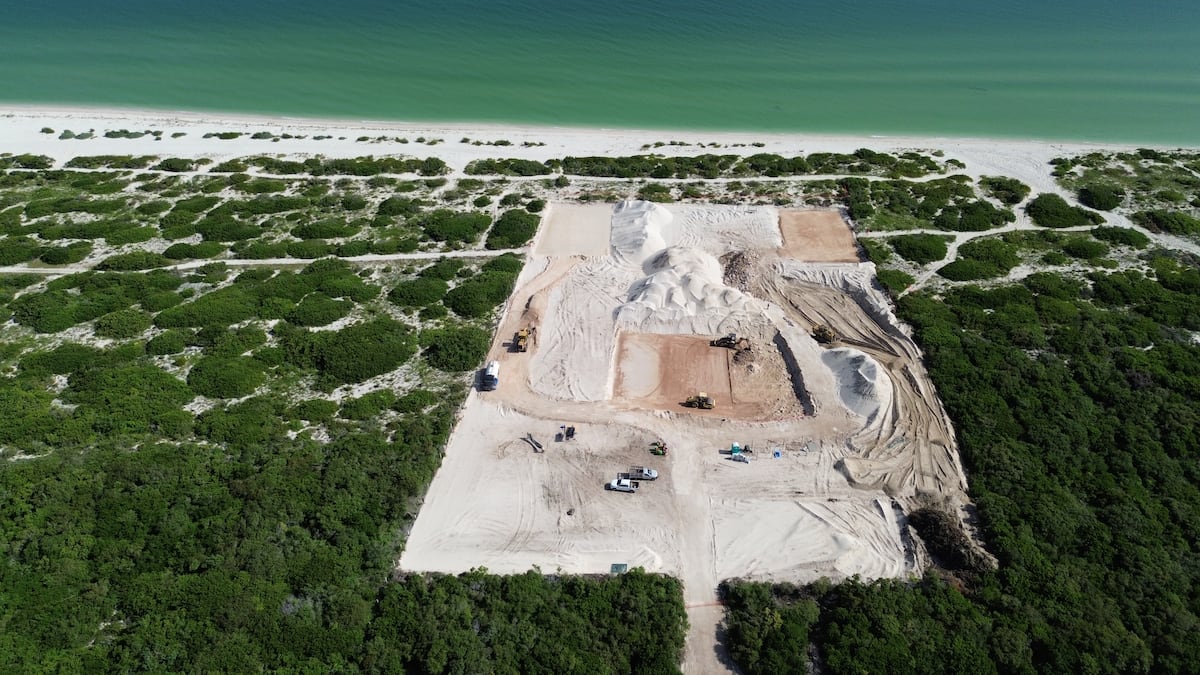
A mound of sand rises amidst the vegetation of the coastal dunes. It’s just by the sea in Chuburná Puerto, a community in the municipality of Progreso, in the Mexican state of Yucatán. A few feet away, on the utility poles along the highway and at the fish sanctuary, advertisements promote the most exclusive developments in “the safest state” in Mexico. One of these real estate projects — the Dunas Tourist Complex, by Designia Desarrollos — is being built there, atop an ecosystem inhabited by local flora and fauna. Some endangered species live there, such as the Mexican sheartail, the Yucatán wren, as well as three of the six sea turtle species found in the country. “The dunes form part of the identity of the Maya people, because they’ve been passed down from generation to generation as a source of sustenance for many families,” says Karen Sosa, a native of Chuburná Puerto and a descendant of families who worked in the salt flats. On July 31, Sosa participated in a demonstration in Mérida – the capital and largest city in Yucatán – against the Dunas Tourist Complex. According to Sosa, real estate developers see the coast as a vacant lot that’s ripe for investment. “But what they don’t see is that we’re talking about a thriving ecosystem that no luxury condominium can replicate or replace once it’s gone,” she adds. On July 31, the protesters demanded the project be permanently halted, its permits revoked, administrative sanctions imposed, and native vegetation restored. They also called for Yucatán to adopt legislation guaranteeing prior, free and informed consultation, and for the coastal strip to be designated a Protected Natural Area.The day before, on July 30, the project was temporarily shut down by the Federal Attorney for Environmental Protection (PROFEPA) for violating the conditions of its permits and for irregularities causing “direct, irreversible damage to the stability of the ecosystem and representing a loss of biodiversity.” The real estate development company Designia Desarrollos declined to be interviewed for this article. The Chuburná dune scrubs are among the few remaining sand dune ecosystems along the Yucatán coast, which has been altered by civil and port construction. These dunes help beaches grow during the summer, while sand from the beaches is deposited on the dunes during hurricanes, cold fronts and the winter season, thus maintaining the natural dynamics of the coast. Gabriela Mendoza, author of the Restoration Manual for the Coastal Dunes of the Yucatán Peninsula (2022), says that, over the years, it has been demonstrated that real estate developments built on coastal dunes and near the sea are “barely sustainable, if at all.”“A project of this kind is deeply concerning because of its impact on native biodiversity and the destruction of an ecosystem that acts as a buffer against ocean-related weather events, cold fronts, storms and hurricanes. Coastal dunes are the first line of defence against climate change,” she warns EL PAÍS. In Yucatán, sediment carried by marine currents is deposited to the east of built infrastructure such as ports and other coastal works, while erosion tends to intensify to the west, placing additional pressure on coastal dunes.138 apartments on the dunesThe protest in the state of Yucatán is the latest example of Mexicans rejecting tourism, industrial and real estate projects that pose environmental threats. Other cases in the country include Perfect Day — a Royal Caribbean cruise line’s theme park in Mahahual, Quintana Roo — and a German-owned ammonia plant in Topolobampo, Sinaloa. In the case of Yucatán, the outrage erupted after the deforestation of an area located within the coastal dunes.In July of 2026, heavy machinery from the Designia Desarrollos project was removing sand from the Chuburná dunes. The project proposes the construction of 14 towers with 138 apartments in total, with capacity for approximately 552 people, according to the environmental impact statement submitted to Mexico’s Secretariat of Environment and Natural Resources (SEMARNAT). The 99,000-square-foot project will feature two swimming pools and cafes on the north side, nestled between the dunes, the beach and the sea. The south side (the land is divided by the Yucalpetén-Chuburná Puerto highway) will house parking and a commercial area, adjacent to the marsh and coastal wetlands.Progreso’s Municipal Urban Development Plan (PMDU), published in 2024, designates the dunes as a non-developable area, with one exception: the plot where the project is being built, within the dunes themselves, which is classified as Type 1 developable land. Auralux Representaciones, the company representing the Dunas Tourism Complex, cited this designation in its Environmental Impact Assessment as justification for building there. The assessment also argues that the area has already been altered by human activity, noting vehicle traffic on weekends, public holidays and during vacation periods.According to the statement, the project won’t encroach upon the Federal Maritime Terrestrial Zone (ZOFEMAT), the 65-foot buffer zone extending into the sea. But Mendoza points out that this distance isn’t enough “to preserve the natural dynamics of beaches and coastal dunes, sediment dynamics and coastal protection. It would also affect biodiversity, as well as environmental goods and services, including regulatory, cultural, provisioning and supporting services.”In the EIS, the company does acknowledge that the original landscape conditions will be lost. “[The project] will transform from a site with relatively well-preserved landscape conditions [due to coastal dune vegetation and mangroves] into a tourist complex, with buildings that will be visible from a great distance, a consequence of the virtually flat terrain of the entire region.”The EIS justifies the construction due to the pre-existing road alterations and other human uses (also related to tourism) that have led “to a deterioration in the quality of natural elements.” The document states that the project will increase the attractiveness for new construction in the area — “due to the exponential growth in coastal development” in Yucatán — and will increase the volume of people and vehicular traffic. A social class being put before an ecosystem The Dunas Tourist Complex, by Designia Desarrollo, is part of a series of real estate projects in the state of Yucatán that are transforming the landscape, the environment and society. Javier Becerril, an economist and author of an academic article titled The Marketing of Investment Lots in Yucatán, Mexico, explains to EL PAÍS that, for the past decade, successive state governments have promoted Yucatán as a paradise and as a destination for public investment, offering solid infrastructure, public safety and political stability. “They propose a trade-off: job creation at the expense of natural resources. The impacts are clear, given the destruction of dunes and mangroves, along with beach erosion,” Becerril notes. In 2018, the land speculation and real estate boom began. Yucatán was being promoted in Mexico and abroad. Government officials and businesspeople, he says, predicted that the Maya Train would boost the hotel and real estate industries, so they started offering land in so-called “Pueblos Mágicos” (“Magical Towns”) and along the Emerald Coast, Yucatán’s coastline. “Those who benefited the least are the people of Yucatán, similar to the situation in Riviera Maya [the resort district located to the south of Cancún], where the major investors in the hotel and real estate industries are foreign,” he states. He has identified between 100 and 130 real estate projects in Yucatán, mainly vertical developments, residential complexes, villas and hotels. Apartment towers represent a particular market segment, with premium features such as luxury finishes, private parking and security, with almost all of them facing the beach. The profits are enormous: the construction cost of the Dunas Tourist Complex is 18 million pesos (just over $1 million), according to the environmental impact assessment, while each apartment sells for between eight million and 13 million pesos ($472,000 to $768,000). The average salary in Yucatán is just 7,700 pesos per month ($450), lower than Mexico’s monthly minimum wage of 9,582.47 pesos ($562). The residents and investors drawn to these developments “represent a new social class, one that bears little resemblance to life in Yucatán,” the economist argues. He says this stands in stark contrast to the state’s socioeconomic reality. “On the other side of the beach, and further inland, are belts of poverty, a clear manifestation of social exclusion.”The main buyers are retirees from Canada, the United States and Europe, followed by domestic purchasers from Mexico City, Monterrey and Guadalajara. They typically buy these properties as retirement homes and winter retreats. Some newcomers to the Yucatán coast even assume the beach is private and block access to it, despite Mexican constitutional protections guaranteeing public access, a trend that, according to the researcher, displaces local residents.“This has generated considerable resentment among residents in almost every beach community. There is social and economic exclusion that may be subtle, but it is noticeable in the differences between social groups, in restaurant prices, nightlife venues and clubs,” he says.In the shadow of the concrete towers rising along Yucatán’s coastline, the people, vegetation and animals that share the dunes and the sea are being displaced.Sign up for our weekly newsletter to get more English-language news coverage from EL PAÍS USA Edition
In Mexico, Yucatán’s coastal dunes are under threat from luxury real estate developments
Full Article
Original Source
Read the full article at English →KhanList aggregates and links to publicly available news content. We do not host full articles from third-party sources. Always verify important information with original sources.