
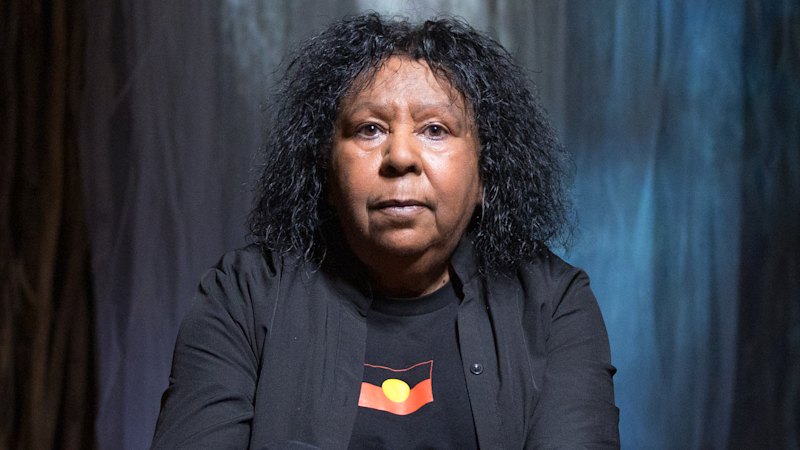
November 26, 2026 — 7:00pmThe timing and the location are perfect for artists Maree Clarke and Megan Evans to tell uncomfortable truths.On the eve of the state election, the pair are confronting the treatment of Indigenous people in Victoria and the would-be next premier’s plans to abolish a treaty between those people and the state government. They are staging an exhibition in Liberal heartland, on the doorstep of Liberal leader Jess Wilson’s seat.Artist Maree Clarke.Simon SchluterShould her party win this Saturday’s state election, Wilson plans to abolish the laws enacting a treaty: a binding agreement, established by Labor, between the state government and Victoria’s First Nations people that would provide the power to negotiate terms with the state government, hold public hearings and question government ministers.Wilson pledged that “we will repeal that, upon coming into government, within the first 100 days”.The artists have invited Wilson to visit their show at Hawthorn Town Hall gallery, called The Uncomfortable Truth, which explores loss, truth-telling, dispossession and responsibility. Wilson declined but the invitation stands, along with the offer of a personalised tour.“I thought it was a perfect place being in Hawthorn because it’s like the heart of the wealth of the colony,” says Clarke, a Mutti Mutti/Yorta Yorta and Boon Wurrung/Wemba Wemba artist.Megan Evans and Clarke.Simon SchluterAs a fifth-generation settler Australian of Scottish and Irish ancestry, Evans comes from the opposite side of Australia’s colonial history to Clarke, but she also believes a treaty is essential. “It’s been so carefully developed over such a long time. All those fantastic young folk ... who are representing all the different mobs around the state, they’ve been doing such a great job. And to lose that is really deeply sad,” she says.“A lot of other non-Indigenous people [and I] would be so grateful to keep the treaty and ... feel like we’ve got some sort of honourable way to be here.”Victoria has gone further than any other state in establishing a treaty, the centrepiece of which is Gellung Warl, a permanent truth-telling body and an accountability commission. It is currently funded for just over $70 million a year, indexed for inflation.Asked about dismantling the policy, a Liberal Party spokesperson said on Thursday: “We must take meaningful steps to address Indigenous disadvantage and empower Aboriginal people and Aboriginal communities.“We believe that reconciliation cannot be achieved through the creation of overlapping institutions but through honesty, partnership and practical action that improves lives.“A Jess Wilson-led Liberals and Nationals government will invest $52 million to expand the Urgent Care Pathways initiative as part of ‘Our Plan to Deliver for Victorians’, giving more Aboriginal Victorians access to vital healthcare closer to home.”In an interview with this masthead in October, Wilson said of her pledge: “We’re doing so to ensure that we see a billion dollars in savings over the next decade, and that we can ensure that we are putting money into programs and outcomes that are going to deliver for Aboriginal Victorians.”Clarke and Evans, however, argue that treaty abolition would be a travesty.“We both hope the exhibition might have opened peoples eyes to the possibility of retaining the treaty that was so hard won,” Evans says.Evans’ Proof (2017), a chaise lounge bearing a map of Indigenous massacre sites, is part of the exhibition.Christian Capurro“In the last 238 years of being dictated to and being ‘looked after’ … it hasn’t worked,” says Clarke. “For Aboriginal people to look after [ourselves] and govern, to make decisions for ourselves, for our community, is the way to go. Why can’t we have self-determination and look after our own affairs?”Ideas explored in the show go to the heart of why the treaty process was developed in the first place. In the centre of the gallery is a chaise lounge – symbolising wealthy colonisers – redesigned by Evans. Called Proof (2017), its side features a massacre map, marking the sites where Indigenous people were killed during the Frontier Wars in this state.It has extended legs, fashioned from rifles and picket fences, and is lined with rabbit fur, a nod to the idea of the rabbit-proof fence.Evans has also embroidered a series of christening dresses in red. Beautiful from afar, it’s only when you get up close that you can read what is written on them. In old-school cursive script, Evans documents the names of the children’s homes her late husband – Gunditjmara artist Les Griggs – lived in growing up.Embroidered christening dresses.Christian CapurroTaken from his mother when he was two years old, Griggs was one of the tens of thousands of Aboriginal children who became part of the stolen generations. “He was very good at escaping,” Evans says, “and as a result he was in lots of different homes.”For the show, Clarke created a series of kopis, the traditional mourning caps made and worn by Indigenous people when grieving. Made from a net of emu sinew and river clay, a kopi can weigh anywhere up to eight kilograms. It is a symbolic wearing or carrying of grief.“Traditionally, it was worn until it fell off your head, or your mourning period was over. You take it off and place it on the grave,” Clarke says. “Western practices don’t work for you fellas and they don’t work for us.”The acclaimed artist, whose mural Barerarerungar is at the new Town Hall station in Melbourne’s CBD, often uses traditional practices. She also mentors the next generation, passing on her knowledge, “because we were forbidden to practice cultural practice, to speak language.”Long Journey Home, by Maree Clarke.Image courtesy of the artist and Vivien Anderson Gallery.A new work made for the show depicts Clarke’s nephews and nieces standing in the ocean wearing “colonialist garb” as she describes it. Underneath, the boys are wearing scar T-shirts made for her Ritual and Ceremony photographic series, while the girls have mourning marking across their eyes. “They’re all dressed in this Victorian, Georgian gear, which is almost like being suffocated ... but [their] culture is still there coming through.” Echoing what former prime minister Paul Keating said in his landmark 1992 Redfern speech, Evans believes there’s a lack of imagination in the non-Indigenous population of Australia about the experiences of First Nations people: “That’s what the uncomfortable truth is, trying to get people to imagine what this would have been like and to feel it for themselves.”The Uncomfortable Truth: Maree Clarke and Megan Evans is at Town Hall Gallery, Hawthorn, until January 30.The Booklist is a weekly newsletter for book lovers from Jason Steger. Get it delivered every Friday.More:ArtsFor subscribersIndigenous cultureJess WilsonFrom our partners
In Liberal heartland, two artists are telling uncomfortable treaty truths
Full Article
Original Source
Read the full article at Smh →KhanList aggregates and links to publicly available news content. We do not host full articles from third-party sources. Always verify important information with original sources.