
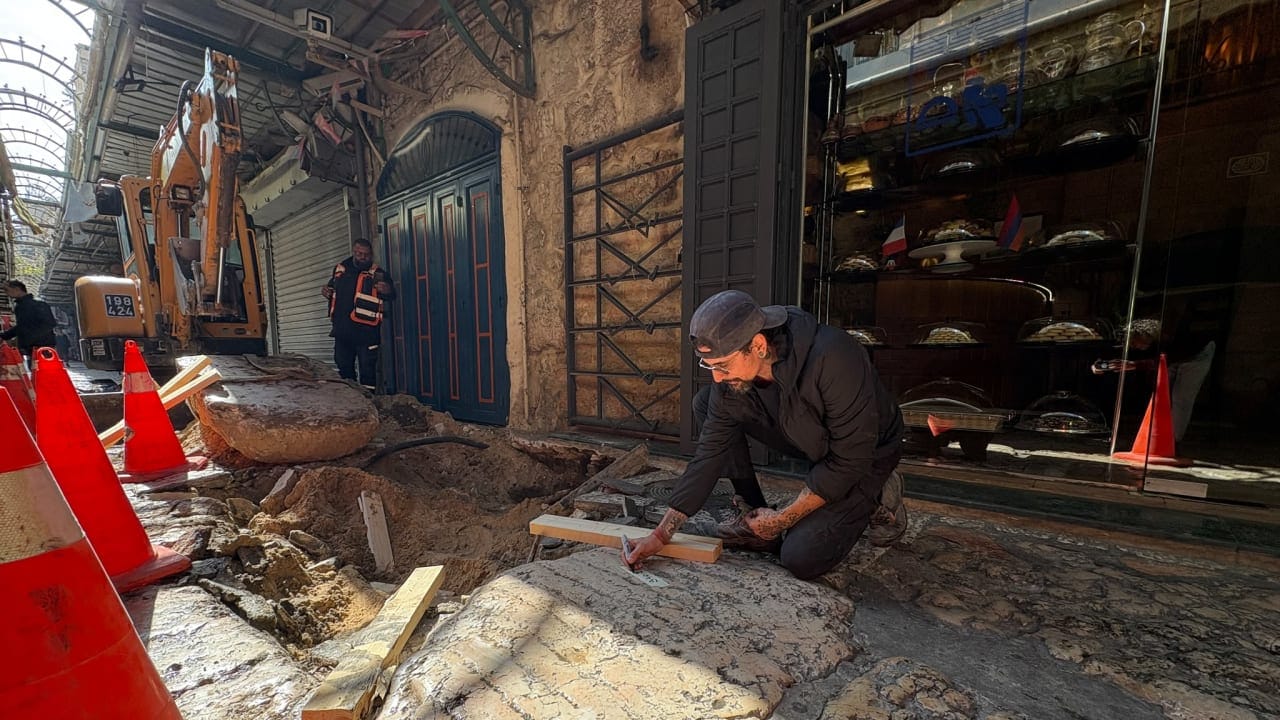
NOVEMBER 15, 2026 10:47The ongoing project to make Jerusalem’s Old City accessible has reached the ancient Christian Quarter Road, which dates back to around 135 CE, when Jerusalem was known as Aelia Capitolina under the Romans.The project, which began planning in 2009 and was formally inaugurated a decade later, aims to make the 1,900-year-old street accessible to wheelchairs and strollers while conserving the original stonework.It is spearheaded by the Jerusalem Affairs Ministry, alongside the Jerusalem Municipality’s Accessibility Department, the Israel Antiquities Authority (IAA), and is being carried out by the East Jerusalem Development Ltd. (PAMI).All the work is being conducted with the guidance of accessibility consultants and within local topographical constraints. Water and electricity infrastructure will also be replaced under the project.Since the beginning of the work, the Old City of Jerusalem has become one of the most accessible historic cities in the world, with some six kilometers of alleyways being made accessible in an area of roughly a square kilometer surrounded by the city’s walls.Christian Quarter Road, Jerusalem's Old City. (credit: PAMI)Moving history without losing itWork on the Roman pavement of the Christian Quarter Road first began in 1977, carried out by the Jerusalem Municipality and PAMI as part of infrastructure improvements and market rehabilitation in the Old City.Archaeologists Shlomo Margalit, Doron Chen and Giora Solar uncovered the remains of a Byzantine-era road hidden at a depth of about 60 cm below the current street level. The remains were identified as being part of the medieval Patriarch’s Street, whose existence is hinted at on the 6th century Madaba Map.These Roman-Byzantine stones were “raised” to the modern street level and integrated within the existing road, allowing pedestrians to travel on the very stones Jerusalem’s residents walked some 1,900 years ago.Earlier this week, experts from the IAA mapped 50 Roman paving stones on the street for conservation, about half of them defined as being in a “complex conservation condition.”In accordance with IAA guidelines, the ancient pavement will be dismantled entirely. Each stone will be numbered, measured and documented on site before removal.Only after the condition of all the stones is assessed, experts will determine which stones will be returned to the street and which will be kept in storage.While the original Roman pavement will be re-laid along the eastern side of the street, about a meter and a half wide, the western side will be covered with level paving suitable for wheelchair accessibility.During the street’s dismantling, the stones wil be carefully lifted to ensure they remain intact. Those deemed unsuitable to returned to the street will be placed into store.During the works, underground infrastructure, including water and electricity lines, will also be replaced, and building facades, awnings and connections to neighboring streets will be treated, as has been done in every Old City accessibility restoration to date.Ensuring Jerusalem is accessible to all“This unique project, which combines modern accessibility with pavement thousands of years old, is part of the vision of the Jerusalem Affairs Ministry to make Jerusalem, our capital, the most accessible city in the world,” said Jerusalem Affairs Ministry CEO Shimon Elbum.“I thank the team at the East Jerusalem Development Company and the many partners in making the Old City accessible for realizing this vision despite unprecedented challenges. The places where the Jewish people arose, and the alleyways our ancestors walked, are now open for the first time to people with disabilities from around the world.”“Jerusalem is one of the oldest and holiest cities in the world, a home and a magnet for millions of people of three faiths,” added Jerusalem Mayor Moshe Lion. “Precisely in a place of such immense historical and religious depth, we bear the duty to ensure that this history is open and accessible to everyone, including people with disabilities.”“Making the Old City accessible is about far more than adapting sidewalks and pavement. It is a move that expresses a basic value of equality, dignity and every person’s right to experience Jerusalem’s most important sites for themselves.”“We are doing this while carefully preserving the stones, the alleyways and the millennia-old heritage, proving that it is possible to preserve the past while at the same time building a city that is more accessible, advanced and inclusive,” he said. “The work on Christians’ Street is another step in this vision, and we will continue working until everyone who wishes to visit the Old City can do so without any mobility limitation.”Follow us on Google
In historic first, Old City of Jerusalem’s Roman-era street to be made wheelchair accessible
Full Article
Original Source
Read the full article at Jpost →KhanList aggregates and links to publicly available news content. We do not host full articles from third-party sources. Always verify important information with original sources.