
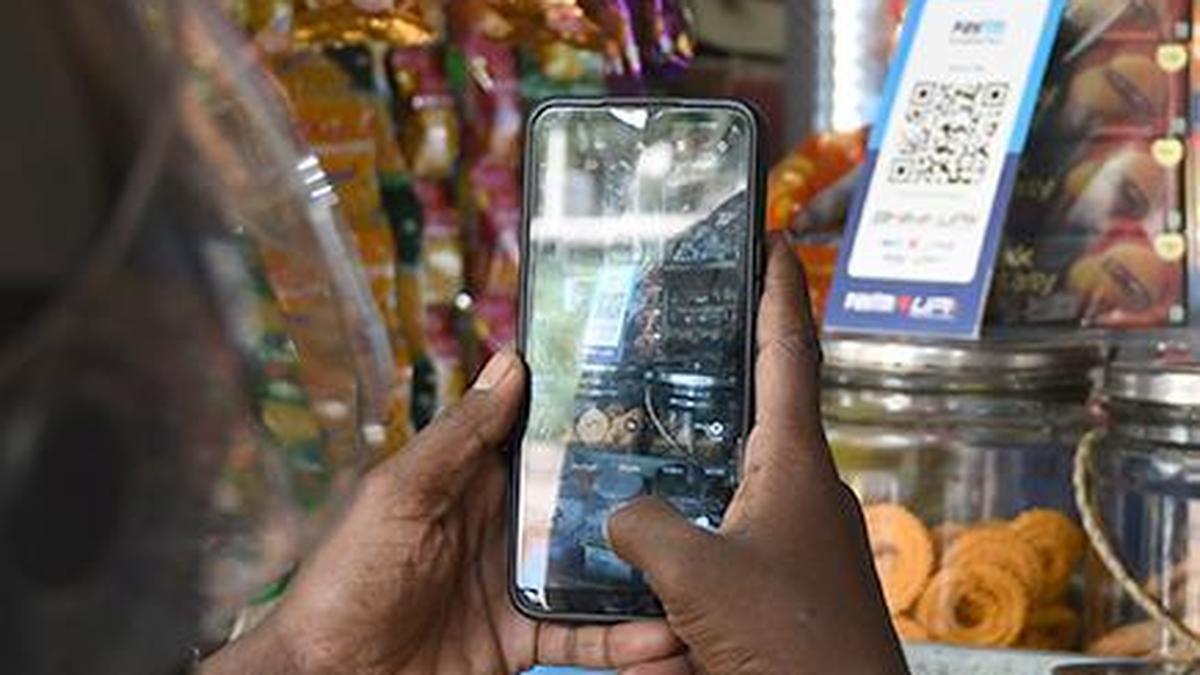
Transactions of ₹2,000 or more in essential and thin-margin sectors, such as railways, telecommunications, insurance, fuel, and agricultural inputs, will attract a flat MDR of ₹5 per transaction. File image for representation only. | Photo Credit: Allen Egenuse J The new Merchant Discount Rate (MDR) on UPI will affect a tiny proportion of UPI users, and will benefit a small number of banks — predominantly private ones like Yes Bank — and a few UPI apps such as Walmart-owned PhonePe, and Google Pay, data from the National Payments Corporation of India (NPCI) shows.The NPCI has said that, starting October 15, 2026, an MDR of 0.4% will be charged on UPI payments of ₹2,000 or more made to mid and large merchants. This will mean that only about 2.5% of UPI transactions by volume will face the charge. All Person-to-Person (P2P) transactions will remain free of charge, regardless of the amount being transferred. Further, payments to merchants up to ₹2,000 will remain free of MDR. In addition, the NPCI has mandated that small merchants including street vendors receiving up to ₹1 lakh per month through UPI QR codes under the Person-to-Person-Merchant (P2PM) category will also be exempt from MDR.Transactions of ₹2,000 or more in essential and thin-margin sectors, such as railways, telecommunications, insurance, fuel, and agricultural inputs, will attract a flat MDR of ₹5 per transaction. Further, capital market transactions such as payments to mutual funds, stockbrokers, dealers, and for equities will attract an MDR of 0.02%, capped at ₹300 per transaction. The transactions that will face MDR account for only about 20% of the value of all UPI transactions done. So, at the maximum, this will result in about Rs 2,400 crore of revenue generated per month..Of the MDR that is collected, the biggest share goes to the customer’s or payer’s bank. The second-highest share goes to the merchant’s bank, followed by the UPI apps, and other payment processors.Among the banks that customers seem to use for UPI payments, Yes Bank emerges as the leader by a huge margin, followed by ICICI Bank.Even among the banks used by merchants to receive UPI payments, Yes Bank is far and away the favourite followed by Axis Bank, ICICI Bank, and HDFC Bank.Of the UPI apps that people use, PhonePe and Google Pay together account for nearly 80% of the volume of transactions, which means they will receive the largest chunk of MDR collected. Published - September 16, 2026 05:51 pm IST
In graphs | Why private banks and foreign UPI apps stand to gain from the MDR charge
Full Article
Original Source
Read the full article at Thehindu →KhanList aggregates and links to publicly available news content. We do not host full articles from third-party sources. Always verify important information with original sources.