
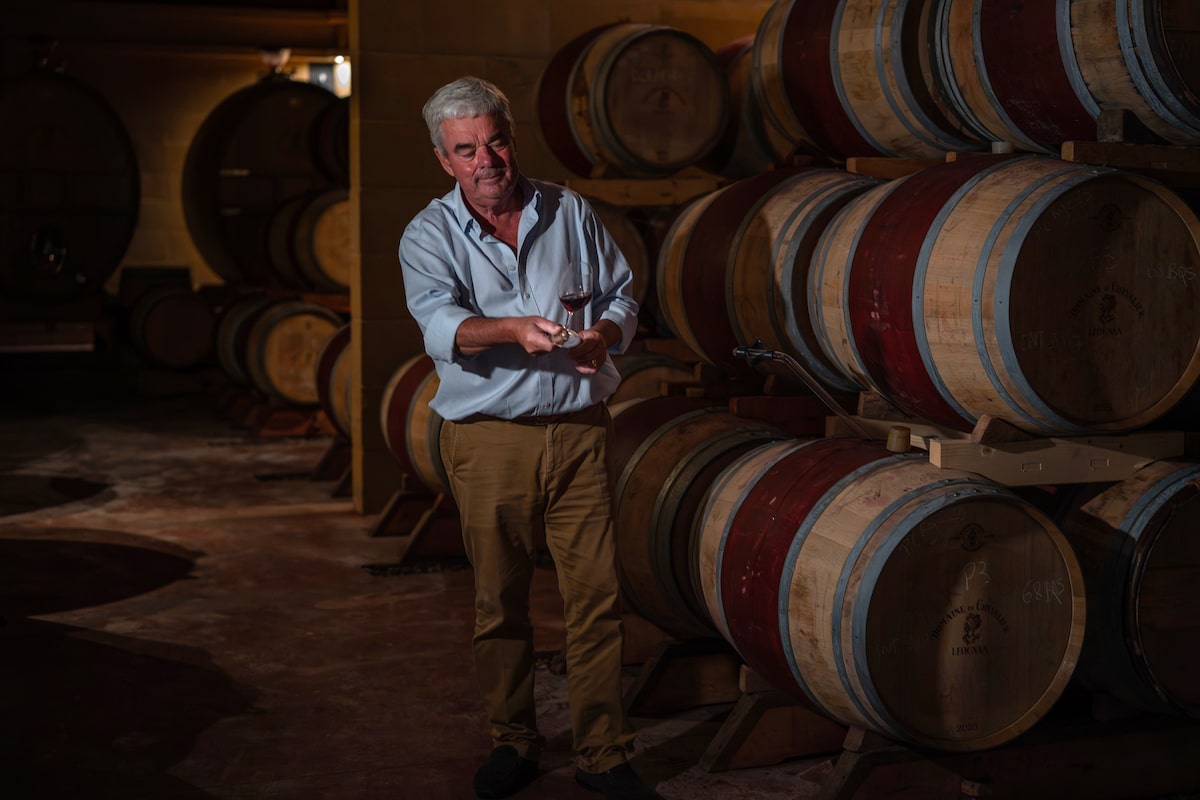
On clear sunny days, Guillaume Duluc likes to stand on top of one of his giant stainless steel fermentation vats and look out over the rows of vineyards that stretch to the horizon in this picturesque region north of Bordeaux in southwestern France.Mr. Duluc has noticed something troubling lately when he gazes at the greenery. There are more patches of vacant land where growers have pulled up their vines and given up. Many of them are families like the Dulucs who have been here for centuries making world-renowned cognac and wine.A summer of drought, searing heat and plummeting sales have taken their toll. And Mr. Duluc fears the worst is yet to come. “It’s just the beginning of the crisis,” he said, shaking his head. “But the crisis, I think, will stay a long time.”His family has been making cognac here since the French Revolution. He’s the eighth generation of Dulucs in charge of the farm, which includes 90 hectares of vines, 20 fermentation vats, a copper distillation system and a shed full of barrels aging some of his finest products.On a recent morning, Mr. Duluc, 38, was up before sunrise directing the final days of harvesting. His wife, Gwenaelle, wielded a plastic rake as she helped unload a truck filled with freshly picked grapes. His father, Pierre, fixed a broken harvester while his mother, Christine, made lunch for the farm’s six workers who have been with the family for decades. It’s been an uphill battle. Mr. Duluc said they’ve lost roughly half their crop because of the extreme weather this summer, the hottest on record for France and much of Europe. Nearly all of their cognac goes to the big players – Rémy Martin and Hennessy – and the buyers haven’t budged on price. Meanwhile, the cost of fuel and other farm supplies has doubled in the past couple of years.They have a decent reserve of cognac they can draw on to fulfill their contracts. But a few more summers like this and there’s no telling where they’ll be. “I’m worried about it,” said Mr. Duluc. This is more than a business for the family. “We love to make cognac,” he said. “We love to talk about it. We love to taste it, and we want other people all around the world to taste it if they want.”That passion for turning grapes into something almost magical has been at the heart of the broader Bordeaux region for nearly 2,000 years, ever since Romans planted the first vines in the estuary of the Garonne and Dordogne rivers. The region’s mild climate and the estuary’s gravelly soil proved ideal for growing grapes. Today there are nearly 8,000 chateaux making some of the best-known brands of Cabernet Sauvignon, Cabernet Franc, Merlot and sweet white wines, in addition to a couple of hundred cognac houses north of the rivers.Winemaking has long dominated Bordeaux and for decades wineries have had to adjust to changing tastes, most notably in the 1970s when they switched from making mostly white wines to reds. But the changes many are seeing now – to the climate and the market – are the most serious yet. Summer temperatures of 40C are becoming commonplace and drought has ravaged vineyards. French agriculture officials expect this year’s grape harvest to be one of the lowest in 30 years and the country’s overall wine production is forecast to be 60 per cent lower than its peak in 1979. The market trends are even more disheartening. Wine consumption has fallen by 14 per cent since 2018, largely because of shifting social habits, according to the International Organisation of Vine and Wine. In France, where drinking wine was once considered a daily ritual, annual consumption has fallen from more than 100 litres per adult in 1960 to less than 20 litres today. “We know people who are just saying no to alcohol,” said Manbeen Riar, a 35-year-old Canadian who was on a recent wine-tasting tour in Bordeaux with her husband and her brother. They’ve taken up wine as a hobby, but they don’t drink much at home or when they go out. Olivier Bernard has experienced just about every high and low of the wine trade in the 43 years he’s been running Domaine de Chevalier, which produces one million bottles annually, 30 per cent white and 70 per cent red. But he’s stunned by the impact of climate change.One of the biggest shocks came in September when his crew finished harvesting the chateau’s 200 hectares two weeks early. “We never imagined to finish our Cabernet Sauvignon by the 17th of September,” he said. “This is the earliest date we have seen in all the history of Bordeaux.” The hotter weather is forcing him to rethink almost everything. Until now, the region’s mild climate allowed wineries to plant smaller vines with fewer leaves, so the grapes can soak up as much sunshine as possible. The loose soil also meant that during dry spells the plants could drive their roots deep down in search of underground water.Mr. Bernard said he’ll have to start growing fewer and larger plants, with big leaves to shield grapes from the sun. Deep roots also won’t be enough during prolonged droughts. Open this photo in gallery:Olivier Bernard, sampling red wine from his estate’s cellar, is rethinking his strategy for coming seasons.He believes local officials will have to drop their long-standing resistance to irrigation and get over their fears that overwatering could ruin the quality of Bordeaux wine.“Five years ago I will tell you, ‘Irrigation is not necessary in Bordeaux,’” he said. “Today I say we have to be ready for that.” His blending technique will also have to change because the grapes are getting smaller, which has an impact on taste.Unlike white wine, which is primarily made from the grapes’ juice, red wine is made from the skin as well. The skin gives the wine a rich colour and it’s loaded with tannin, a natural chemical that provides body and flavour. Smaller grapes mean a higher concentration of skin and tannin, and more careful mixing. “Balance means that you need to have everything in the wine, but nothing too much,” he said. Open this photo in gallery:Vines take years to mature, so growers must think long-term about how many and which kinds of plants are needed. Volatility in the wine market has made this harder.Across the Garonne river, Estelle Roumage is also grappling with the same issues at her organic winery called Chateau Lestrille.Ms. Roumage’s family has been making wine – white, rosé and red – on 32 hectares of land near Saint-Émilion for more than a century. The chateau typically produces 150,000 bottles annually for private clients. “But over the past seven years, my average production has been 65 per cent of that,” she said. While her red wine sales have been falling, she still sees a decent market for whites and rosés. “You need to adapt to the climate. You need to adapt to the market,” she said. All around her, friends and neighbours are giving up. The French government has launched a program to cut supply by paying wineries €4,000 per hectare to pull out their vines. Enough farmers have accepted the offer that 28,000 hectares are being taken out of wine production, around 30 per cent of the Bordeaux region’s total acreage.“It’s heartbreaking to see someone, especially young people who 10 years ago were full of energy and hope, and they are now feeling like ‘No, I can’t do this. It’s not viable’,” said Ms. Roumage.Open this photo in gallery:David Stannard believes in manual labour and natural methods at his winery near Cardan.On a warm September morning, David Stannard hollered instructions to a cluster of 10 neighbours, mostly teenagers, who’d come to harvest the last grapes in his vineyard near the medieval village of Cardan.Almost everything in Mr. Stannard’s vineyard is done by hand and the whole community chips in. He named the winery Paradise Rescued, a nod to his belief in letting nature take its course. He’s a chemical engineer by training – originally from Britain and employed for years in Australia – and he takes almost a mad scientist approach to winemaking. One of his best blends, which he calls Block X, is a unique mix of Petit Verdot, Cabernet Franc and Merlot.He only has one hectare of land and a few fermentation vats. But he’s not out to make a fortune. He’s on a mission to prove that winemaking in Bordeaux can be sustainable.As part of that effort, he’s stopped using tractors, and rails against farmers who rely on giant harvesting machines. Heavy machinery compacts the soil and causes rainwater to drain away, he said. “To me, it makes a lot of sense to use people rather than machines.”Open this photo in gallery:Harvest time at Mr. Stannard’s winery brings the whole community together.He encourages grass to grow wild throughout the vineyard, which he says helps the soil retain its moisture and stay shielded from the sun. Instead of pesticides and herbicides, he makes concoctions from weeds such as horsetail. He mixes dried horsetail with rainwater and sprays the solution on his vines. The silica in the weed helps strengthen the vines and protects them from fungal diseases. “There’s things you can do if you look inventively at it,” he said. Even with his tinkering, his production is falling. He used to make 2,500 bottles a year, but he won’t come close this year. “This summer has extremely highlighted what probably is going to become a new norm,” he said.Sometimes he thinks that Mother Nature is teaching Bordeaux a lesson. “I can’t help wondering whether nature is just giving back to us a message about what we’re doing,” he said. That message “is going to keep ratcheting up until it either burns the skin off us, or we take some action.” More from The Globe on wineAlcohol and the trade warHere are six Canadian wines to drink instead of U.S. labelsHow U.S. tariffs are driving Canadian brewers toward Chinese aluminum cansU.S. tariffs push Canadian alcohol producers to rethink their biggest export marketChristopher Waters on Canadian wineA new Niagara-on-the-Lake pinot noir makes a grand entranceSummerland’s recovering wineries work toward the futureThree fortified wines to savour this fall
In French wine country, climate change, tariffs and dwindling demand are a recipe for trouble
Full Article
Original Source
Read the full article at Theglobeandmail →KhanList aggregates and links to publicly available news content. We do not host full articles from third-party sources. Always verify important information with original sources.