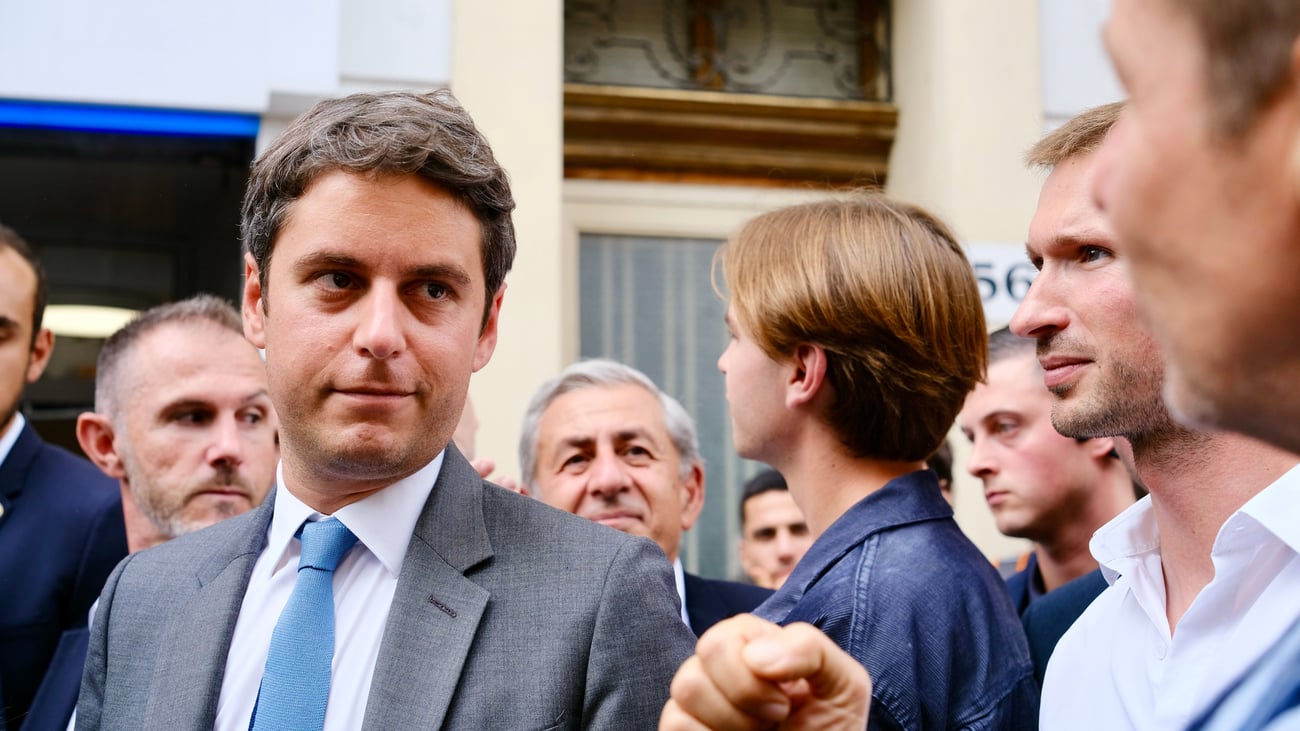
PARIS (CN) — In the leadup to France’s 2027 presidential elections, extremist candidates have hit the ground running.Despite an embezzlement conviction that nearly left her ineligible to run, extreme-right National Rally leader Marine Le Pen is topping the polls with roughly 35%. A likely contender to face her: Hard-left France Unbowed’s Jean-Luc Mélenchon — a polarizing candidate criticized as antisemitic, a label that ironically defined Le Pen’s party for decades.The center bloc, however, has yet to throw its full weight behind a candidate. Although there are three people seen as the strongest contenders — former prime ministers Édouard Philippe and Gabriel Attal, and European Parliament member Raphaël Glucksmann — other politicians toy with the idea of running on a seemingly daily basis.Experts cite a complex landscape where candidates have to distance themselves from French President Emmanuel Macron’s legacy and deal with the nuances of what “centrist” really means.“The centrists … cannot play the novelty card,” Thomas Guénolé, a political scientist who teaches at EDHEC Business School, said. “They cannot say that they’ll change the system because they have been the system for 10 years now.”Far-right leader Marine Le Pen arrives at the courtroom for the verdict of her appeals trial, in Paris, France, Tuesday, July. 7, 2026. (AP Photo/Michel Euler)In France, the political spectrum is much more complex than left, right and center; the full range is represented in varying degrees by different parties. In the National Assembly, the lower chamber of Parliament, 11 different groups hold seats.“Perhaps a first methodological point is, what do we call the center? Because that could be the heart of the matter, incidentally,” Bruno Cautrès, author of “The Dead-End Vote: 2024 Election Chronicles,” said. “It’s almost impossible to have a single candidate from the center. That’s what Emmanuel Macron originally tried [during his first presidential run in] 2017, but he was elected primarily by the center-left.”The centrist competition reveals its own political microcosm. Glucksmann is seen as the most left-leaning, compared with center-left Attal and center-right Philippe.In Guénolé’s view, the distinction is key, because each could capture or offset a certain group of voters against the far right.“Philippe’s entire strategy is to attract the right-wing electorate, whereas Attal’s strategy would instead be to attract the center-left electorate,” Cautrès said. “So I think this is tied to the fact that the center, as a unified entity, does not exist — in fact, you have different centers.”France’s presidential elections typically occur in two rounds. If one candidate doesn’t obtain more than 50% of the vote initially, the top two candidates advance to a runoff.Candidates are strategizing under the assumption that Le Pen will be their second-round opponent.Yann Wernert, a senior policy fellow at the Jacques Delors Center, said there seems to be limited space for non-extreme candidates. In his view, more moderate politicians will have to adjust their rhetoric to appeal to voters seduced by promises made by parties like the RN and France Unbowed, which are often unrealistic.Vowing to bring France out of its economic deficit, while simultaneously promising a significant reduction on income tax, is a classic example.“I would say the overarching difficulty is to challenge the populist recipe — the narrative that things are easy to achieve if only we would do this or that, and simply deny that there are complex issues to be addressed and difficult choices that will have to be made,” Wernert said. “If you confront that with a more realistic view or even a blood, sweat and tears speech, you might just lose because that’s not attractive enough to voters.”Edouard Philippe, former prime minister of France, during his statement to the press ahead of the vote of confidence in the government in Paris, France, Sept. 2, 2025. (Xose Bouzas / Hans Lucas via AFP)Centrists will also have to toe a thin line between distancing themselves from Macron’s unpopular legacy while retaining his voters. On July 19, the polling center Ipsos measured the French president’s approval rating at 21%, up 2 points since the last survey.“It’s not attractive to portray oneself as a successor to the current president,” Wernert said. “You don’t want to inherit his legacy, since the financial situation is very difficult at the moment and there’s only been limited space for political action during the last two years because there’s no clear majority in the National Assembly.”Since Philippe and Attal both served as prime ministers under Macron, the link could be hard to sever. But that doesn’t mean they’re not trying.“Can Attal say that for many years, he had sounded the alarm on public deficits, that no one listened to him?” Cautrès said. “He can’t say it, because he was [prime minister] until yesterday, in 2024.”Instead, Attal has been criticizing Macron’s decision to call snap legislative elections and dissolve the government in 2024, which effectively ended his term as prime minister. The move was widely seen as a reckless mistake that empowered the National Rally, since they ended up winning a record number of seats.When Macron accepted current Prime Minister Sébastien Lecornu’s resignation and reappointed him four days later in October 2025, Attal jumped at the opportunity to distance himself. He told the press, “I no longer understand the actions of the president of the Republic.”Meanwhile, Philippe has taken aim at the public deficit, which has grown from 3% to 5.1% of France’s GDP since Macron took office in 2017. The country’s public debt also increased from 98% to 115.6% of GDP in the same period.“My objective is not very sexy or popular, but it is to say, ‘let’s restore order to our [financial] accounts and allow ourselves room to maneuver,” Philippe told the French outlet RTL in the beginning of July. “If we want to remain prosperous and also free, we will have to organize [around] a little more work and a little more effort.”Glucksmann benefits from spending most of his political career on the European stage, which frees him of the apprehension surrounding Macron. However, Cautrès believes Glucksmann’s fate ultimately depends on who wins the “sort of unspoken primary" between Philippe and Attal.“Depending on which of the two ultimately prevails, it will have an impact on the third,” he said. “It’s clear that if Attal fails to come out on top in the matchup against Philippe … that could open up space for Glucksmann on the center-left.”Subscribe to our free newslettersOur weekly newsletter Closing Arguments offers the latest about ongoing trials, major litigation and rulings in courthouses around the U.S. and the world, while the monthly Under the Lights dishes the legal dirt from Hollywood, sports, Big Tech and the arts.Additional Reads
In French presidential campaign, centrists struggle to define themselves against extremes
Full Article
Original Source
Read the full article at Courthousenews →KhanList aggregates and links to publicly available news content. We do not host full articles from third-party sources. Always verify important information with original sources.